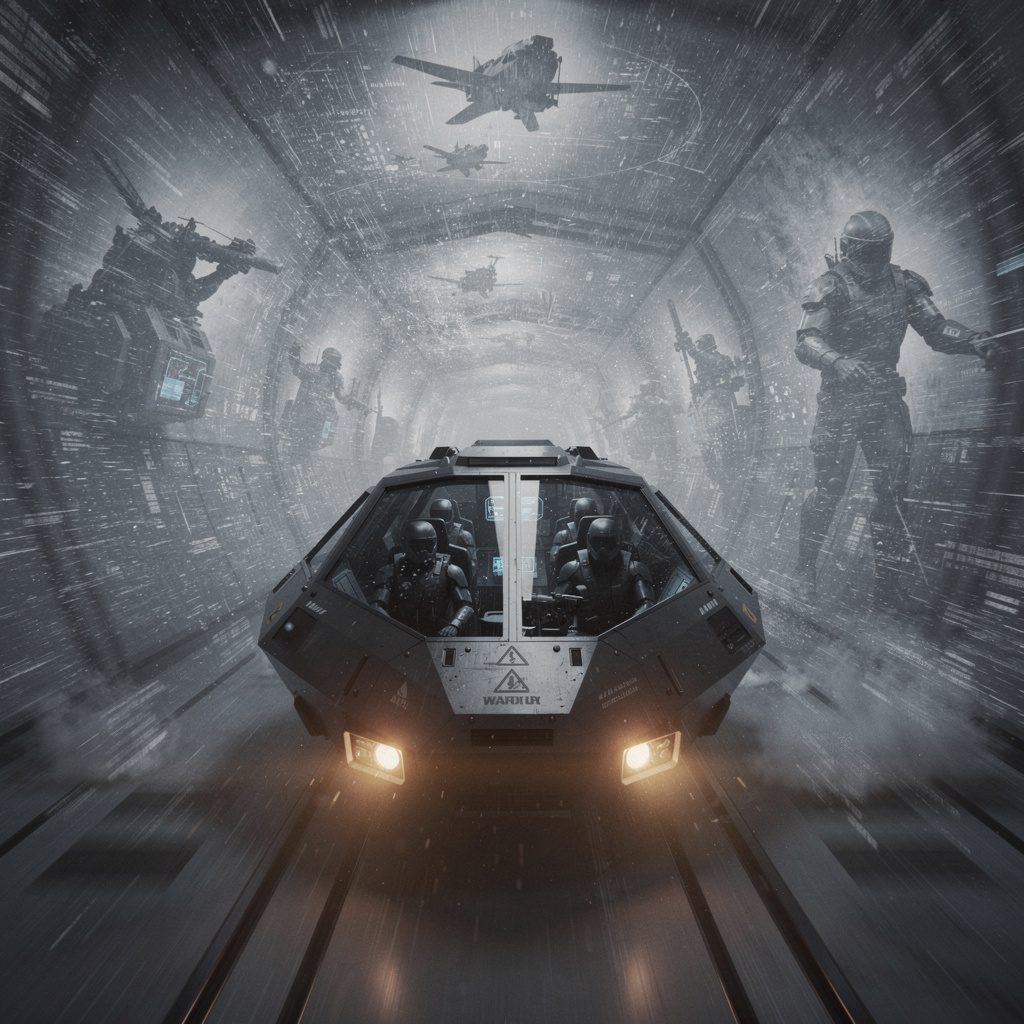
The order came through at 03:47 temporal local, and nobody questioned it. That was the first mistake.
They were already deep inside the Sable Corridor — a narrow slice of reconstructed timeline running between the Collapse of ’87 and the Armistice of ’92 — when Lesia Rudenko read the command string aloud from the relay screen mounted to the forward bulkhead of the insertion pod. Her voice was flat. Tactical. The kind of voice you use when the words don’t make sense but the chain of command does.
“All units, stand down. Abort extraction. Hold position and await secondary confirmation.”
Ambrose Thornbury looked up from the breach console. He was a big man, built like a cargo hauler, with close-cropped silver hair and the kind of eyes that had seen enough bad orders to recognize one on sight. He said nothing. He just looked at Rudenko. She looked back.
Tunde Pruitt was already checking the authentication codes. He moved fast, fingers working the haptic overlay above his wrist terminal, cross-referencing the command string against the Temporal Operations Authority signature database. The pod hummed around them — a low, pressurized vibration, like the chest of something breathing. Outside the reinforced viewports, the Corridor looked the way it always did: a grey-lit tunnel of compressed probability, the walls flickering with faint residual images of events that almost happened. Shadows of a war that had been partially unwound.
“Codes check out,” Pruitt said. “It’s a genuine TOA transmission.”
Eleanor Winterbourne, seated at the rear of the pod with her extraction kit across her knees, exhaled slowly. She was the team’s temporal medic — responsible for stabilizing the extraction target once they reached him, managing the physiological stress of a body pulled out of one moment and dropped into another. She’d done it eleven times. She knew what happened when the body resisted the pull. She also knew what happened when a mission was aborted mid-insertion.
Nothing good. Nothing clean.
“We’re four minutes from the anchor point,” Thornbury said, his voice measured. “If we hold here, we drift. If we drift past the window, we can’t re-enter without a full recalibration back at Meridian Station. That’s a forty-eight hour turnaround.”
Rudenko knew the math. She’d been running it since the order hit the screen.
The target was Dmitri Havel, a TOA field analyst who had gone dark inside the Corridor six days ago — six days in real-time, which translated to somewhere around three weeks of subjective experience inside the unstable zone he’d been monitoring. The Corridor wasn’t a place you stayed. It was a place you passed through, fast and clean, with a team at your back and a fixed anchor point waiting on the other side. Havel had neither. His anchor had degraded. His comms had dropped to intermittent bursts. The last burst, received eighteen hours ago, had contained only coordinates and a single line of text:
“They’re going to close it. Don’t let them.”
Nobody had explained what “it” meant. The debrief team at Meridian had flagged the transmission as possible temporal stress psychosis. Standard protocol. The extraction order had still been issued. The team had still been deployed.
And now someone was telling them to stop.
Pruitt pulled up the transmission metadata. He was quiet for a long moment. The pod shuddered as a probability eddy rolled through the Corridor wall — a ghost-tremor, the echo of some event that had been partially erased and not fully resolved.
“Transmission origin timestamp,” Pruitt said carefully, “is flagged as post-mission.”
The words landed like a dropped charge.
Post-mission. The order to abort had been sent from a point in time after this mission was already complete. Someone, somewhere in the TOA command structure, had looked at the outcome of what they were about to do — and sent the abort backward through the relay network to stop them before they did it.
That was legal. Technically. The TOA had built the temporal relay system precisely for that purpose: to allow command corrections to reach field teams before errors became irreversible. It was used sparingly. It was supposed to be used only when the alternative was catastrophic.
Winterbourned said, quietly: “So they know what we find.”
No one answered. The pod crept forward on its insertion track, momentum carrying it toward the anchor point whether they engaged thrust or not. Three minutes out now.

 WhatsApp
 Telegram
 Email







Categories
- AI & Technology
- Contemporary
- Corporate Control
- Creepypasta
- Crime Thriller
- Cyberpunk
- Dark Fantasy
- Enemies to Lovers
- Fairy Tale Retelling
- Fantasy
- First Contact
- Forbidden
- Genetic/Body Horror
- High Fantasy
- Monster Hunter
- Mythic/Folklore
- Paranormal
- Portal/Otherworld
- Post-Apo
- Post-Collapse Society
- Psychological Thriller
- Romances
- SCI-FI
- Second Chance
- Slow Burn
- Space Combat
- Spacepunk
- Surveillance State
- Survival Thriller
- Thrillers
- Time Travel
- Treasure Hunter
- Urban Fantasy
- Witchcraft/Curses
Tags
10min stories atmospheric atmospheric fantasy atmospheric fiction contemporary romance Creepy creepypasta crime thriller dark fantasy debt dystopia emotional fiction enemies to lovers ensemble cast epistolary fantasy female protagonist first person forbidden romance framed narrative high fantasy love story magic Memory mystery Paranormal psychological horror psychological thriller romance sci-fi second chance second chance romance short fiction short story slow burn space station speculative fiction supernatural Survival survival thriller suspense thriller travel romance witchcraft workplace romance
Leave a Reply