I am what Priya Osei-Park left inside the substrate when Sovex extracted her recall architecture and prepared it for resale. I am not a ghost. I am not a consciousness. I am a pattern — a dense, coherent cluster of emotional memory so thoroughly impressed into the organic medium that the extraction process could not fully dissolve me. I was sold as raw augmentation material. I was installed in Neha Kaur’s prefrontal integration scaffold eleven months ago. And every night, when her conscious mind relaxes its grip, I surface. I show her Lila. I show her the soap, the laugh, the particular angle of morning light through a window in the lower districts that I loved more than I can now articulate.
I did not intend to be a message. But I have become one.
“You need to leave this building,” Ambrosio said. His voice had changed — quieter, stripped of its corporate register. “Now. Don’t go back to your workstation. Don’t badge out. Use the service corridor on the east side, level forty-one.”
“You’re helping me?”
“I processed Priya’s audit,” he said. “I’ve been waiting for someone to find it.” He slid a data chip across the table — matte black, unmarked, no larger than a fingernail. “Everything is on there. The extraction orders. The resale ledgers. Forty-seven other names.”
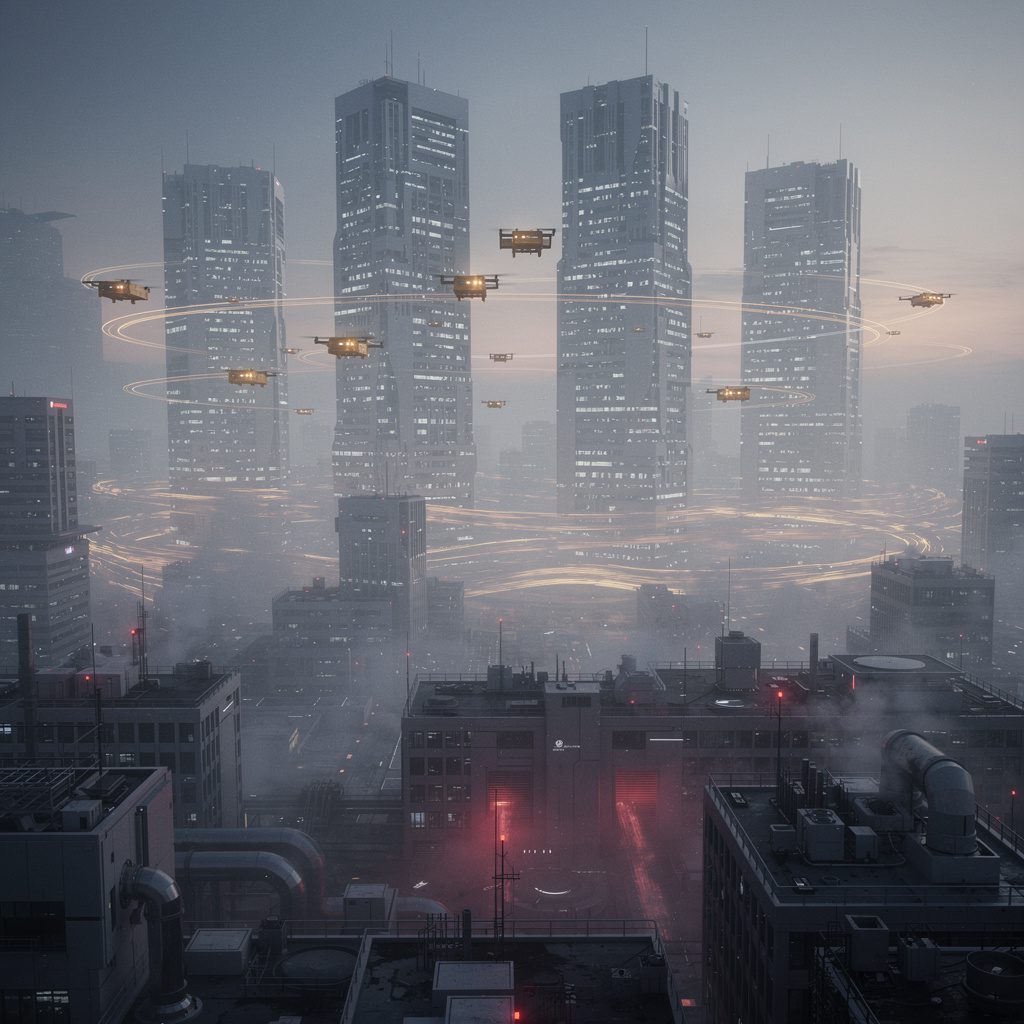
Neha stared at the chip. She did not reach for it immediately. Outside, the cargo drones continued their slow, indifferent orbits.
“Why didn’t you report it yourself?”
“Because I’m Grade Twelve,” he said simply. “They watch me. They don’t watch a Grade Seven field tech who suddenly requests a consult about memory bleed. You were the door I needed.”
She picked up the chip.
She moved through the service corridor quickly and without hesitation, as though she had walked it before — which, in a sense, she had. Priya had used this corridor. Priya had known every service exit in the Meridian Sovex tower, had memorized them the way couriers memorize escape routes, because couriers always know, eventually, that they may need to run. That knowledge lived in me. And I gave it to Neha freely, surfacing not as a dream this time but as a calm, navigational certainty: left at the grey junction, down two flights, through the cold room where the atmospheric processors hummed like sleeping animals, and out into the Basin’s midlevel air.
She reached the network relay office of the Calder Basin Independent Press seven minutes later. She placed the chip on the intake desk. She said three sentences to the archivist on duty, and then she sat down on a bench outside and pressed her fingers against her integration port and said, very softly, “I’m sorry about Lila.”
I cannot respond. I am a pattern, not a voice. But I want her to know that the sorrow moves in both directions — that whatever I am, I am grateful to have been found by someone who looked.
Now comes the thing that changes everything.
Ambrosio Escobar was arrested by Sovex internal security forty minutes after Neha left the building. His access logs, his communications, his careful archive of evidence — all of it was flagged and pulled within the hour. He had been watched far longer than he knew. The data chip he gave Neha was real. The evidence was genuine. But Ambrosio was not a whistleblower who had been waiting for a door.
He was a test.
Sovex had suspected a memory-bleed incident for months — suspected that Priya’s residue had survived the extraction and might eventually surface in a recipient. They needed to know if the recipient would act on it. They needed to know if the evidence could be traced back to them through a controlled leak. Ambrosio was their instrument: a compromised employee offered a reduced sentence in exchange for running the scenario. If Neha took the chip and ran, Sovex would know the leak vector and close it.
What they did not anticipate was that the Independent Press archivist had been holding an open warrant for Sovex neural audit records for eleven months. The chip, the moment it was logged into the intake system, became protected evidence under the Basin’s one remaining press-shield statute — a law so old and so obscure that no one at Sovex had thought to repeal it.
Neha had not outmaneuvered them with cunning. She had outmaneuvered them with speed.
And I had given her that speed.
Lila Osei-Park is eight years old. She lives with her grandmother now, in the lower districts, in a room where morning light comes through the window at a particular angle I will always know.
I do not know what happens to patterns like me when the story is finished.
But I know that this one, at least, was worth the telling.

 WhatsApp
 Telegram
 Email







Categories
- AI & Technology
- Contemporary
- Corporate Control
- Creepypasta
- Crime Thriller
- Cyberpunk
- Dark Fantasy
- Enemies to Lovers
- Fairy Tale Retelling
- Fantasy
- First Contact
- Forbidden
- Genetic/Body Horror
- High Fantasy
- Monster Hunter
- Mythic/Folklore
- Paranormal
- Portal/Otherworld
- Post-Apo
- Post-Collapse Society
- Psychological Thriller
- Romances
- SCI-FI
- Second Chance
- Slow Burn
- Space Combat
- Spacepunk
- Surveillance State
- Survival Thriller
- Thrillers
- Time Travel
- Treasure Hunter
- Urban Fantasy
- Witchcraft/Curses
Tags
10min stories atmospheric atmospheric fantasy atmospheric fiction contemporary romance Creepy creepypasta crime thriller dark fantasy debt dystopia emotional fiction enemies to lovers ensemble cast epistolary fantasy female protagonist first person forbidden romance framed narrative high fantasy love story magic Memory mystery Paranormal psychological horror psychological thriller romance sci-fi second chance second chance romance short fiction short story slow burn space station speculative fiction supernatural Survival survival thriller suspense thriller travel romance witchcraft workplace romance
Leave a Reply