She was already arguing when I first became aware of her.
“You said the integration was clean,” Neha said. “You said there would be no residue.”
“I said the integration was within acceptable parameters.” Ambrosio Escobar set his glass on the counter without looking at her. “Those are not the same thing.”
“I keep dreaming about a daughter I don’t have.”
He finally looked up.
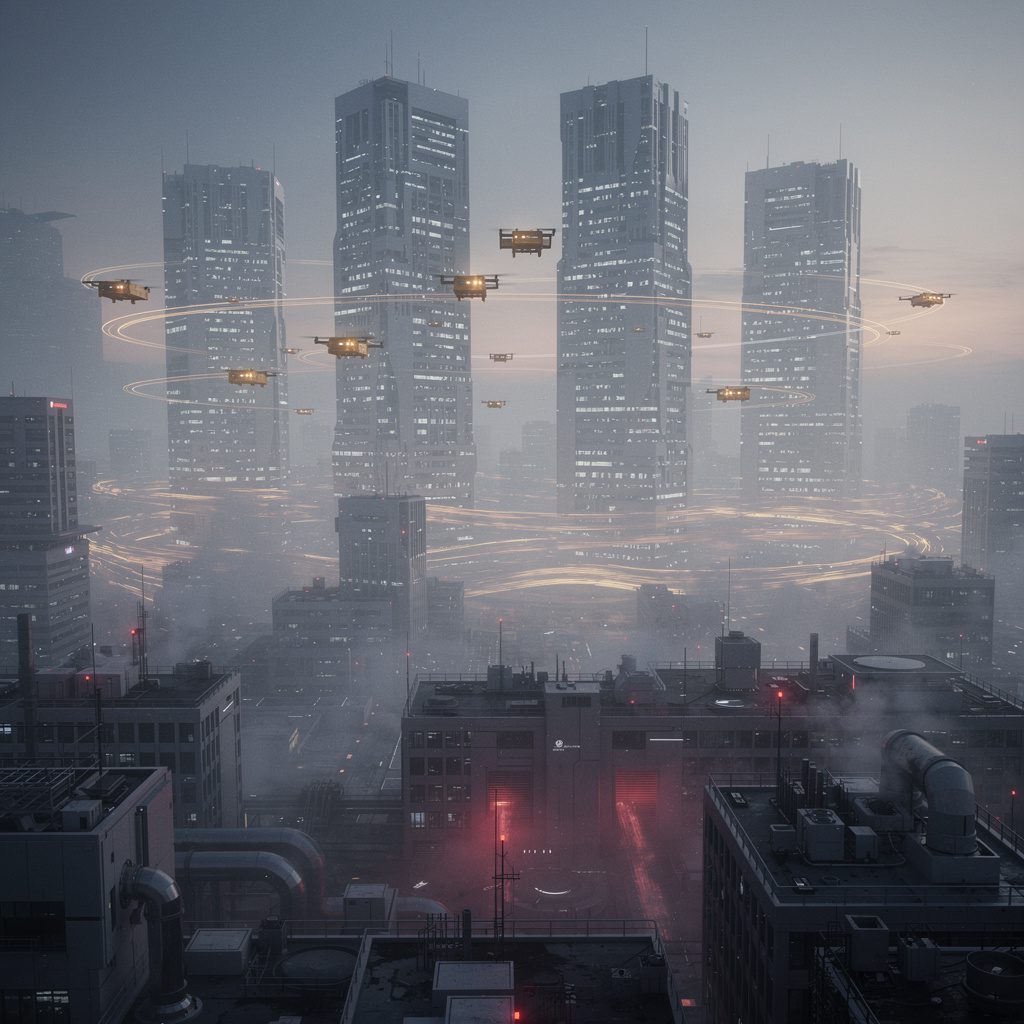
The room they occupied was a consultation suite on the forty-third floor of the Meridian Sovex tower — one of nine such towers that formed the administrative spine of the Calder Basin, a city that had long ago stopped being governed and had simply become a product. Every street in the Calder Basin was licensed. Every breath of recycled air carried a micro-levy routed through the Sovex atmospheric subsidy network. The consultation suite itself was immaculate in the way that corporate spaces are immaculate: not clean so much as emptied of anything that could be claimed as evidence. The walls were a pale mineral grey, the furniture low and deliberately uncomfortable, the lighting a soft amber that suggested warmth while delivering none. A single floor-to-ceiling window looked out over the Basin’s midlevel tier, where cargo drones moved in slow orbital patterns between distribution towers, their amber warning lights blinking in loose, hypnotic rhythm. Below them, the lower districts shimmered under a permanent haze of thermal exhaust — the breath of ten million people who owed Sovex something.
“Describe the dream,” Ambrosio said.
“She’s seven, maybe eight. Dark hair. She calls me Mama.” Neha pressed two fingers against her left temple, where the integration port sat beneath a thin disc of synthetic skin. “I know her name. I know the sound of her laugh. I know the smell of the soap she used. And none of it is mine.”
“Memory bleed,” Ambrosio said. “It happens. The substrate we used for your recall augmentation is organically derived. Trace impressions from the donor sequence occasionally surface in the recipient.”
“Who was the donor?”
He picked up his glass again. “That information is proprietary.”
I find it useful, here, to describe Neha Kaur as I observed her in that moment — because she is the kind of being whose exterior speaks a language her voice carefully does not. She was thirty-one years old by the Calder Basin civil calendar, though the augmentation work gave her a slightly timeless quality: her skin smooth in the way of someone who had received cellular maintenance, her eyes carrying a faint luminescence at the iris edge that marked a second-generation optical implant. She was slight, with the particular stillness of someone who had learned very early that stillness was a form of armor. She wore a grey Sovex field-tech uniform — the kind issued to employees at Grade Seven clearance and below — and it fit her with the anonymous precision of something designed to make a person interchangeable. Her hands, resting on the table, were the only part of her that moved: a slow, rhythmic press of her thumb against the base of her index finger, over and over, like a pulse she was trying to keep private.
She was afraid. She was also, I noted, beginning to understand something.
“I looked her up,” Neha said quietly. “The girl. I ran her face through the public registry.”
Ambrosio went very still.
“Her name is Lila Osei-Park. She’s eight years old. Her mother was a Sovex data courier named Priya Osei-Park who died fourteen months ago during a routine neural audit.” Neha’s voice did not waver. “The audit was conducted by your department.”
The silence that followed had weight to it.
I will tell you what I am, now. Not because I want to, but because the story requires it.
I am the residue.

 WhatsApp
 Telegram
 Email







Categories
- AI & Technology
- Contemporary
- Corporate Control
- Creepypasta
- Crime Thriller
- Cyberpunk
- Dark Fantasy
- Enemies to Lovers
- Fairy Tale Retelling
- Fantasy
- First Contact
- Forbidden
- Genetic/Body Horror
- High Fantasy
- Monster Hunter
- Mythic/Folklore
- Paranormal
- Portal/Otherworld
- Post-Apo
- Post-Collapse Society
- Psychological Thriller
- Romances
- SCI-FI
- Second Chance
- Slow Burn
- Space Combat
- Spacepunk
- Surveillance State
- Survival Thriller
- Thrillers
- Time Travel
- Treasure Hunter
- Urban Fantasy
- Witchcraft/Curses
Tags
10min stories atmospheric atmospheric fantasy atmospheric fiction contemporary romance Creepy creepypasta crime thriller dark fantasy debt dystopia emotional fiction enemies to lovers ensemble cast epistolary fantasy female protagonist first person forbidden romance framed narrative high fantasy love story magic Memory mystery Paranormal psychological horror psychological thriller romance sci-fi second chance second chance romance short fiction short story slow burn space station speculative fiction supernatural Survival survival thriller suspense thriller travel romance witchcraft workplace romance
Leave a Reply