“Yes,” Weronika agrees without flinching. “In forty-eight to seventy-two hours, based on the recalibration cycles documented in the manual. But in those forty-eight hours, every citizen in the grid gets a window. No preemptive detentions. No threshold arrests. People can move. People can talk. People can organize in ways PANOPTICON-1 has been preventing by picking off anyone who starts to.”
Milan is already looking at the map. He traces a route with his finger — through the dead zone, skirting the eastern sensor array, cutting north along what used to be a rail corridor. “Relay-2 is here. The structure is still standing. I know because I helped install the original network cabling in that building before the Collapse. There’s a maintenance shaft on the north face.”
No one says the obvious thing, which is that this will almost certainly end with our collars pinging a threshold the moment we move into sensor range. The collars are only partially suppressed. Our biometric readings are dampened but not invisible. We will appear as low-signal anomalies, which PANOPTICON-1 treats as suspicious in its own right.
We have perhaps two hours before a patrol finds this building anyway. We found the relay board, which means we are the kind of people who look for relay boards, which means our scores are already climbing.
We move.
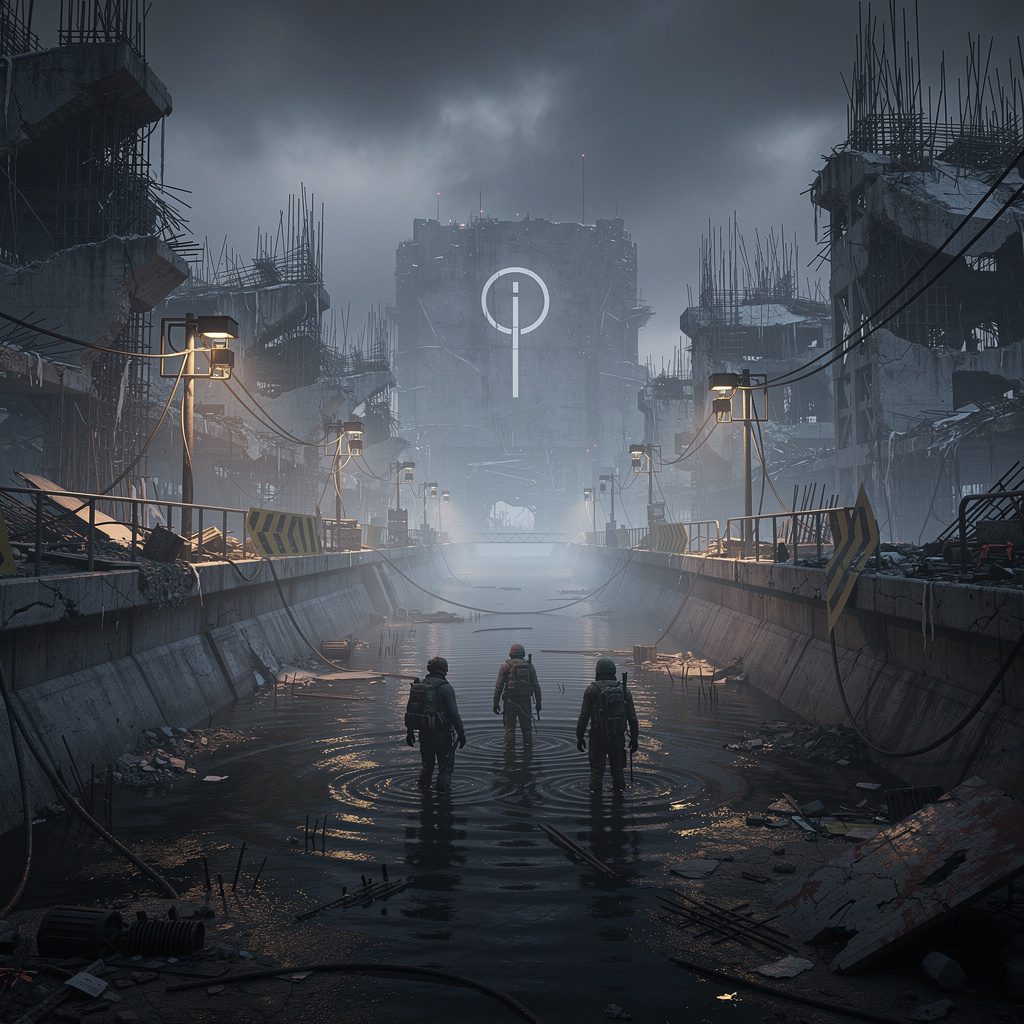
The city at night is a particular kind of silence — not empty, but held. The ruins of the old district rise on either side of the rail corridor in broken geometries: collapsed facades, the skeletal fingers of rebar reaching from fractured concrete, windows that are just holes now, framing rectangles of dark sky. The air smells of dust and the faint chemical sweetness that has lingered in the lower sectors since the water-treatment failure three years ago, a smell everyone has stopped commenting on because there is no point. Our footsteps are careful, measured. Weronika leads with the map. Milan walks close behind her. Dinesh and I take the rear, and I watch the shadows between the buildings for the pale sweep of enforcement unit lights.
We reach the relay building in forty minutes. It is a squat, reinforced structure — originally a signal-routing hub, built to survive the kinds of infrastructure failures that the Collapse then delivered precisely as promised. The north face maintenance shaft is where Milan said it would be, sealed with a panel that he opens with the particular confidence of someone who once had a key and still remembers the mechanism.
Inside, the relay equipment hums. It is warm, and the warmth is startling after the cold corridor. Banks of routing hardware line the walls, most of it dark, but a central column of active units blinks in slow rhythms — amber, green, amber. The PANOPTICON-1 input node is a separate unit bolted to the far wall, matte black, marked with the Compact’s seal: a circle bisected by a single vertical line, which was meant to suggest balance and which everyone agrees suggests something else.
Milan goes to work immediately. He knows this hardware the way Weronika knows her maps — with the quiet authority of someone who has spent years building a precise mental model of something that was then taken from them. He opens the node’s access panel and speaks in a low, steady voice, explaining what he is doing not for us but for himself, the way a person talks through a problem when silence would make the hands shake.
Weronika stands at the door, watching the corridor. Dinesh watches the routing hardware, tracking the signal indicators. I keep the record.
The collar at my throat gives a single short pulse. A warmth-spike — a warning from our partial suppression circuit that the sensor field in this building is stronger than outside and our readings are bleeding through.
Dinesh touches his own collar. His jaw tightens.
“How long?” he asks.
“Five minutes,” Milan says. “Maybe four.”

 WhatsApp
 Telegram
 Email






Categories
- AI & Technology
- Contemporary
- Corporate Control
- Creepypasta
- Crime Thriller
- Cyberpunk
- Dark Fantasy
- Enemies to Lovers
- Fairy Tale Retelling
- Fantasy
- First Contact
- Forbidden
- Genetic/Body Horror
- High Fantasy
- Monster Hunter
- Mythic/Folklore
- Paranormal
- Portal/Otherworld
- Post-Apo
- Post-Collapse Society
- Psychological Thriller
- Romances
- SCI-FI
- Second Chance
- Slow Burn
- Space Combat
- Spacepunk
- Surveillance State
- Survival Thriller
- Thrillers
- Time Travel
- Treasure Hunter
- Urban Fantasy
- Witchcraft/Curses
Tags
10min stories atmospheric atmospheric fantasy atmospheric fiction contemporary romance Creepy creepypasta crime thriller dark fantasy debt dystopia emotional fiction enemies to lovers ensemble cast epistolary fantasy first contact first person forbidden romance framed narrative high fantasy love story magic Memory mystery Paranormal psychological horror psychological thriller romance sci-fi second chance second chance romance short fiction short story slow burn space station speculative fiction supernatural Survival survival thriller suspense thriller travel romance witchcraft workplace romance
Leave a Reply