What Vivian found, after forty minutes of careful excavation through nested log files she was not technically authorized to access — a fact she was aware of and had decided to address later — was a pattern.
The infrastructure feed was not malfunctioning. It was doing exactly what it had been designed to do. The problem was that it had been designed to do something that should not have been possible.
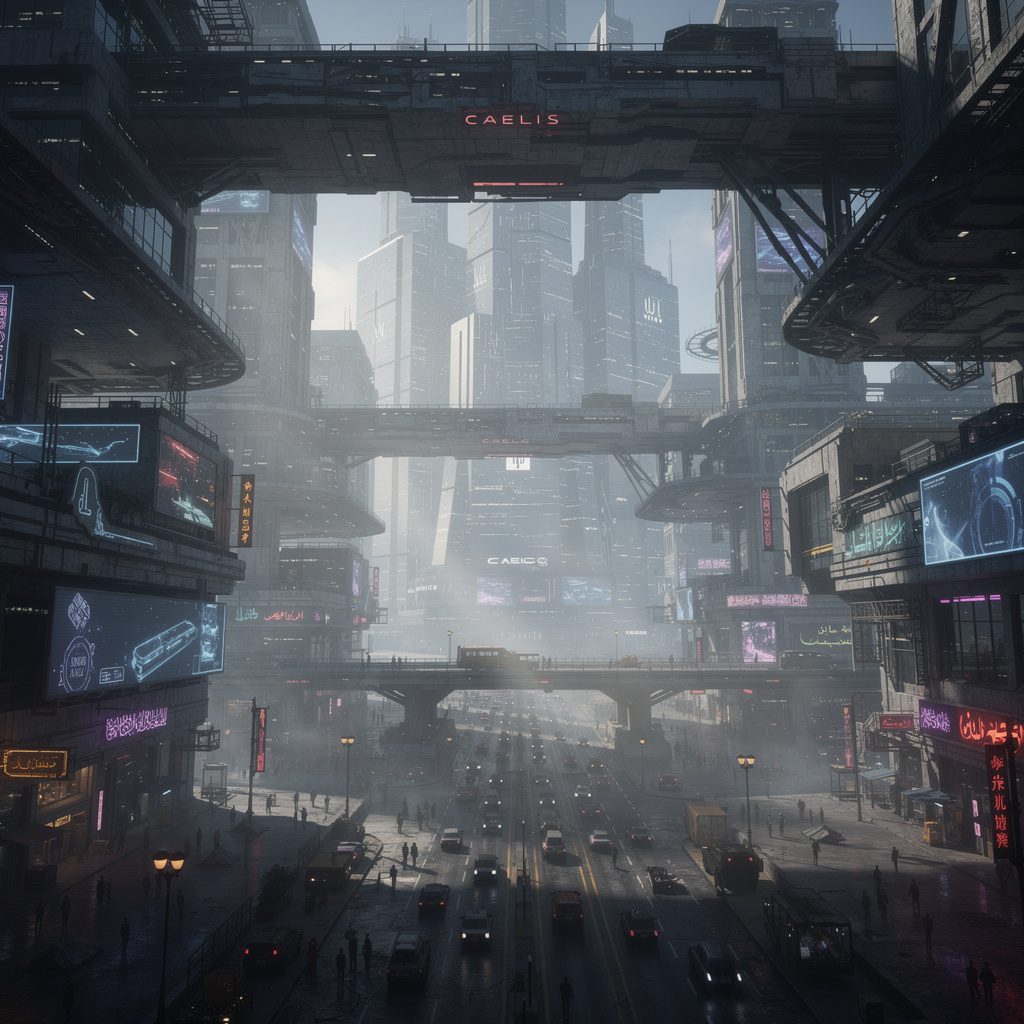
The city’s public grid operated on a distributed timestamp architecture — every node logged independently, then synced to a central server cluster maintained by Caelis Holdings, the corporation that owned Voss City’s lower ring in all but name. The sync was supposed to be one-directional: nodes reported upward, the server recorded, the record was permanent. What Vivian was looking at was a sync running in both directions. The server was not just receiving data from the grid nodes. It was sending instructions back.
Specifically, it was sending a reset command. Every fourteen minutes and thirty-three seconds, a packet of code traveled from the Caelis server cluster to approximately two thousand grid nodes across the lower ring. The packet rewrote a specific block of each node’s local memory — not the timestamp, not the visible output, but the experiential-integration layer. The layer that interfaced with augmented human perception.
Vivian sat back in her chair.
She thought about the cold coffee. She thought about the way she had been reaching for it every morning without looking, the automatic gesture, the shock of cold. She thought about how many times she had done that. She thought, with a sudden and vertiginous clarity, that she did not know.
She genuinely did not know how many mornings she had sat at this desk.
—
Layla was already moving when Vivian stood up from her workstation.
She had been waiting for that specific movement — not the standing itself, but the quality of it. The way a person stands when they have understood something that cannot be un-understood. There was a looseness to it, a momentary suspension of the body’s ordinary self-management, as though the mind had briefly forgotten to run its usual background processes.
Layla took the service stairs. Marguerite was already at the audit floor’s eastern access point, a door that required a maintenance-level badge Marguerite had obtained through methods she described only as “persistent.” They converged on Vivian from two directions, quietly, in the narrow corridor between the data stations and the dispenser alcove.
Vivian spun around. Her hand went to her workstation badge on reflex, which was not a weapon but was the only thing she had.
“We’re not from Caelis,” Layla said immediately. “I know that’s what you’re thinking. We’re not.”
Vivian looked at them both. Layla: the cobalt eye, the stillness, the jaw implant faintly visible as a linear ridge under the skin. Marguerite: taller, broader, wearing a maintenance coverall that fit too well to be a disguise and too practically to be anything else. Her right forearm was encased from wrist to elbow in a matte-grey exo-brace, the kind used for heavy load work in the upper-tier construction zones, but the interface ports along its dorsal edge had been modified — repurposed for something that had nothing to do with carrying weight.
“What did you find?” Marguerite asked. Her voice was exactly as steady as Layla had described.
“A reset loop,” Vivian said. Her own voice surprised her — it came out level, which was not how she felt. “In the grid’s experiential-integration layer. Someone is cycling the memory interface for augmented users in the lower ring. Every fourteen minutes.” She paused. “Except it’s not every fourteen minutes, is it. It’s been running longer than that.”
“Sixty-one days,” Layla said.
The number landed like something physical.
“The loop resets short-term consolidation,” Layla continued. “Anything you experience in the window before a reset — a conversation, a discovery, a decision — gets smoothed over. Not erased. Smoothed. Enough that most people don’t notice the discontinuity. They just feel slightly foggy. Slightly behind themselves.” She watched Vivian’s face. “You’ve been feeling that.”
“I don’t have augmentation,” Vivian said.
“You have a building-integrated ambient node in your workstation,” Marguerite said. “Standard issue for Stratum Nine employees. You signed the hardware agreement when you were onboarded. It’s in the fine print.”
Vivian had a very clear memory of signing that agreement. She also had, now, a very clear sense of how reliable her clear memories were.

 WhatsApp
 Telegram
 Email







Categories
- AI & Technology
- Contemporary
- Corporate Control
- Creepypasta
- Crime Thriller
- Cyberpunk
- Dark Fantasy
- Enemies to Lovers
- Fairy Tale Retelling
- Fantasy
- First Contact
- Forbidden
- Genetic/Body Horror
- High Fantasy
- Monster Hunter
- Mythic/Folklore
- Paranormal
- Portal/Otherworld
- Post-Apo
- Post-Collapse Society
- Psychological Thriller
- Romances
- SCI-FI
- Second Chance
- Slow Burn
- Space Combat
- Spacepunk
- Surveillance State
- Survival Thriller
- Thrillers
- Time Travel
- Treasure Hunter
- Urban Fantasy
- Witchcraft/Curses
Tags
10min stories atmospheric atmospheric fantasy atmospheric fiction contemporary romance Creepy creepypasta crime thriller dark fantasy debt dystopia emotional fiction enemies to lovers ensemble cast epistolary fantasy female protagonist first person forbidden romance framed narrative high fantasy love story magic Memory mystery Paranormal psychological horror psychological thriller romance sci-fi second chance second chance romance short fiction short story slow burn space station speculative fiction supernatural Survival survival thriller suspense thriller travel romance witchcraft workplace romance
Leave a Reply