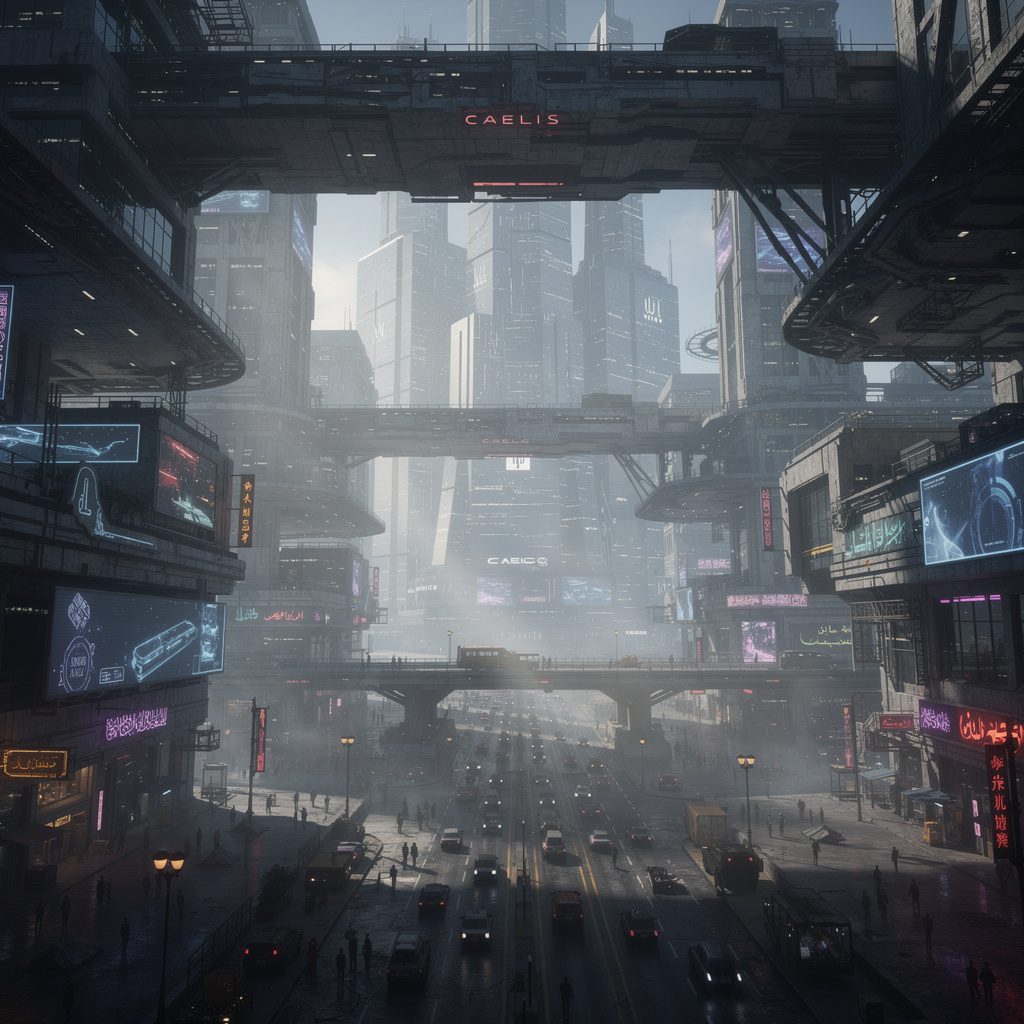
The coffee was always cold by the time Vivian noticed it.
Not lukewarm. Not the cooling remnant of a distracted morning. Cold the way a thing is cold when it has been sitting untouched for hours — a flat, ceramic chill against her palm, the surface tension of the liquid unbroken, as though no one had ever meant to drink it. She noticed it every morning the same way: reaching for the mug on the left side of her workstation without looking, fingers finding the handle automatically, the shock of cold pulling her eyes down from the holographic feeds scrolling above her desk. She would frown. Set it aside. Order another from the building’s dispenser. Forget.
She forgot a lot of things, lately.
Vivian Holbrook worked the data-audit floor of Stratum Nine, the forty-fourth level of the Caelis Tower complex in the lower ring of Voss City. The lower ring was not the worst place to live — that distinction belonged to the crawl-warrens beneath the mag-rail lines, where people slept in shifts and sold their cortical bandwidth by the hour — but it was far enough below the tower’s upper tiers that the sky, when visible at all, came in thin blue slivers between the overhanging architecture of the wealthy. Stratum Nine smelled of recycled air and warm circuitry. The overhead lights ran on a perpetual artificial cycle that approximated daylight without ever quite achieving it. Most of the auditors had stopped noticing years ago.
Vivian still noticed. That was the thing about her that her supervisor, Lars Bjornstad, had written in her quarterly review with something between admiration and unease: “Ms. Holbrook demonstrates an unusual retention of baseline environmental awareness.” He had not meant it as a compliment, exactly. In a building where the goal was frictionless productivity, noticing things was a liability.
She was noticing something now.
The feed on her secondary monitor — a passive data-stream from the city’s public infrastructure grid, the kind of low-priority background noise that auditors were supposed to flag for anomalies and mostly didn’t — was cycling. Not refreshing in the normal sense, not pulling new data from upstream servers. Cycling. The timestamp in the lower corner of the feed was incrementing forward, reaching 07:14:33, and then resetting. Not visibly, not with any flicker or stutter. But Vivian had been staring at it for eleven minutes and she had counted the reset four times.
She pulled up the raw log on a tertiary panel and started reading.
—
Three floors above the audit level, in a narrow monitoring room that appeared on no official building schematic, Layla Basha watched Vivian Holbrook read.
Layla’s setup was compact and deliberate: a single curved console, two screens, a chair with no armrests because armrests made her feel contained. She had short-cropped hair, dark and severe, and the kind of stillness that came not from calm but from long practice at not revealing what she was thinking. Her left eye was augmented — a deep cobalt iris housing a micro-lens array that could read biosignatures at thirty meters, track pupil dilation, parse micro-expressions with enough precision to distinguish curiosity from fear. She had paid for it herself, in installments, over four years. It had been worth every credit.
She watched Vivian’s hands move across the panel. She watched the slight forward lean of Vivian’s shoulders, the specific angle of attention that meant a person had found something and was trying to decide if they should keep looking.
Layla had been watching Vivian Holbrook for six days. She had been watching the loop for longer.
“She’s in the logs,” Layla said quietly, to no one visible. But her subdermal comm implant, a thin strip of conductive mesh running along her jaw, carried the words to the woman in the service corridor two floors down.
“How deep?” Marguerite Hollis’s voice came back low and steady. Marguerite was the kind of person who sounded calm in the same way that load-bearing walls were calm: not because nothing was happening, but because she was built to absorb it.
“Surface. But she’s methodical. She’ll get there.”
“Then we move.”
“Not yet.” Layla’s augmented eye tracked a micro-tremor in Vivian’s jaw — not fear, not yet. Excitement. The particular excitement of someone whose instinct has just been confirmed. “Let her find it herself. She needs to understand what she’s looking at before we tell her what it means.”

 WhatsApp
 Telegram
 Email







Categories
- AI & Technology
- Contemporary
- Corporate Control
- Creepypasta
- Crime Thriller
- Cyberpunk
- Dark Fantasy
- Enemies to Lovers
- Fairy Tale Retelling
- Fantasy
- First Contact
- Forbidden
- Genetic/Body Horror
- High Fantasy
- Monster Hunter
- Mythic/Folklore
- Paranormal
- Portal/Otherworld
- Post-Apo
- Post-Collapse Society
- Psychological Thriller
- Romances
- SCI-FI
- Second Chance
- Slow Burn
- Space Combat
- Spacepunk
- Surveillance State
- Survival Thriller
- Thrillers
- Time Travel
- Treasure Hunter
- Urban Fantasy
- Witchcraft/Curses
Tags
10min stories atmospheric atmospheric fantasy atmospheric fiction contemporary romance Creepy creepypasta crime thriller dark fantasy debt dystopia emotional fiction enemies to lovers ensemble cast epistolary fantasy female protagonist first person forbidden romance framed narrative high fantasy love story magic Memory mystery Paranormal psychological horror psychological thriller romance sci-fi second chance second chance romance short fiction short story slow burn space station speculative fiction supernatural Survival survival thriller suspense thriller travel romance witchcraft workplace romance
Leave a Reply