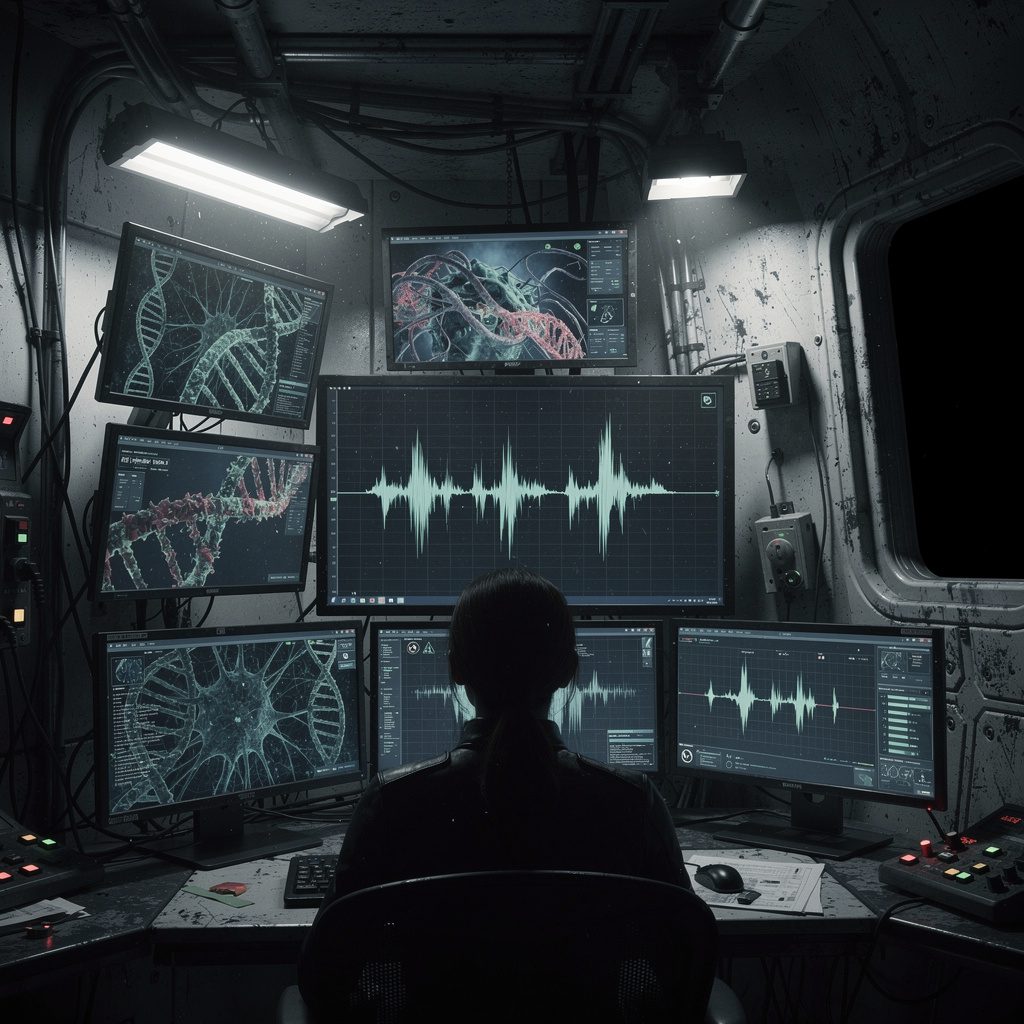
I have been here eleven months. I have read enough traffic to know that “anomalous but non-critical” is a classification that gets applied to things the Corps does not want to prioritize. I know that a research record this significant, arriving attached to a crisis transmission from a colony that went dark for nine weeks, will be quarantined, classified, and buried behind seventeen layers of administrative review while the people who need to act on it argue about jurisdiction.
I know those three other systems with matching samples. They are in the active survey rotation. There are people working near that substrate right now.
I make a decision.
I spend the next two hours doing something I have never done before. I use my signal analyst access — access that is broad enough for a station operator, narrow enough that I have never needed to push its edges — and I push. I copy the full research record. I compile Cabrera’s transmission and summary. I write a cover document, three pages, as clear and precise as I can make it, laying out what the record contains and what it means for the active survey systems.
And then I route it. Not just to the Corps hub. To the hub, and to the independent Colonial Science Oversight Board, and to two university xenobiology departments whose public research addresses extraterrestrial biological systems, and to a journalist at the Veridia Independent Press who I have seen break Corps suppression stories before.
I hit send.
Then I sit and wait for the consequences.
They come in forty minutes. My console access is suspended. A priority message from Corps Security demands I hold in place for a formal review. A second message, terse, from my station supervisor, tells me I have “committed a serious breach of protocol” and that I should “prepare a full account of my actions.”
I prepare the account. I write it honestly. I include everything.
But the record is already out. The university departments have already received it. The journalist has already received it. The sequence data, Cabrera’s voice, the names of the three other systems — it is already moving through channels the Corps cannot quietly close.
I think about Carmela Cabrera in that last hour before she stopped being able to speak. Composing a summary with the patience and precision of someone who knows the work matters more than the person doing it. Sending it anyway, into the silence, hoping someone on the other end was paying attention.
I was paying attention.
I do not know if she is still alive. I do not know what she looks like now, after the sequence has finished what it started. I do not know if the word “alive” still means what it meant. The research record suggests it does. The research record suggests she is somewhere on that colony surface, transformed past recognition, past communication, past anything I could call familiar — but present. Still present.
That is something. I hold onto it because it is all I have.
The Corps review board will come. There will be hearings. My career, such as it was, is most likely finished. Eleven months of quiet work on a relay station, pouring rust-flavored coffee and forwarding packets — that version of my life ended the moment I pressed send.
I am not sure I am sorry.
Outside the station’s single viewport, the dark is absolute and enormous. No stars visible from this angle, just the deep black of the space between systems, the kind of dark that reminds you how small the lit places are. Somewhere in that dark, Mira-4 turns on its orbit around a distant star, and on its surface, in the quiet of the southern basin, the sequence does what it has always done.
Reads. Edits. Transforms.
Not malicious. Not benign. Just… what it is.
I pick up the cold coffee and drink the last of it.
I sit with what I have done, and what it cost, and what it may yet save.
The console hums. The lights hold steady. And the signal — Cabrera’s voice, her data, her careful and precise last gift to anyone who would listen — moves outward through the network at the speed of light, past the point where anyone can stop it now.

 WhatsApp
 Telegram
 Email






Categories
- AI & Technology
- Contemporary
- Corporate Control
- Creepypasta
- Crime Thriller
- Cyberpunk
- Dark Fantasy
- Enemies to Lovers
- Fairy Tale Retelling
- Fantasy
- First Contact
- Forbidden
- Genetic/Body Horror
- High Fantasy
- Monster Hunter
- Mythic/Folklore
- Paranormal
- Portal/Otherworld
- Post-Apo
- Post-Collapse Society
- Psychological Thriller
- Romances
- SCI-FI
- Second Chance
- Slow Burn
- Space Combat
- Spacepunk
- Surveillance State
- Survival Thriller
- Thrillers
- Time Travel
- Treasure Hunter
- Urban Fantasy
- Witchcraft/Curses
Tags
10min stories atmospheric atmospheric fantasy atmospheric fiction contemporary romance Creepy creepypasta crime thriller dark fantasy debt dystopia emotional fiction enemies to lovers ensemble cast epistolary fantasy female protagonist first person forbidden romance framed narrative high fantasy love story magic Memory mystery Paranormal psychological horror psychological thriller romance sci-fi second chance second chance romance short fiction short story slow burn space station speculative fiction supernatural Survival survival thriller suspense thriller travel romance witchcraft workplace romance
Leave a Reply