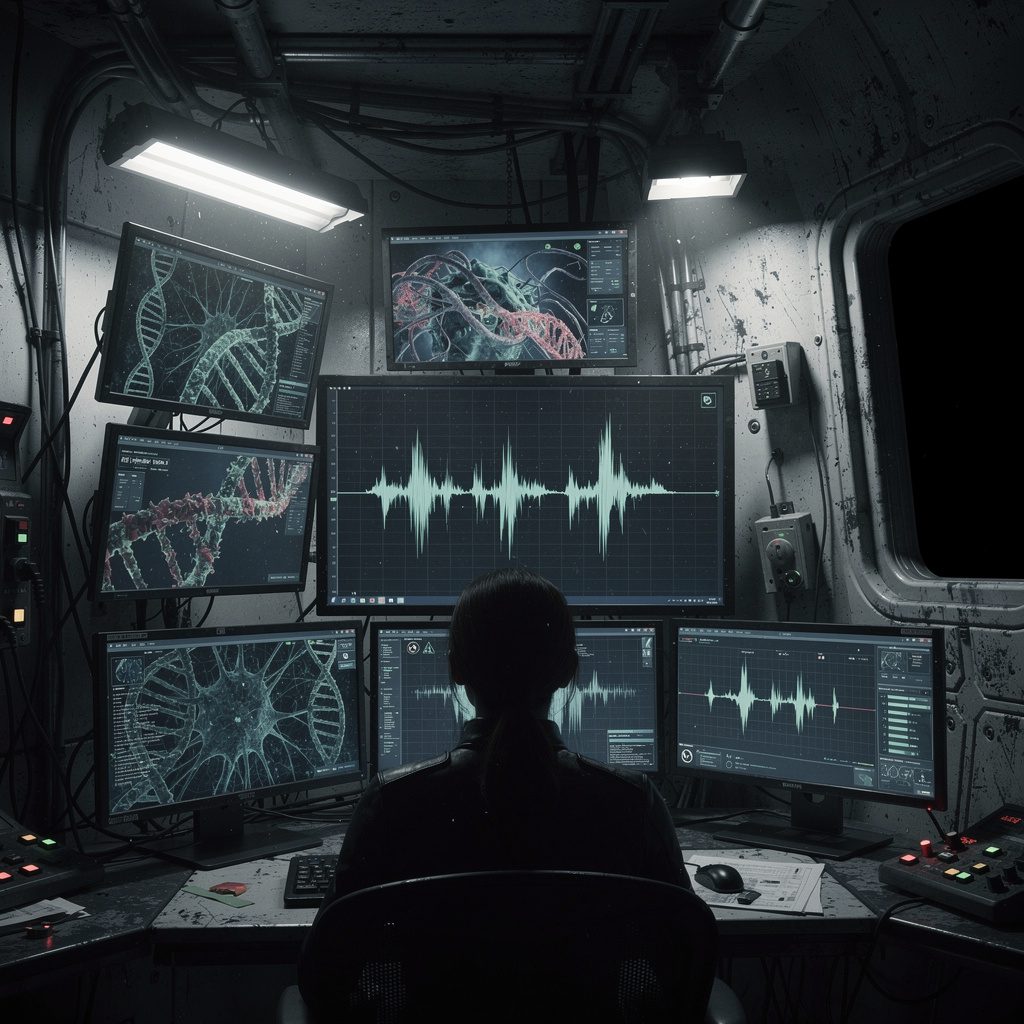
The recycled air in the station hisses through the vents. A proximity alert blinks twice on the far console, then clears itself. Routine.
I play the transmission again.
And then I do the thing I am not supposed to do alone. I do not route it immediately to the Corps hub. I do not flag it for the duty officer. I pull up the Mira-4 colony file and I start reading everything I can find.
Mira-4 was established three years ago as a geological and biological survey outpost. Sixteen personnel. The southern basin Cabrera mentioned is listed in the survey logs as a high-mineral substrate zone with elevated organic compound readings — flagged as “interesting, low priority.”
Low priority.
I find Carmela Cabrera’s personnel file. She has a small photo in the header. Dark hair pulled back, sharp eyes behind rectangular glasses, the kind of expression that suggests she has little patience for anything that isn’t precise. Her research record is long and dense with genetic taxonomy work. She is not someone who uses imprecise language. If she said the sequence reads a genome, she meant it literally.
Four hours pass. I barely move.
I am building a picture from fragments — the survey logs, the Corps correspondence about the antenna disruption, the diagnostic drone report, a brief mention in a quarterly overview of “unusual biological complexity” in Mira-4’s southern basin samples. That last line was written six weeks before the colony went silent.
Six weeks. Someone at the Corps hub read that line and moved on.
At 08:44, the secondary packet arrives.
Cabrera’s full research record. Forty-seven files. Genetic sequencing data, microscopy logs, audio and video field notes, and a final written summary that she must have spent her last coherent hours composing.
I read the summary first.
The sequence — she names it the Mira Substrate Sequence in the documentation, clinical and precise to the end — is not a living organism in any conventional sense. It is closer to a biological algorithm. It exists in the mineral layers of the southern basin, encoded in molecular structures that have no cellular machinery of their own. It is passive. Inert. Until it contacts DNA.
On contact, it begins a process Cabrera describes as “reiterative genomic recomposition.” It does not destroy the host’s DNA. It does not replace it. It layers onto it. Adds sequences. Rewrites regulatory genes. Alters protein expression in cascading waves that move through every system in the body over a period of weeks.
The result, she writes, is not death.
The result is transformation.
She documents it in her colleagues. The early stages: changes in skin texture, in eye structure, in the density and composition of muscle and bone. The middle stages: alterations in neural architecture, changes in sleep patterns, in the way they respond to stimulus. The later stages she describes carefully, choosing every word with the same precision I imagine she brought to everything.
They are still alive, she writes again. I can confirm that. Their metabolic readings are stable. Their neural activity is present. But the cognitive patterns have shifted so far from baseline human that I cannot establish meaningful communication. They are aware of me. I believe they are aware of me. But whatever they are aware of, it is no longer what I am.
And then the line that stops me cold.
The sequence is not unique to Mira-4. I found matching molecular signatures in archived Corps deep-survey samples from three other systems. Samples taken years ago, logged, and filed without analysis. The sequence is out there. It has been out there. We have been walking past it for years without knowing what it was.
I sit back.
The station hums around me. The coffee is cold. The lights in the main corridor flicker once, the way they always do at the shift change, and I watch the flicker like I have never seen it before.
I know what I have to do.
I know what the right thing is, what the Corps protocol says, what any reasonable person in my position would do: flag it, escalate it, route the full record to the hub and let the people above me handle it.
I also know what happens when the Corps handles things.

 WhatsApp
 Telegram
 Email






Categories
- AI & Technology
- Contemporary
- Corporate Control
- Creepypasta
- Crime Thriller
- Cyberpunk
- Dark Fantasy
- Enemies to Lovers
- Fairy Tale Retelling
- Fantasy
- First Contact
- Forbidden
- Genetic/Body Horror
- High Fantasy
- Monster Hunter
- Mythic/Folklore
- Paranormal
- Portal/Otherworld
- Post-Apo
- Post-Collapse Society
- Psychological Thriller
- Romances
- SCI-FI
- Second Chance
- Slow Burn
- Space Combat
- Spacepunk
- Surveillance State
- Survival Thriller
- Thrillers
- Time Travel
- Treasure Hunter
- Urban Fantasy
- Witchcraft/Curses
Tags
10min stories atmospheric atmospheric fantasy atmospheric fiction contemporary romance Creepy creepypasta crime thriller dark fantasy debt dystopia emotional fiction enemies to lovers ensemble cast epistolary fantasy female protagonist first person forbidden romance framed narrative high fantasy love story magic Memory mystery Paranormal psychological horror psychological thriller romance sci-fi second chance second chance romance short fiction short story slow burn space station speculative fiction supernatural Survival survival thriller suspense thriller travel romance witchcraft workplace romance
Leave a Reply