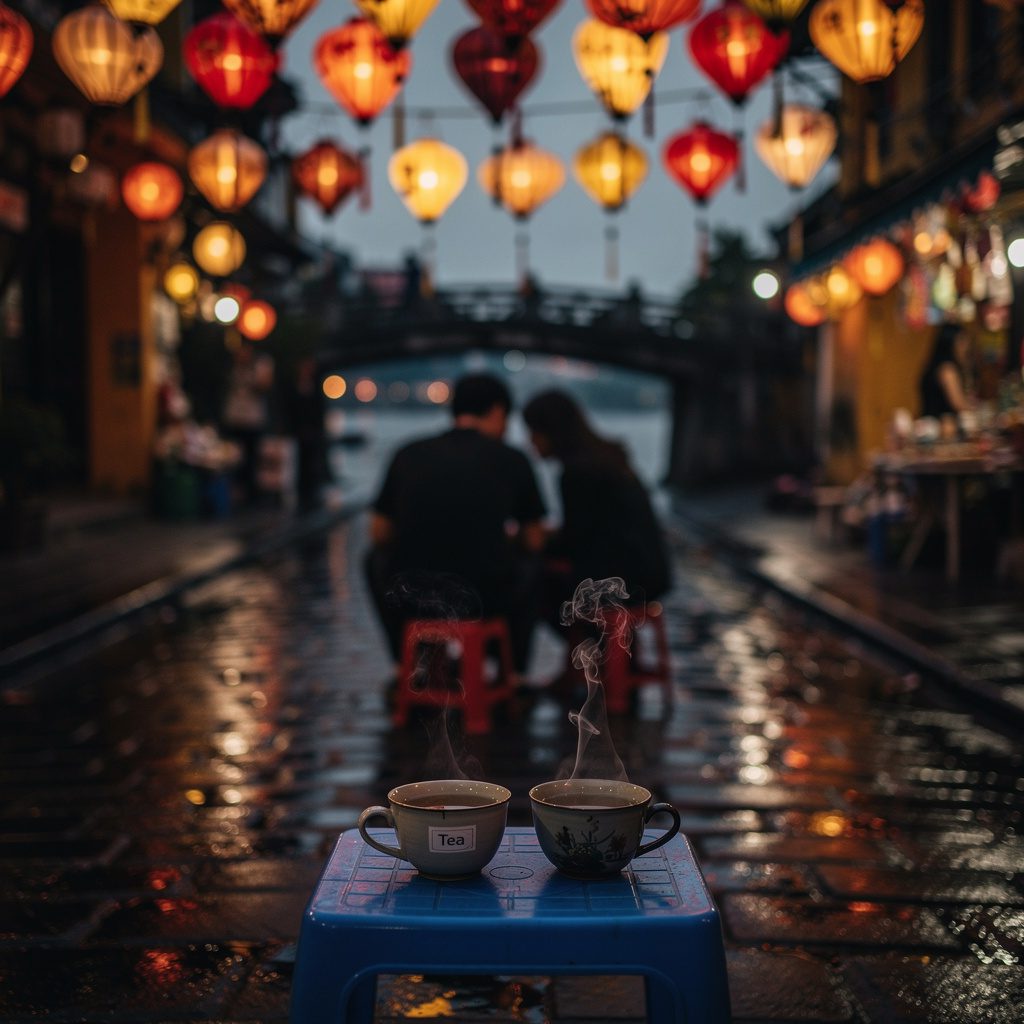
Tobias, I learned across the following evenings, was an architectural historian. He was in Hoi An documenting the town’s fusion architecture for a research project — the way French colonial and Chinese merchant and Vietnamese vernacular styles had pressed against each other over centuries and produced something that belonged entirely to itself. He talked about buildings the way some people talked about people: with curiosity and a kind of patient tenderness.
“Every wall here is a conversation,” he told me one night, his chrysanthemum tea cooling between his hands. “Between different people, different centuries. The town didn’t erase what came before. It just kept building around it.”
I took a photograph of the lantern light on the river that night and knew I was actually photographing the feeling of sitting next to him.
This was the part that frightened me.
Not him. Not specifically. But the feeling of wanting to be somewhere — this somewhere, this stool, this smell of star anise and lotus and old stone — in a way that had nothing to do with the photograph I might take or the story I might file. Wanting to be here because he was here, and because the way he talked about walls and centuries made me feel, quietly and against my will, that I might be worth staying in one place for too.
The sharp moment came on the seventh night.
We had walked away from the stall after tea, drifting down the lane without deciding to, the way you do when a conversation has its own momentum. The lanterns swayed. The river glittered. A child ran past us with a paper star that spun light in all directions, and Orla laughed — I laughed — and when I turned back to Tobias, he was already looking at me.
Not the way people look at something that surprised them. The way they look at something they have been looking at for a while and have only just stopped pretending otherwise.
My chest did something I didn’t have a word for.
“How long are you here?” he asked.
“Three more days,” I said.
Something moved through his expression. He nodded once, slow, and looked back at the river.
We walked back in a silence that held too much.
I didn’t sleep well. I lay in my guesthouse room with the ceiling fan turning overhead and the distant sound of the river and thought about three days like they were a sentence being handed down. Which was absurd. I barely knew him. I was always three days from somewhere. That was the whole architecture of my life.
But that was exactly the problem, wasn’t it.
The second sharp moment came the following evening, before I’d even sat down.
I arrived at the stall and he was already there — not writing in his notebook, not holding his tea. Just sitting, hands loose in his lap, watching the lane like he was waiting. When he saw me, he didn’t smile right away. He just exhaled.
“I thought you might not come,” he said.
“I come every night,” I said, though my voice came out quieter than I intended.
“I know,” he said. “I was worried this might be the night you didn’t.”
I sat down. The tea woman brought my lotus without being asked. The lanterns swayed. I looked at my hands around the warm cup and tried to locate the version of myself who was good at this — good at lightness, good at departures framed as adventures, good at not wanting things that required her to stay.
She was harder to find than usual.
“Tobias.”
“Orla.”
“Why do you keep coming here?” I asked. “There are other stalls. Other parts of the market.”
He was quiet for a moment. The soup cart near the bridge sent its thread of star anise through the warm night air.
“Same reason you do, I think,” he said.
I looked at him.
“I don’t know what that reason is,” I said. It was the most honest thing I’d said in a long time. Maybe longer than I wanted to count.
“Yes you do,” he said. Gently. Without pressure. Just — certainly.

 WhatsApp
 Telegram
 Email







Categories
- AI & Technology
- Contemporary
- Corporate Control
- Creepypasta
- Crime Thriller
- Cyberpunk
- Dark Fantasy
- Enemies to Lovers
- Fairy Tale Retelling
- Fantasy
- First Contact
- Forbidden
- Genetic/Body Horror
- High Fantasy
- Monster Hunter
- Mythic/Folklore
- Paranormal
- Portal/Otherworld
- Post-Apo
- Post-Collapse Society
- Psychological Thriller
- Romances
- SCI-FI
- Second Chance
- Slow Burn
- Space Combat
- Spacepunk
- Surveillance State
- Survival Thriller
- Thrillers
- Time Travel
- Treasure Hunter
- Urban Fantasy
- Witchcraft/Curses
Tags
10min stories atmospheric atmospheric fantasy atmospheric fiction contemporary romance Creepy creepypasta crime thriller dark fantasy debt dystopia emotional fiction enemies to lovers ensemble cast epistolary fantasy female protagonist first person forbidden romance framed narrative high fantasy love story magic Memory mystery Paranormal psychological horror psychological thriller romance sci-fi second chance second chance romance short fiction short story slow burn space station speculative fiction supernatural Survival survival thriller suspense thriller travel romance witchcraft workplace romance
Leave a Reply