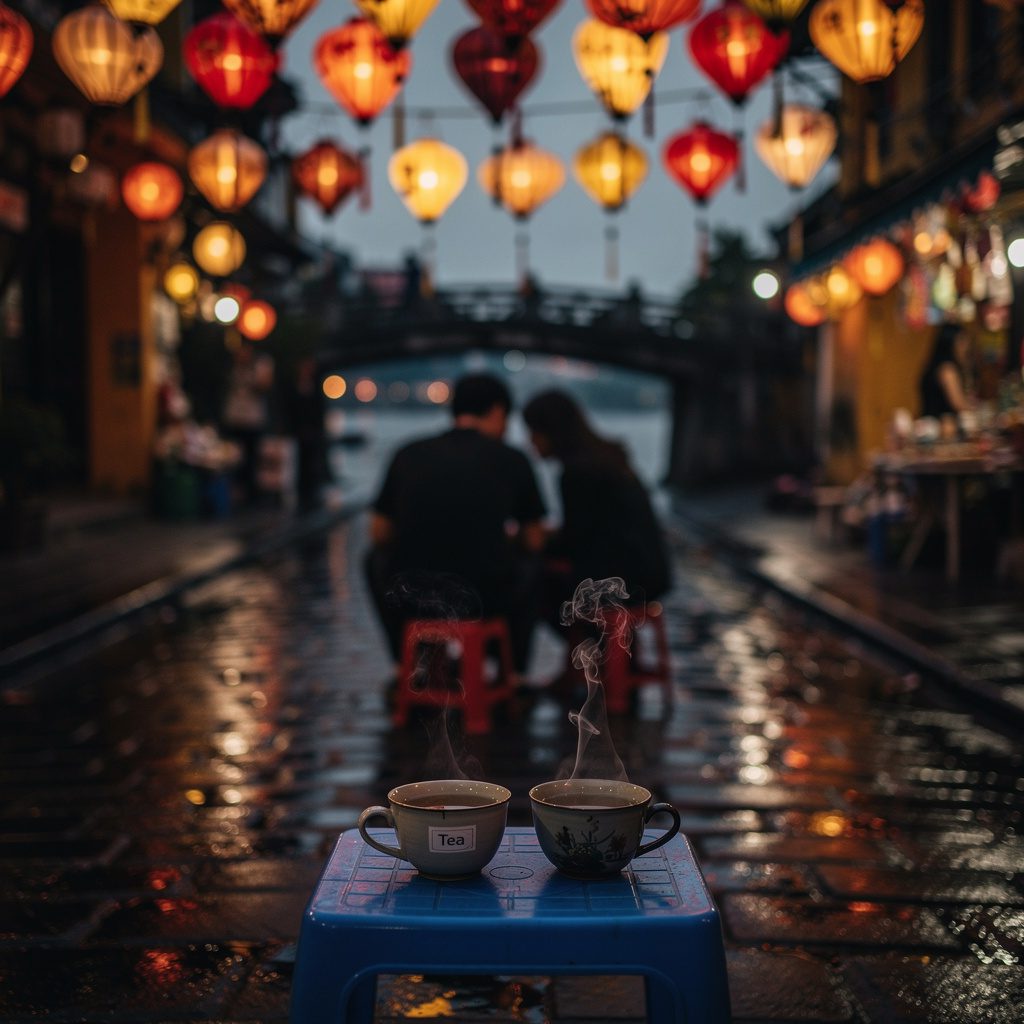
There was a smell I kept returning to without meaning to — star anise and warm sesame oil drifting from a soup cart near the bridge, cutting through the lantern smoke. I noticed it before I noticed him. That detail mattered, though I didn’t understand why until much later.
I had been in Hoi An for eleven days by the time I admitted I was no longer sightseeing. I was waiting.
The Ancient Town’s night market unfolded every evening along the Thu Bon River like something from a dream that hadn’t finished being invented. Silk lanterns — red, gold, persimmon, pale jade — hung in long swaying rows over the narrow lane, and their light turned everyone beneath them into something softer, something more. Vendors called out in lilting Vietnamese, children chased each other between the stalls, and the river beyond the stone bridge caught every reflection and held it, trembling.
I’d found a spot at a small outdoor tea stall tucked between a tailor’s shop and a woman selling hand-painted ceramics. The stall had four low plastic stools and a gas burner and a woman who made lotus tea so fragrant it felt like drinking something sacred. I’d come the first night by accident. I’d come every night since on purpose, though I told myself it was just the tea.
The first time I saw Tobias Marlowe, he was standing at the ceramic stall next door, turning a small blue bowl over in his hands like he was trying to understand something it had done.
He was tall in a way that looked uncomfortable in the narrow lane — shoulders that had learned to angle slightly inward, a habit of folding himself to fit. Dark hair that needed cutting. A worn linen shirt the color of sea glass. He wasn’t beautiful in any obvious way. He was the kind of face you could look at for a long time and still feel like you were only just beginning to see it.
He bought the bowl. He didn’t buy the tea.
He was back the next night.
This time he sat two stools away from me, ordered something from the tea woman with a Vietnamese phrase that clearly surprised her, and then opened a small notebook and began writing in it with the focused quiet of someone who was used to being alone in public. I watched him the way you watch something you’re pretending not to watch. He didn’t look up.
The third night, he sat one stool closer.
I told myself this was coincidence. The stall was small. Stools were limited. Hoi An was not a large town, and the night market was where everyone eventually ended up, drifting down its lantern-lit lane like paper boats on the river. There was no reason to read anything into the geometry of plastic stools.
But I knew the smell of star anise before I turned to look for him now. That was the part I couldn’t explain away.
On the fourth night, he spoke first.
“You always order the lotus.”
Not a question. An observation offered plainly, like he was reading a fact from his notebook.
I looked at him. Up close, his eyes were a complicated shade — not quite brown, not quite anything else. There was a small scar along his jaw, pale and old.
“You always order the chrysanthemum,” I said.
He smiled. It was a slow smile, the kind that arrived in pieces.
“Orla,” I said, because it seemed like the next right thing.
“Tobias.”
We didn’t say much more that night. But when I left, I realized I’d been there two hours longer than I’d meant to stay.
Here is what I knew about myself by that point in my life: I was good at arriving places and bad at staying. I had a career built on the former — travel photography, the kind that required you to be perpetually mid-passage, always between one beautiful somewhere and the next. I had a camera bag that weighed more than some people’s suitcases and a habit of leaving before things got complicated. I told myself this was freedom. I told myself it with great conviction.
I’d been doing it for six years. I’d been very free.

 WhatsApp
 Telegram
 Email







Categories
- AI & Technology
- Contemporary
- Corporate Control
- Creepypasta
- Crime Thriller
- Cyberpunk
- Dark Fantasy
- Enemies to Lovers
- Fairy Tale Retelling
- Fantasy
- First Contact
- Forbidden
- Genetic/Body Horror
- High Fantasy
- Monster Hunter
- Mythic/Folklore
- Paranormal
- Portal/Otherworld
- Post-Apo
- Post-Collapse Society
- Psychological Thriller
- Romances
- SCI-FI
- Second Chance
- Slow Burn
- Space Combat
- Spacepunk
- Surveillance State
- Survival Thriller
- Thrillers
- Time Travel
- Treasure Hunter
- Urban Fantasy
- Witchcraft/Curses
Tags
10min stories atmospheric atmospheric fantasy atmospheric fiction contemporary romance Creepy creepypasta crime thriller dark fantasy debt dystopia emotional fiction enemies to lovers ensemble cast epistolary fantasy first contact first person forbidden romance framed narrative high fantasy love story magic Memory mystery Paranormal psychological horror psychological thriller romance sci-fi second chance second chance romance short fiction short story slow burn space station speculative fiction supernatural Survival survival thriller suspense thriller travel romance witchcraft workplace romance
Leave a Reply