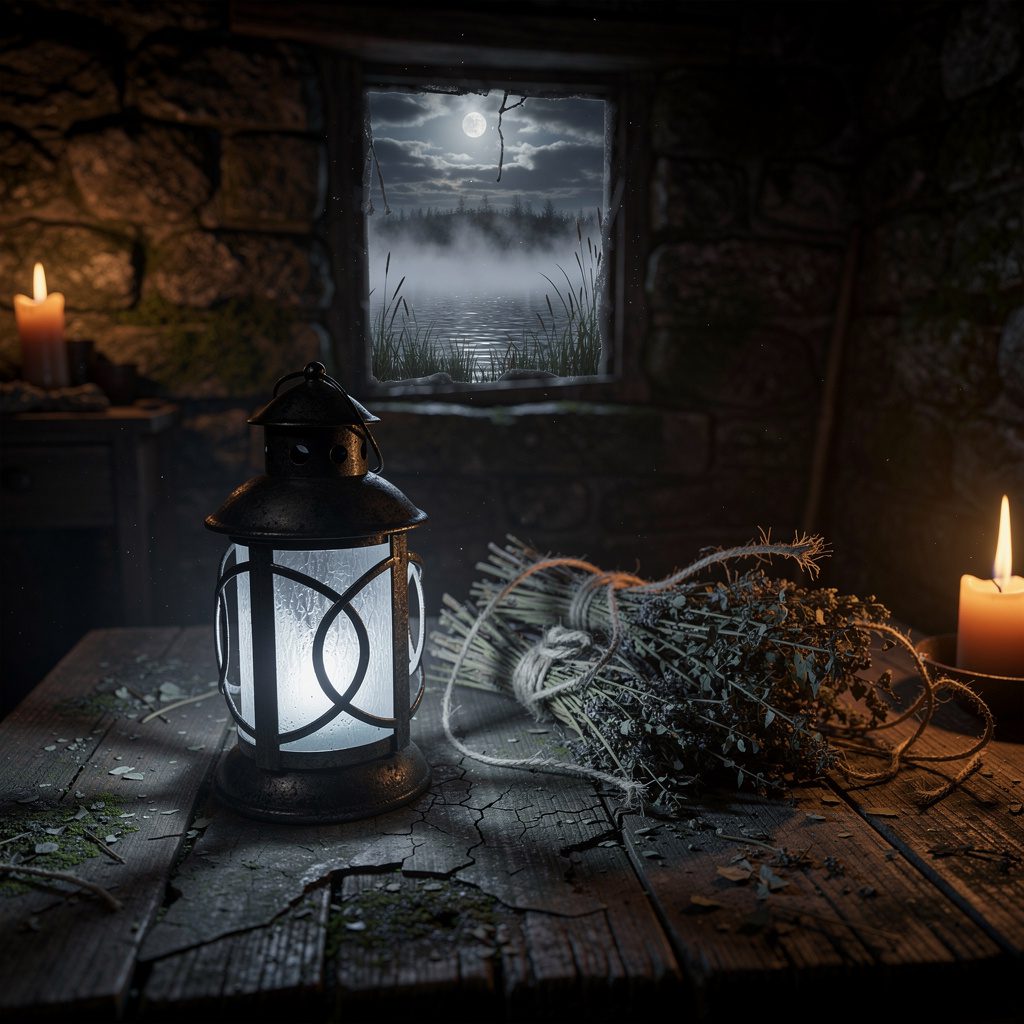
Across the square, a man she had never seen before was walking toward her stall with the careful, unhurried stride of someone who had been walking a long time and had learned not to rush. He was tall and broad through the shoulders, dressed in a traveler’s coat the color of storm cloud, its hem stiff with dried mud from a dozen different roads. His face was weathered to a deep umber, creased at the eyes and mouth, and he wore his grey-streaked hair close-cropped beneath a wide-brimmed hat he had not bothered to remove. He carried no visible weapon. He carried no pack. He carried only a leather satchel slung across one shoulder, and his eyes, dark and unhurried, were fixed not on Mira but on the lantern.
“I’ve been looking for that,” he said, stopping at the edge of her table.
“It isn’t for sale,” Mira said, which surprised her, because she had not decided to say it.
The man looked at her then, and something in his expression shifted—not surprise, exactly, but a recalibration, the way a navigator adjusts when a landmark is not where the chart said it would be. “I know,” he said. “I’m not here to buy it. I’m here because it called me.”
The humming in the lantern rose, just briefly, and then fell again.
His name was Rodrigo Alvarez, and he told her what he knew in the flat, careful voice of a man reciting a thing he had recited before, to other people, in other places, who had mostly not believed him. He was a keeper—not a priest, not a mage, but something older than either, a person trained in the traditions of a scattered order whose purpose was to track objects of what he called “chosen inheritance.” These were relics, he explained, that did not wait to be found. They moved. They arrived. They attached themselves to a bearer of their own selection, and they remained with that bearer until the bearer had done whatever the relic had come to help them do. Then they left. Usually quietly. Sometimes not.
“What did it come to help me do?” Mira asked.
“I don’t know yet,” Rodrigo said. “They don’t tell me that part.”
Mira looked at the lantern. The lantern sat quietly, giving nothing away. “How long have you been following it?”
“Six years.” He said it without self-pity. “It’s moved eleven times. You’re the twelfth bearer.”
That night, sitting at her kitchen table with the lantern between them and a pot of barley tea going cold, Rodrigo explained the rest. Each bearer, he said, had been an ordinary person. A ferryman. A midwife. A stonemason. None of them had known why they were chosen until the moment arrived, and the moment, when it came, was always the same in structure: a threshold, a choice, and something that could not be undone. The lantern did not grant power. It did not protect. It illuminated—not the dark outside, but the dark inside a situation, the hidden thing that everyone around it had failed to see.
“And after?” Mira said.
“After, it leaves.”
She sat with that for a moment. Outside, the marsh was making its nighttime sounds, the low percussion of frogs and the occasional distant cry of a marsh bird hunting in the dark. The lantern, she realized, was glowing now—steadily, for the first time, not at the edge of her vision but directly, clearly, a soft cold light that cast no shadows. She had been looking at it directly for a full minute and it had not vanished.
Then she understood.
Not the lantern. The moment. The threshold. It was not coming. It had already arrived.
She stood up and walked to the window that faced the marsh, and she looked out at the dark water and the mist, and she saw what she had been looking at every morning for three weeks without truly seeing: the slow, patient retreat of the marsh edge. The water was closer than it had been in her childhood. Closer than it had been five years ago. Closer, she now realized with the lantern’s cold clarity burning in her peripheral vision, than it had been even last spring. The marsh was rising. Not from rain. Not from the season. From something deeper, something that had been building beneath the peat and the black water, some old pressure in the earth that the village’s elders had been quietly, collectively, choosing not to name.

 WhatsApp
 Telegram
 Email






Categories
- AI & Technology
- Contemporary
- Corporate Control
- Creepypasta
- Crime Thriller
- Cyberpunk
- Dark Fantasy
- Enemies to Lovers
- Fairy Tale Retelling
- Fantasy
- First Contact
- Forbidden
- Genetic/Body Horror
- High Fantasy
- Monster Hunter
- Mythic/Folklore
- Paranormal
- Portal/Otherworld
- Post-Apo
- Post-Collapse Society
- Psychological Thriller
- Romances
- SCI-FI
- Second Chance
- Slow Burn
- Space Combat
- Spacepunk
- Surveillance State
- Survival Thriller
- Thrillers
- Time Travel
- Treasure Hunter
- Urban Fantasy
- Witchcraft/Curses
Tags
10min stories atmospheric atmospheric fantasy atmospheric fiction contemporary romance Creepy creepypasta crime thriller dark fantasy debt dystopia emotional fiction enemies to lovers ensemble cast epistolary fantasy first contact first person forbidden romance framed narrative high fantasy love story magic Memory mystery Paranormal psychological horror psychological thriller romance sci-fi second chance second chance romance short fiction short story slow burn space station speculative fiction supernatural Survival survival thriller suspense thriller travel romance witchcraft workplace romance
Leave a Reply