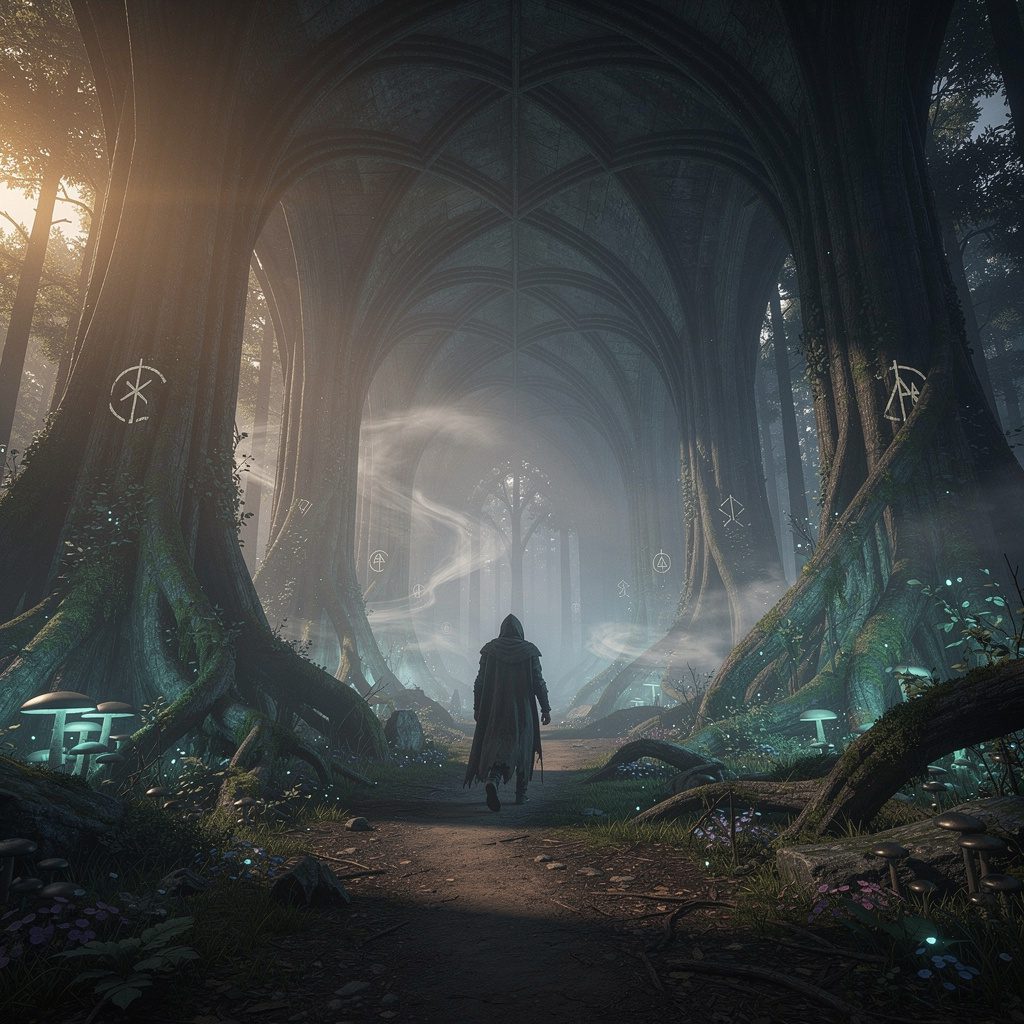
She is sitting on the root with her knees pulled up, and she looks exactly like Ngozi looks when she is frightened and pretending not to be. Her coat is muddied and torn. Her braids have come half-undone. She looks up at me and her face does something the copy’s face has never done: it breaks, all at once, into a kind of desperate, undisguised relief.
“Catriona.” Her voice is rougher than the copy’s. Real, somehow. Used.
I cross the clearing in four steps. I take her face in my hands.
“Tell me something,” I say. “Something the forest can’t know.”
She doesn’t hesitate. “The stone I named Hypatia has a crack down the middle. I never told you. I was afraid you’d say it was broken and I should throw it out.”
The clearing exhales. Or the forest does. The luminescence deepens for a moment, then contracts, and I feel it — a resistance in the air around us, a pressure that does not want to release what it holds. The salt is in my hand before I know I’ve reached for it. I open the paper and pour it in a slow circle around us both, and the resistance spikes, and then, like a knot pulled from both ends, it gives.
The walk out is longer than the walk in.
The forest shows us things. I do not look. Ngozi holds my hand and keeps her eyes forward, and I do the same, and we move through the blue-green silence with our shoulders touching, and eventually the light changes — warms, yellows, thins — and the root-line appears ahead, and we step over it and into the ordinary afternoon air of the Varenwood road.
—
We go home.
The thing in the green coat is gone when we arrive. The rooms are exactly as they should be. The jar of river stones is on the windowsill. I pick up Hypatia and turn her over, and the crack is there, thin and dark, running from crown to base.
Ngozi sleeps for eighteen hours. When she wakes, she dreams. I watch her face move.
I should feel only relief. I do feel relief. It is real and it is enormous and I am grateful for it in a way I have no language for.
But something is different in me now.
I cannot name it precisely. It is not loss in the ordinary sense. It is more like the grief of edges — Ngozi’s phrase, and I understand it now in my body rather than just in my mind. I went into Varenwood knowing exactly who I was: a cartographer’s apprentice, a sister, a person who buys salt on Tuesdays because small rituals are how you hold your shape. I came out with my sister. I came out with everything I went in for.
But the forest took something in exchange. Not a memory. Not a name. Something quieter than that. Some certainty I had about the borders of myself — where I ended and the world began, where the known gave way to the unmappable — is gone. I look at the compass on the table, its needle still now, pointing north as it should, and I feel the ghost of that dreamy spin. I feel the forest in the instrument. In my hands. In the particular quality of the silence when the house settles at night.
I am almost, but not quite, who I was when I walked in.
I think that is the price. I think the forest is very old, and very fair, in its way.
I make a cup of tea. I sit at the window. Outside, the Varenwood road curves south toward the tree line, and the trees stand against the sky, enormous and iron-dark and patient, and they do not look back at me.
I tell myself they do not look back.
I finish my tea.

 WhatsApp
 Telegram
 Email







Categories
- AI & Technology
- Contemporary
- Corporate Control
- Creepypasta
- Crime Thriller
- Cyberpunk
- Dark Fantasy
- Enemies to Lovers
- Fairy Tale Retelling
- Fantasy
- First Contact
- Forbidden
- Genetic/Body Horror
- High Fantasy
- Monster Hunter
- Mythic/Folklore
- Paranormal
- Portal/Otherworld
- Post-Apo
- Post-Collapse Society
- Psychological Thriller
- Romances
- SCI-FI
- Second Chance
- Slow Burn
- Space Combat
- Spacepunk
- Surveillance State
- Survival Thriller
- Thrillers
- Time Travel
- Treasure Hunter
- Urban Fantasy
- Witchcraft/Curses
Tags
10min stories atmospheric atmospheric fantasy atmospheric fiction contemporary romance Creepy creepypasta crime thriller dark fantasy debt dystopia emotional fiction enemies to lovers ensemble cast epistolary fantasy female protagonist first person forbidden romance framed narrative high fantasy love story magic Memory mystery Paranormal psychological horror psychological thriller romance sci-fi second chance second chance romance short fiction short story slow burn space station speculative fiction supernatural Survival survival thriller suspense thriller travel romance witchcraft workplace romance
Leave a Reply