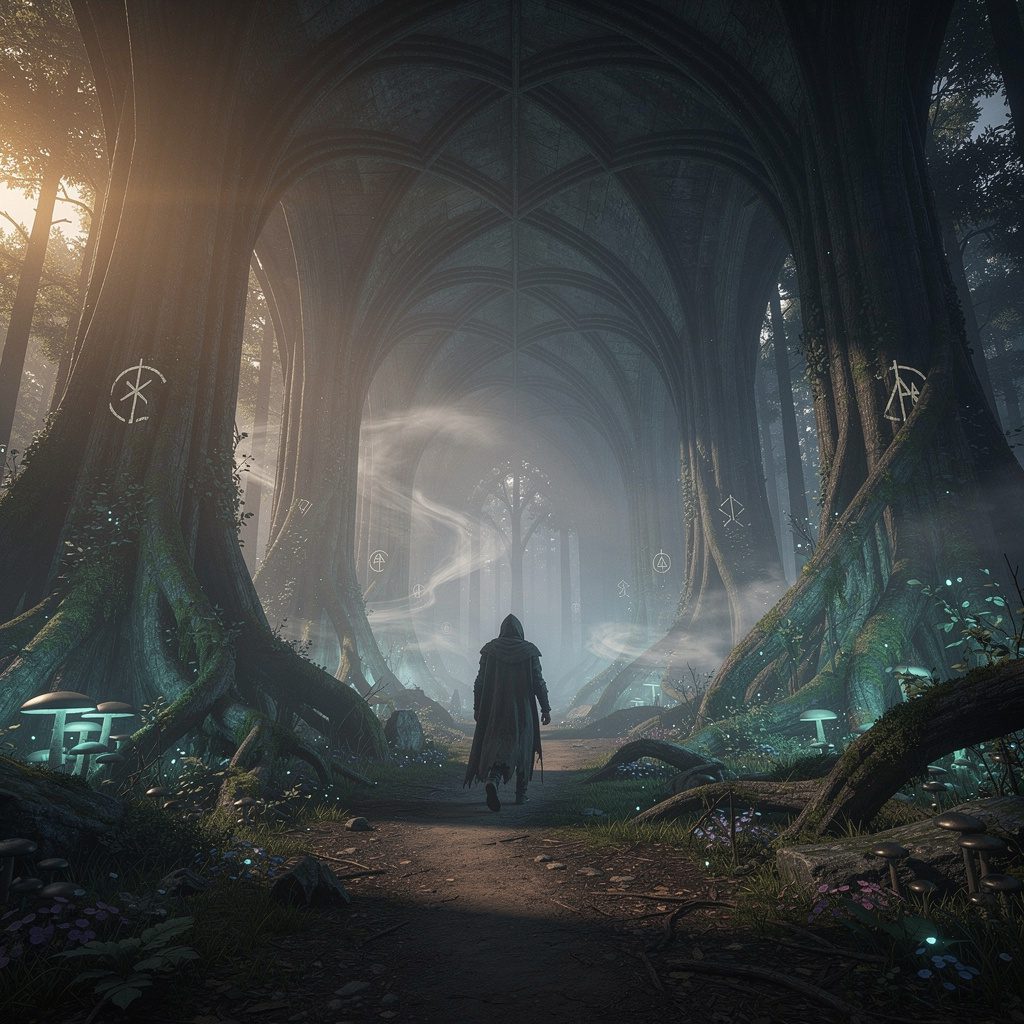
Now I am at the tree line.
Valenwood is old in the way that defies measurement. The trees at its border are massive — their trunks wider than a house, their bark the color of old iron, their roots erupting from the earth in long, tangled arches that you must climb over or duck under to proceed. Above the root-line, the canopy begins almost immediately, so dense that the light inside the forest is not diminished sunlight but something else entirely: a deep, blue-green luminescence that seems to emanate from the wood itself, from the moss on the stones, from the pale fungi clustered in the hollows of fallen logs. The air changes the moment you pass the first row of trees. It becomes cooler by several degrees, and it carries a smell that I can only describe as the smell of elsewhere — mineral and green and faintly electric, like the air before lightning, but without the threat. There is no wind. There has never been wind inside Varenwood, according to every account I have read in the cartographers’ archive. The silence is not empty. It is occupied. Something lives in it, patient and enormous, and it is aware of every footfall, every exhaled breath, every heartbeat you bring inside.
I take my first step in.
The woman I met in the market — the one at the stall that vanished — told me one thing before she disappeared into the crowd. She was old, or she seemed old: her face was seamed and dark brown and utterly calm, and her eyes were the pale amber of creek water over sand. She sold nothing I could identify. Her table held only a collection of small glass bottles, each one containing something that moved.
“You’re going in for someone,” she said. Not a question.
“My sister.”
“The forest doesn’t keep them,” she said. “It swaps them. Puts something of itself inside and sends the body home. The real person is still in there, walking. They just can’t find the way out because they can’t remember the door.” She picked up one of the bottles and held it to the light. Inside it, something like smoke turned slowly. “You have to remind them. Something only they would know. Something the copy can’t have learned.”
“How do I find her?”
“You won’t,” the woman said. “She’ll find you. The forest shows the lost ones the people looking for them. That’s how it’s cruel. They can see you coming. They just can’t reach you.”
She set the bottle down. She did not look at me again.
—
I am three hundred meters inside Varenwood when I feel the pull.
It is not a sound or a sight. It is a pressure, directional, like a hand on my shoulder turning me gently. I follow it because I have nothing else to follow. The compass spins uselessly — it has since I crossed the tree line, its needle circling with slow, dreamy indifference. The salt is in my coat pocket, a folded paper of it, though I am no longer certain what I intended to do with it. The forest is doing something to linear thought. Not destroying it. Softening it, the way water softens paper, so that my intentions remain but their edges blur.
I think about Ngozi. Not the thing sleeping in her bed. The real one.
Ngozi, who used to narrate our mother’s recipe for groundnut soup in a fake documentary voice while she cooked, deadpan and precise, describing the addition of each ingredient as though it were a significant archaeological discovery. Ngozi, who kept a jar of river stones on the windowsill and named each one after a mathematician. Ngozi, who cried at the end of every map I finished, not from sentimentality but from what she called the grief of edges — the sadness that a map implies, she said, because every border is also a declaration of everything left out.
I am crying. I did not notice when it started.
The forest floor shifts. The light brightens slightly. And there, in a small clearing where three enormous roots form a natural chamber, I see her.

 WhatsApp
 Telegram
 Email







Categories
- AI & Technology
- Contemporary
- Corporate Control
- Creepypasta
- Crime Thriller
- Cyberpunk
- Dark Fantasy
- Enemies to Lovers
- Fairy Tale Retelling
- Fantasy
- First Contact
- Forbidden
- Genetic/Body Horror
- High Fantasy
- Monster Hunter
- Mythic/Folklore
- Paranormal
- Portal/Otherworld
- Post-Apo
- Post-Collapse Society
- Psychological Thriller
- Romances
- SCI-FI
- Second Chance
- Slow Burn
- Space Combat
- Spacepunk
- Surveillance State
- Survival Thriller
- Thrillers
- Time Travel
- Treasure Hunter
- Urban Fantasy
- Witchcraft/Curses
Tags
10min stories atmospheric atmospheric fantasy atmospheric fiction contemporary romance Creepy creepypasta crime thriller dark fantasy debt dystopia emotional fiction enemies to lovers ensemble cast epistolary fantasy female protagonist first person forbidden romance framed narrative high fantasy love story magic Memory mystery Paranormal psychological horror psychological thriller romance sci-fi second chance second chance romance short fiction short story slow burn space station speculative fiction supernatural Survival survival thriller suspense thriller travel romance witchcraft workplace romance
Leave a Reply