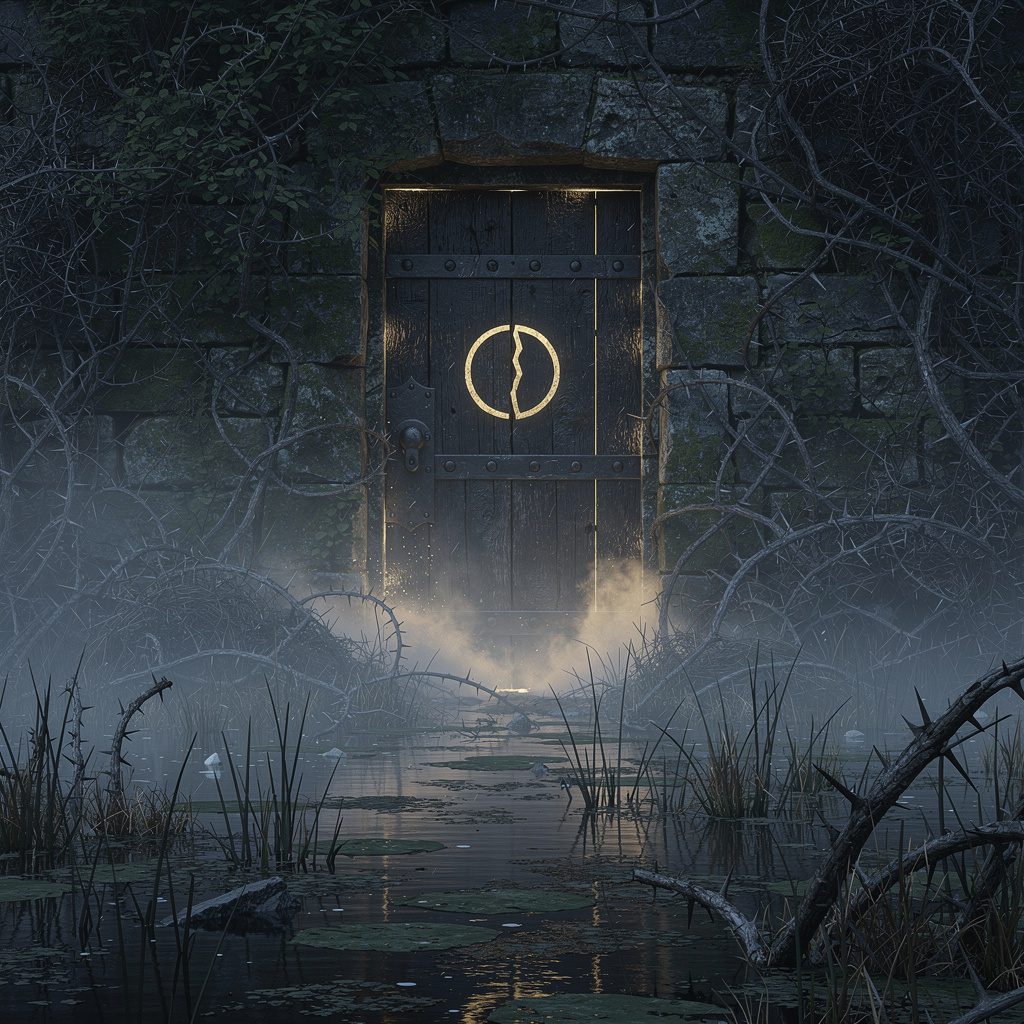
They all turned to look at me. I am Eryndor. I had been tracking this door for eleven years, following the grief-root’s trail through old herbalist texts and marsh surveys and three separate fires that all, I now understood, had been caused by the same original source of heat: the distillation process itself, which runs hot in its final stages.
Josette’s mother’s apothecary had not been destroyed by accident.
Her mother had built this place. Had fed it. Had been the one to start the distillation.
I watched Josette’s face as she understood this.
—
The tension broke badly, the way tension that has been building across three weeks and four different griefs tends to break.
Verona said: “So her mother caused the fire that killed the apothecary.” Not a question. Not an accusation. Just a shape being named.
“To complete the process,” I said. “The final stage requires the maker to release the last thing they are holding. For her, that was the building. Her life’s work. She gave it so the distillation would finish.”
Callum looked at the vessel. “And what does it do? The distillate.”
“It does not reverse loss,” I said, because I could see what he was thinking, and I would not let him carry that hope another step if it was not true. “It cannot bring back what is gone. But — and this is the part the old texts argue about — it is said to show you what the lost thing left behind. What grew in the space it made. The way grief-root only grows where something has been buried and mourned for. Loss makes a shape, and things grow in that shape.”
Josette picked up the vessel.
The wax seal cracked under her thumb with a sound like a small bone settling.
The luminous thing inside rose — not dramatically, not with any theatrical rush of light — it simply rose, the way steam rises from a cup, and it spread through the small space, and each of them breathed it in.
—
I cannot tell you what each of them saw. That is not mine to tell. What I can tell you is what I saw, because I breathed it too, standing in the doorway.
I saw my eleven years of searching, and I saw what had grown in the space that searching had occupied — the places I had not gone, the people I had not stayed long enough to know, the experiments I had run in empty rooms when I might have run them with someone beside me. I saw it clearly, without the fog of habit that usually makes such things invisible.
It was not comfortable. It was not meant to be.
But it was true.
Josette, when she came back to herself — a few seconds or a few minutes later, time moved strangely in that space — was crying without any of the self-consciousness that had armored her since the fire. Not performing grief. Just having it, the way you have weather: present, undeniable, moving through.
“She chose this,” Josette said. Not asking.
“Yes,” I said.
“She chose to lose the apothecary so this would finish. She chose to lose the last thing she had of herself so other people’s losses could become — what? A gift?”
“A record,” I said. “And an answer, for those who could find it. Not a cure. An answer.”
Josette was quiet for a long moment. The luminous distillate had settled now, thin as morning mist, and was slowly, gently dissipating into the stone walls. The room would not hold the distillate forever. It had never been meant to. It had been meant to be opened, breathed in, used — by exactly the kind of people who could open the door.
“She knew I would find it,” Josette said.
“I believe she hoped you would,” I said carefully. “I cannot promise she knew.”

 WhatsApp
 Telegram
 Email






Categories
- AI & Technology
- Contemporary
- Corporate Control
- Creepypasta
- Crime Thriller
- Cyberpunk
- Dark Fantasy
- Enemies to Lovers
- Fairy Tale Retelling
- Fantasy
- First Contact
- Forbidden
- Genetic/Body Horror
- High Fantasy
- Monster Hunter
- Mythic/Folklore
- Paranormal
- Portal/Otherworld
- Post-Apo
- Post-Collapse Society
- Psychological Thriller
- Romances
- SCI-FI
- Second Chance
- Slow Burn
- Space Combat
- Spacepunk
- Surveillance State
- Survival Thriller
- Thrillers
- Time Travel
- Treasure Hunter
- Urban Fantasy
- Witchcraft/Curses
Tags
10min stories atmospheric atmospheric fantasy atmospheric fiction contemporary romance Creepy creepypasta crime thriller dark fantasy debt dystopia emotional fiction enemies to lovers ensemble cast epistolary fantasy first contact first person forbidden romance framed narrative high fantasy love story magic Memory mystery Paranormal psychological horror psychological thriller romance sci-fi second chance second chance romance short fiction short story slow burn space station speculative fiction supernatural Survival survival thriller suspense thriller travel romance witchcraft workplace romance
Leave a Reply