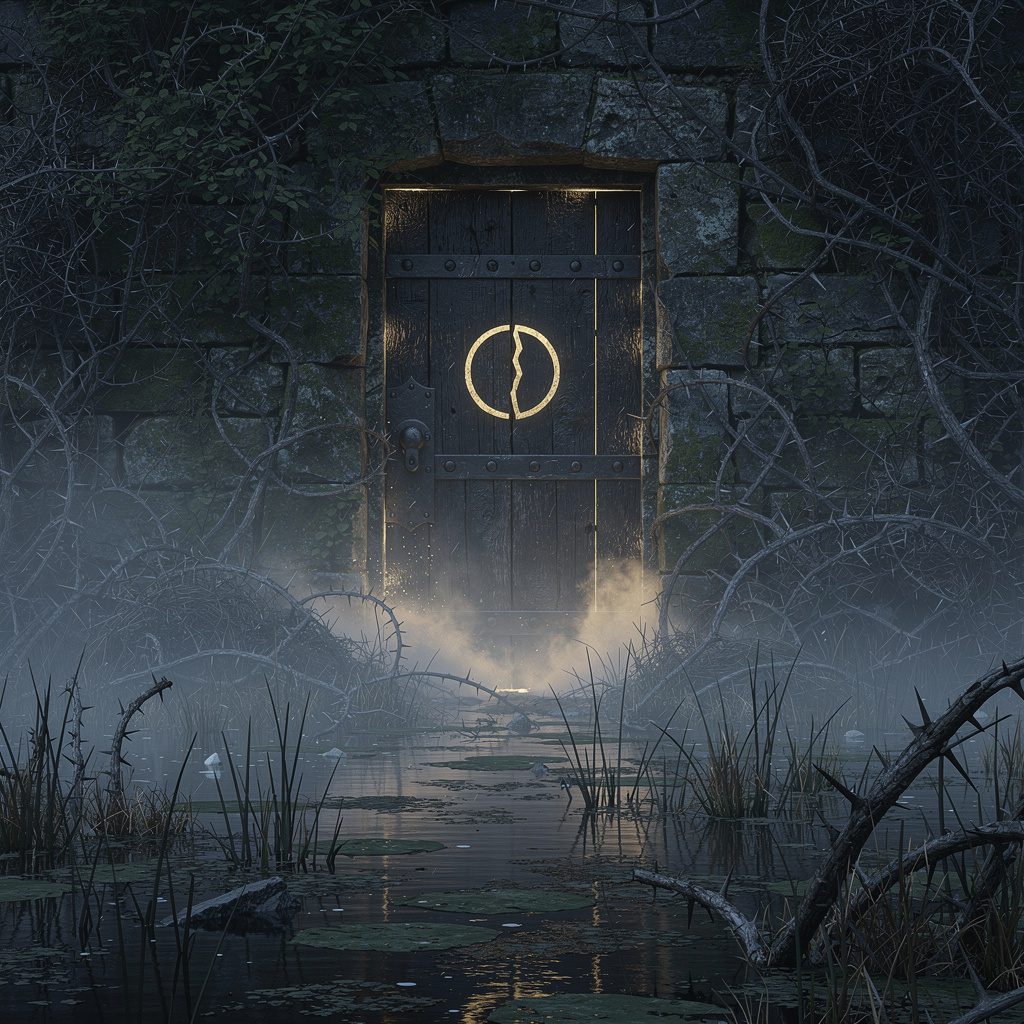
I need to pause here and tell you what the door actually was, because the four of us — yes, four, I will get to myself shortly — spent the better part of a day arguing about it, and most of what was said was wrong.
The door was not a portal in the conventional sense. It was not a gate between worlds, not a threshold to a spirit realm, not a passage to anywhere that existed on a map, even a correct one. What it was, as best I can reconstruct from my notes and from what we each experienced, was a kind of distillation. A place where something essential had been concentrated, the way a good reduction on a slow fire becomes more itself than the thing it started as.
The symbol on it — the broken circle — appears in three texts I know of, all of them pre-Aldenmere, all of them concerning what the old herbalists called the grief-root: a plant that grows only where something has been buried and mourned for, a plant that has no medicinal use but that draws certain kinds of old magic the way iron draws lightning.
The door was made of grief-root wood.
And it only opened for someone who had genuinely lost something they could not recover.
—
Josette found the others at the bank. She had followed a path she could not have described if asked — an instinct, a pull, the kind of navigation that operates below language. She arrived with her notebook and her satchel and her wax pencil and found Callum already trying to push the door open with his shoulder, which was not working.
“Stop,” she said.
He stopped, more from surprise at her tone than obedience.
“Who are you?” Daichi asked.
“Josette Manswell. My mother owned the apothecary that burned. I’ve been studying this symbol for three weeks.” She held up her notebook. The sketch was precise, detailed, annotated in a cramped hand. “You won’t open it by force.”
Verona looked at the notebook. Then at Josette. “How does it open?”
“I think,” Josette said, and she hesitated in a way that made clear she did not often hesitate, “I think you have to have lost something real. And you have to know it. Not pretend you haven’t. Not file it away and call it assessment.”
Silence.
The marshes made their sounds around them — the creak of reed stems, the distant call of a marsh bird, water moving over stone in the slow, patient way water has.
Callum said, quietly: “I lost my daughter. Four years ago. Fever.” He said it the way a person says a thing they have said many times in private and almost never aloud.
He put his hand on the door.
It opened.
—
What was inside is harder to describe than the door itself. The space beyond was small — barely larger than a generous closet — and it smelled overwhelmingly of grief-root: dark, resinous, the way deep forest smells after rain, with something under it that was almost sweet and almost wrong. The walls were lined with small objects. A child’s wooden toy. A ring. A bundle of dried flowers, brown with age. A letter, folded and refolded until the creases had worn soft as cloth.
They were not random objects. Each one had been placed with deliberate care on a narrow shelf that ran the full circumference of the space, and each one was accompanied by a small card, handwritten in different hands across what must have been many years. The cards did not say names. They said things like: she sang every morning and I cannot remember the melody now, and: his boots are still by the door and I cannot move them, and: I planted the seeds she gave me and they grew and I had no one to tell.
In the center of the space, on a low stone plinth, was a single glass vessel. It was the size of a large fist, sealed with dark wax, and inside it something moved — not liquid, not smoke, but something between the two, slow and luminous, the pale gold of late afternoon light through leaves.
Josette reached for it.
“Don’t,” Daichi said, sharp.
“It’s what we came for.”
“We don’t know what it is.”
“I do,” said a voice. Mine. I stepped in from the doorway — I had been standing in the blackthorn, I had been there the whole time, I had been trying to decide whether to speak. “It is a grief-distillate. Old alchemy. The kind that requires decades to mature. Someone built this space and spent a long time filling it with loss, and what you are looking at is what loss becomes when it is kept carefully and not wasted.”

 WhatsApp
 Telegram
 Email







Categories
- AI & Technology
- Contemporary
- Corporate Control
- Creepypasta
- Crime Thriller
- Cyberpunk
- Dark Fantasy
- Enemies to Lovers
- Fairy Tale Retelling
- Fantasy
- First Contact
- Forbidden
- Genetic/Body Horror
- High Fantasy
- Monster Hunter
- Mythic/Folklore
- Paranormal
- Portal/Otherworld
- Post-Apo
- Post-Collapse Society
- Psychological Thriller
- Romances
- SCI-FI
- Second Chance
- Slow Burn
- Space Combat
- Spacepunk
- Surveillance State
- Survival Thriller
- Thrillers
- Time Travel
- Treasure Hunter
- Urban Fantasy
- Witchcraft/Curses
Tags
10min stories atmospheric atmospheric fantasy atmospheric fiction contemporary romance Creepy creepypasta crime thriller dark fantasy debt dystopia emotional fiction enemies to lovers ensemble cast epistolary fantasy female protagonist first person forbidden romance framed narrative high fantasy love story magic Memory mystery Paranormal psychological horror psychological thriller romance sci-fi second chance second chance romance short fiction short story slow burn space station speculative fiction supernatural Survival survival thriller suspense thriller travel romance witchcraft workplace romance
Leave a Reply