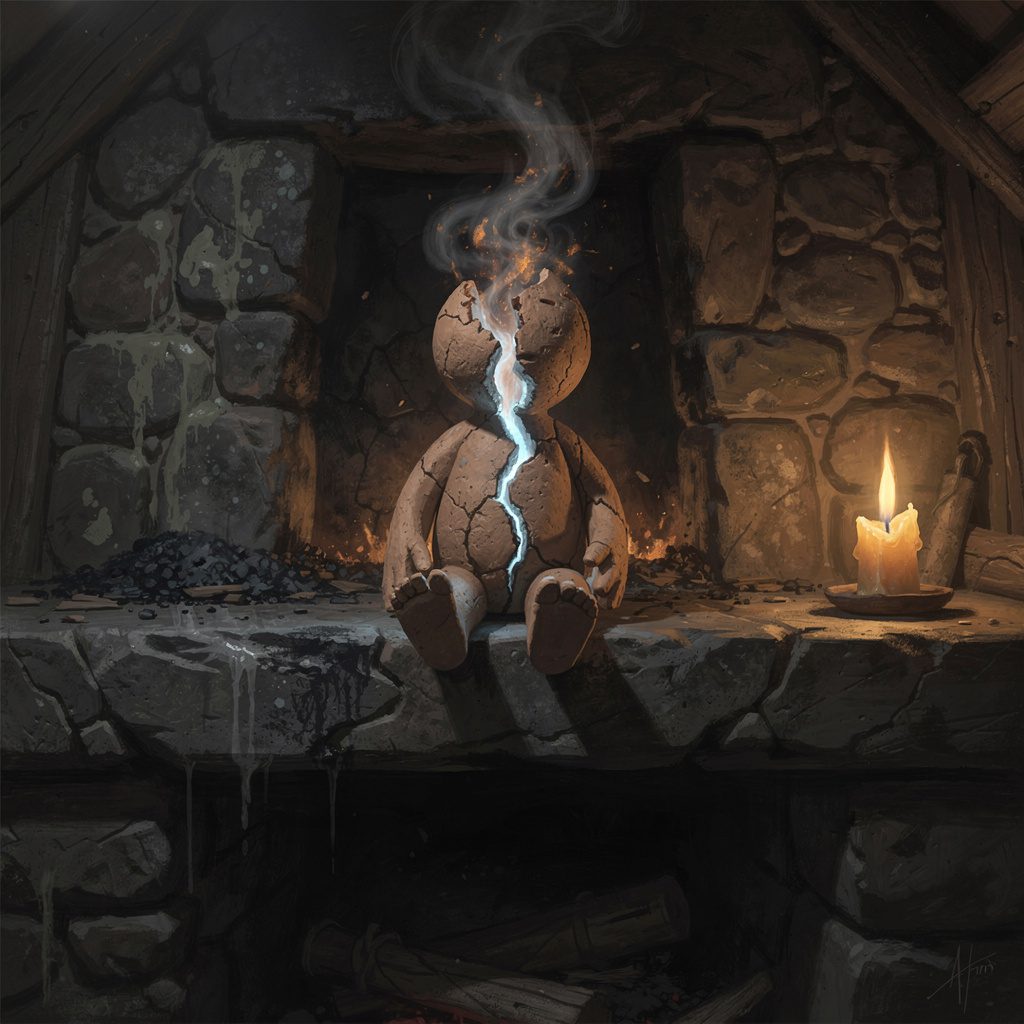
But Anwar’s hand did not lift from it immediately. She stayed kneeling, her palm pressed to the broken figure, and Pallavi saw that the mark on Anwar’s hand was glowing with that same cold light, and that it was not fading the way the figure’s light had faded. It was deepening. The curse, in its last moment of coherence, had done the only thing left available to it: it had pulled back into its carrier’s mark, back into the skin where it had always had a foothold, and it was trying to re-anchor there. Anwar made a sound that was not quite a cry. Her hand pressed harder against the clay. Her voice continued, lower now, rougher, the words coming with visible effort. Pallavi crossed the room in two steps and placed both her hands over Anwar’s — not to do the unbinding herself, which she could not, but to add her own trained resistance to the pull, to be a counterweight, to hold the line while Anwar finished the work.
The light in the mark went out.
The smoke stopped.
Anwar stayed kneeling for a long time after, her hand still pressed to the broken clay, her breathing unsteady. When she finally lifted her palm and turned it toward the hearth’s faint remaining warmth, the mark was gone. Not faded. Gone. The skin was clean and slightly reddened, like skin that has been pressed hard against something for too long, and that was all. Pallavi stood back and looked at the empty hearth and the cracked clay figure and the cold chimney above them and said nothing for a while, because there was nothing that needed to be said immediately. Outside, the rain continued. The cottage had already begun to feel smaller, its oppressive warmth entirely gone, just a damp and neglected room with crumbling plaster walls and a hearth full of old ash.
Anwar stayed in Ashkeld. Not permanently — she was clear about that when she spoke to Osborne the next morning, Pallavi standing beside her as a kind of witness. She would stay through the winter, she said, to make certain the unbinding held, to be present if any residue of the curse surfaced in the children who had been affected. She said it in the tone of a person paying a debt they know cannot be fully paid, which is the only honest tone available for such things. Osborne looked at her for a long time with his red, sleepless eyes, and then he nodded, once, and that was that. Pallavi took her coin and her pack and left Ashkeld before noon, walking back up the ridge road in the thin winter light. She did not look back at the village, or at the tanner’s cottage with its cold and silent chimney. She had done what she came to do. The cost of it — Anwar’s eight years, the missing child, the sleepwalking, the burned palm — was not hers to carry. She carried it anyway, a little, the way you carry the weight of a door you have finally managed to close.

 WhatsApp
 Telegram
 Email







Categories
- AI & Technology
- Contemporary
- Corporate Control
- Creepypasta
- Crime Thriller
- Cyberpunk
- Dark Fantasy
- Enemies to Lovers
- Fairy Tale Retelling
- Fantasy
- First Contact
- Forbidden
- Genetic/Body Horror
- High Fantasy
- Monster Hunter
- Mythic/Folklore
- Paranormal
- Portal/Otherworld
- Post-Apo
- Post-Collapse Society
- Psychological Thriller
- Romances
- SCI-FI
- Second Chance
- Slow Burn
- Space Combat
- Spacepunk
- Surveillance State
- Survival Thriller
- Thrillers
- Time Travel
- Treasure Hunter
- Urban Fantasy
- Witchcraft/Curses
Tags
10min stories atmospheric atmospheric fantasy atmospheric fiction contemporary romance Creepy creepypasta crime thriller dark fantasy debt dystopia emotional fiction enemies to lovers ensemble cast epistolary fantasy female protagonist first person forbidden romance framed narrative high fantasy love story magic Memory mystery Paranormal psychological horror psychological thriller romance sci-fi second chance second chance romance short fiction short story slow burn space station speculative fiction supernatural Survival survival thriller suspense thriller travel romance witchcraft workplace romance
Leave a Reply