Pallavi listened to all of it with her hands wrapped around her tea and her eyes on the table. When Osborne finished, she asked only one question: “Does anyone go to the cottage voluntarily?” He hesitated. That hesitation lasted just long enough to tell her the answer was yes, and that he did not want to say so. She waited. He said, finally, that a woman had arrived in the village about three months ago, before any of it started — or perhaps just as it started, he could not be sure of the exact timing. She had taken a room at the inn. She gave her name as Anwar, which was a man’s name, and no one had asked her about it. She spent her days in her room or walking the valley roads alone. She had not done anything wrong, precisely. But she had been seen, twice, standing at the edge of the lane that led to the tanner’s cottage, just standing there, looking at it. Osborne said this in the tone of a man presenting evidence at a trial he did not want to be presiding over.
Pallavi found Anwar at the inn that afternoon. She was younger than Pallavi had expected — perhaps thirty, perhaps less — with a long, angular face and close-cropped hair and the particular stillness of someone who had learned to take up as little space as possible. She was sitting at the window table with a cup of something hot, and she looked up when Pallavi sat down across from her without invitation, and she did not look surprised. She looked, instead, like someone who had been waiting for exactly this. That was the first thing that made Pallavi careful. The second was that Anwar’s hands, folded on the table, bore the faintest trace of a circular mark on the left palm — the same mark the returned child had been wearing, except older, faded to near-invisibility, the kind of thing you would only see if you were looking for it in good light. Pallavi was looking for it. She saw it. She said nothing about it yet.
They talked for a long time, the afternoon light shifting from pale gold to amber to the flat grey of cloud-cover coming in from the north. Anwar spoke carefully, in the way of someone who had rehearsed a story and was now deciding in real time how much of it to actually tell. She said she had come to Ashkeld because she was following the smoke — the same smoke Pallavi had come to investigate. She said she had seen it from a distance, from a road three valleys over, and had known what it was. When Pallavi asked her how she had known, Anwar looked at her left hand for a moment, just a flicker of a glance, and then looked back up. She said, “Because I made it.”
The silence after that was the kind that has weight.
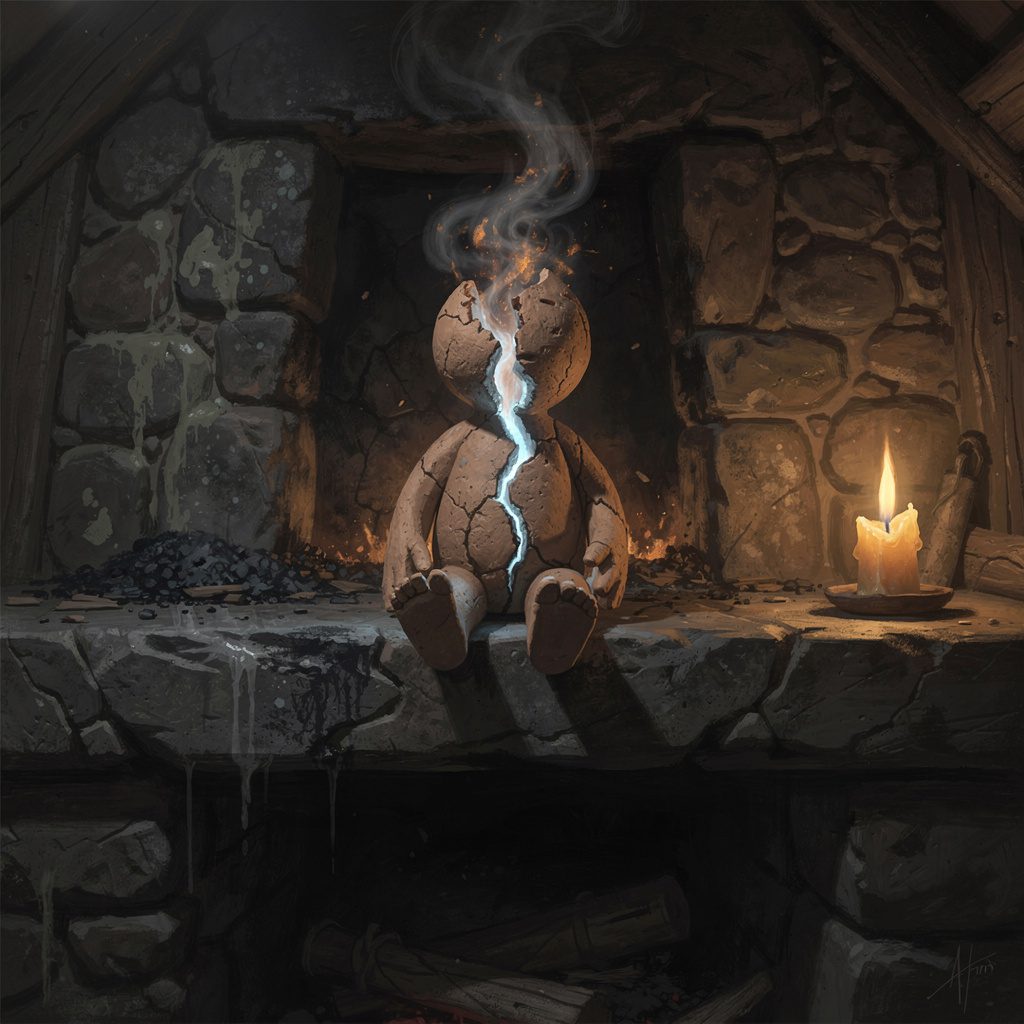
Anwar’s story came out in the long, difficult way of things that have been kept compressed for too long — expanding slowly, with pressure, into the available space. She had been a witch’s apprentice in a city three weeks’ travel to the south, a city called Vethara that sat on a river delta and smelled of salt and dye-works and the particular sharp sweetness of the flowering vines that grew up every wall. Her teacher had been a woman of considerable power and considerable cruelty, the kind of practitioner who treated knowledge as a form of control. The curse now residing in the tanner’s cottage — and it was a curse, Anwar confirmed this flatly, without drama — had originally been cast by that teacher, bound into an object and sent north as a commission for someone Anwar had never met, someone who had wanted a specific and terrible thing done to this specific and unremarkable valley. Anwar had been the one to carry the object north. She had been twenty-two. She had not understood, fully, what she was carrying. When she had understood, she had been too far north to turn back, and too frightened of her teacher to refuse, and she had left the object at the tanner’s cottage because the tanner had already been dead for years and the cottage was empty and she had told herself, with the particular self-deception of someone who is very frightened, that an empty cottage was a safe enough place, that the curse needed a host to activate, that no one would be harmed. She had been wrong. She had known she was wrong even as she told herself she was right. She had spent eight years since then moving from place to place, unable to stay anywhere long, unable to undo what she had done because unbinding required access to the original object and she had not been able to make herself go back into that cottage. The mark on her palm was from the day she had carried the object — the curse had recognized her as its carrier and left its signature on her skin. A reminder. A leash, almost.

 WhatsApp
 Telegram
 Email







Categories
- AI & Technology
- Contemporary
- Corporate Control
- Creepypasta
- Crime Thriller
- Cyberpunk
- Dark Fantasy
- Enemies to Lovers
- Fairy Tale Retelling
- Fantasy
- First Contact
- Forbidden
- Genetic/Body Horror
- High Fantasy
- Monster Hunter
- Mythic/Folklore
- Paranormal
- Portal/Otherworld
- Post-Apo
- Post-Collapse Society
- Psychological Thriller
- Romances
- SCI-FI
- Second Chance
- Slow Burn
- Space Combat
- Spacepunk
- Surveillance State
- Survival Thriller
- Thrillers
- Time Travel
- Treasure Hunter
- Urban Fantasy
- Witchcraft/Curses
Tags
10min stories atmospheric atmospheric fantasy atmospheric fiction contemporary romance Creepy creepypasta crime thriller dark fantasy debt dystopia emotional fiction enemies to lovers ensemble cast epistolary fantasy first contact first person forbidden romance framed narrative high fantasy love story magic Memory mystery Paranormal psychological horror psychological thriller romance sci-fi second chance second chance romance short fiction short story slow burn space station speculative fiction supernatural Survival survival thriller suspense thriller travel romance witchcraft workplace romance
Leave a Reply