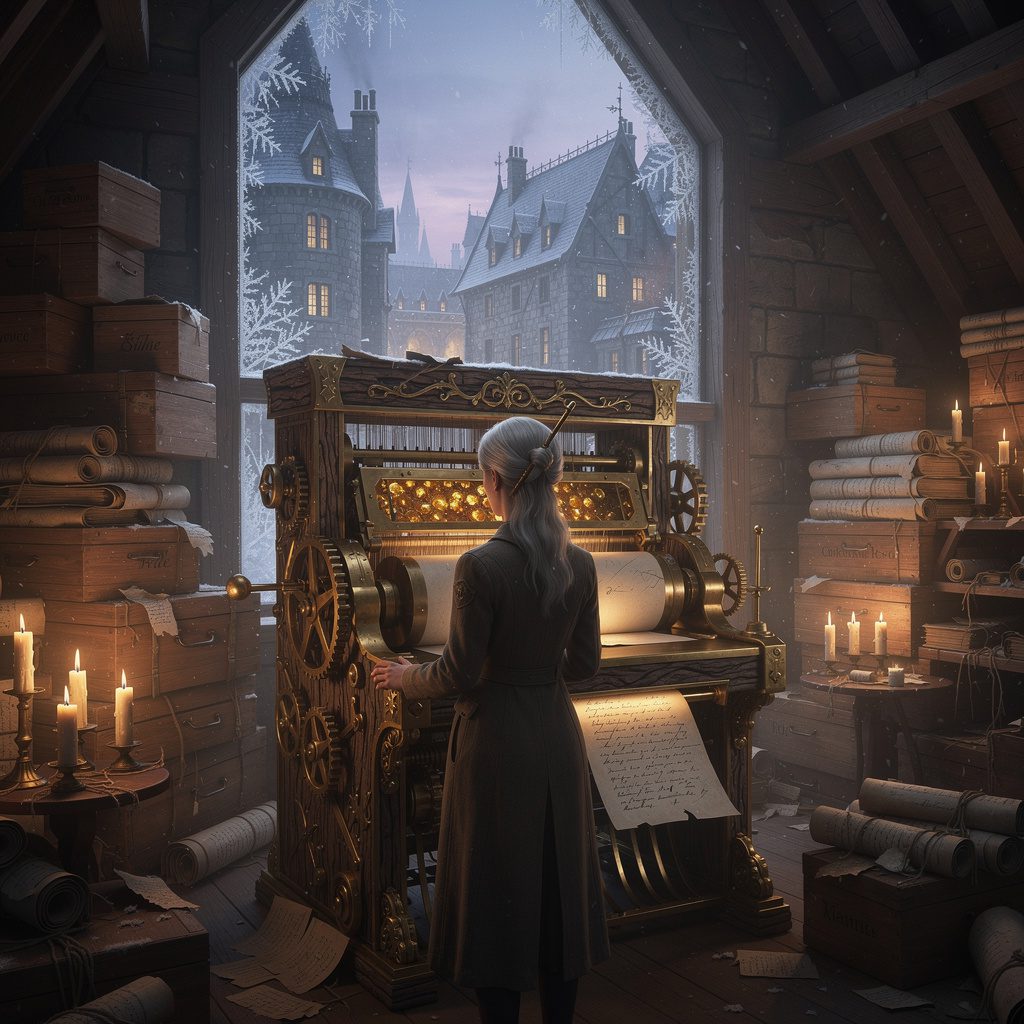
Verity had said, with considerable composure, “Who are you.” It was not a question, quite. It was the sound of a person already understanding that the answer would be unsatisfying.
“Someone who has read ahead,” he said. And then he left.
She had opened the manuscript.
It was her own.
Not a story she had written — she had never written a story, only completed the stories of others. But this was hers in the way that a reflection is yours: it contained her life, rendered in a handwriting she did not recognize, describing events she had lived but never recorded. Her first day in the attic. The fisherman’s manuscript, which she had completed in her second year, the true ending of which had made her cry in a way she had not cried since childhood. The grandmother’s garden passage, which she had sat with for three years before the Loom hummed its approval. Page after page of her life, accurate in every particular, written with the kind of attention that only comes from very long watching. And then, one hundred and twelve pages in, the manuscript stopped. The last line read: She had not yet decided what the garden was for.
Verity did not know what this meant. She did not know what garden. She had no garden. She lived in an attic.
But she felt it — the way she felt a true ending approaching in someone else’s work, that low resonant hum beneath the breastbone — and she understood that the manuscript was not describing a literal garden. It was describing something she had been growing in herself for fourteen years without naming it, without telling anyone, without even fully admitting it to her own interior. And the Loom, apparently, required her to name it before it would accept the page.
I told you I was at the edges. I should tell you now: I am the grandmother. Not a ghost — nothing so dramatic. The Loom completed my story six years ago, and completion, as it turns out, does not mean ending. It means the loose thread is finally woven in. I have been part of the Loom’s mechanism ever since, in the way that a gear becomes part of an engine: not lost, but incorporated. I watched Verity sit with my garden passage for three years. I watched her find the true ending for it — the one I could not reach myself, which was that the garden was the only place I had ever felt I was allowed to simply exist without performing usefulness for anyone. She found that. She rang it true. And because she did, I have been watching over her work ever since, the way a well-made part watches over the machine it belongs to. The stranger in the canal-colored coat is not mine to explain. Some mechanisms are older than I am.
Two minutes.
Verity’s hands were on the manuscript. The Loom was wound — she had wound it at dawn, as always, the forty-seven-turn clockwise rotation of the main wheel, the three-quarter counter-turn of the secondary lever, the small percussive tap on the feed-tray that the manual called optional and that Verity had long since determined was not optional at all. The machine was ready. It was waiting for her to feed the last page. The last page was blank. She had to write the ending herself — not invent it, complete it — and she had spent eight days circling the question of the garden like a person circling a room they are afraid to enter.
She picked up the brass stylus.
The garden, she thought. What is the garden.
And then — because the Loom was humming, because the hum was in her chest, because fourteen years of learning to hear truth had not, it turned out, left her entirely deaf to her own — she knew.

 WhatsApp
 Telegram
 Email







Categories
- AI & Technology
- Contemporary
- Corporate Control
- Creepypasta
- Crime Thriller
- Cyberpunk
- Dark Fantasy
- Enemies to Lovers
- Fairy Tale Retelling
- Fantasy
- First Contact
- Forbidden
- Genetic/Body Horror
- High Fantasy
- Monster Hunter
- Mythic/Folklore
- Paranormal
- Portal/Otherworld
- Post-Apo
- Post-Collapse Society
- Psychological Thriller
- Romances
- SCI-FI
- Second Chance
- Slow Burn
- Space Combat
- Spacepunk
- Surveillance State
- Survival Thriller
- Thrillers
- Time Travel
- Treasure Hunter
- Urban Fantasy
- Witchcraft/Curses
Tags
10min stories atmospheric atmospheric fantasy atmospheric fiction contemporary romance Creepy creepypasta crime thriller dark fantasy debt dystopia emotional fiction enemies to lovers ensemble cast epistolary fantasy female protagonist first person forbidden romance framed narrative high fantasy love story magic Memory mystery Paranormal psychological horror psychological thriller romance sci-fi second chance second chance romance short fiction short story slow burn space station speculative fiction supernatural Survival survival thriller suspense thriller travel romance witchcraft workplace romance
Leave a Reply