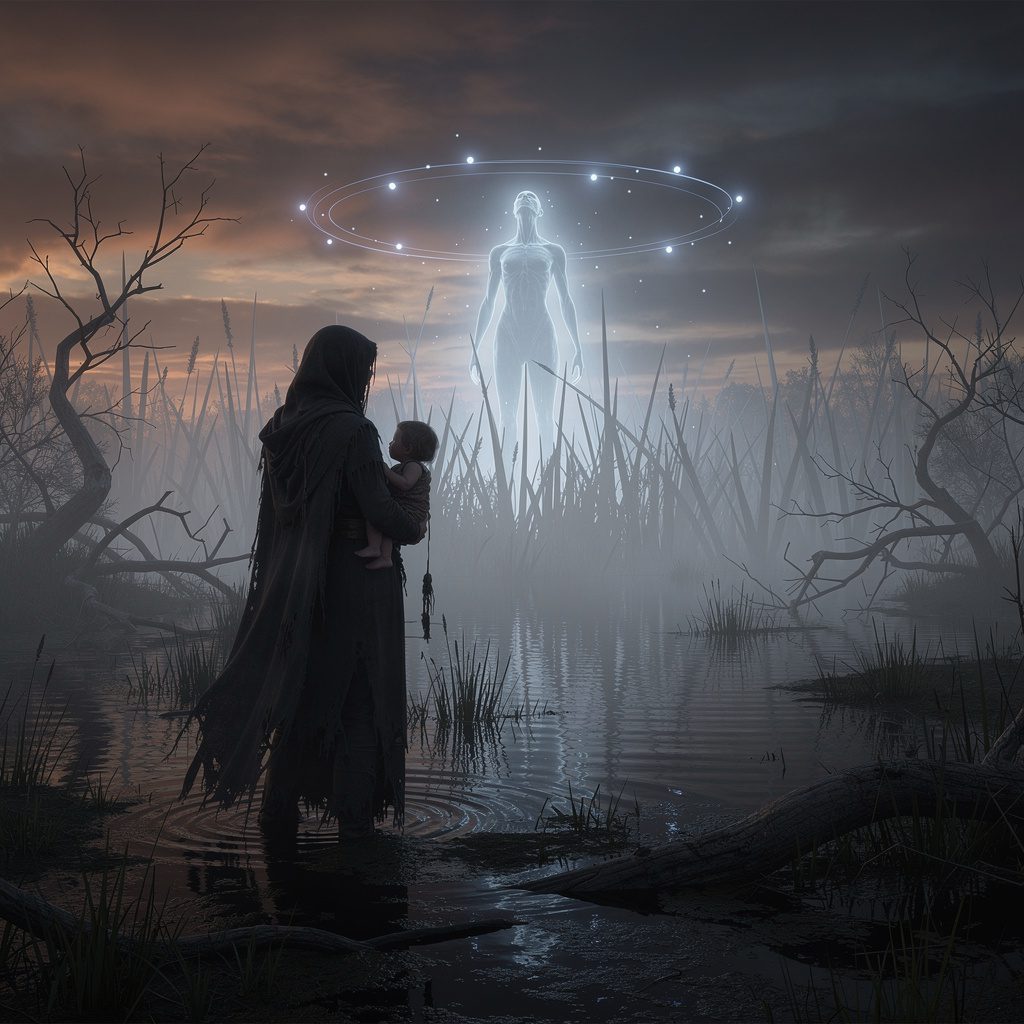
It steps into the open water between two islands, and Aditi’s breath locks in her chest so completely that her vision sharpens at the edges the way it does when the body prepares for something it cannot name. The creature is tall — taller than a man by a full head — and its limbs are wrong in the way the shepherd described, the joints bending a half-beat after the motion that should require them to bend, as though the body is translating instructions from somewhere slightly outside itself. Its skin, if it is skin, is the color of waterlogged birch bark, pale and peeling at the shoulders and forearms, and beneath the peeling edges there is not muscle or bone but a faint luminescence, the same cold blue-white as the false fireflies, as though whatever is inside it is made of the same light. Its face — and it has a face, that is the unbearable part, it has a face arranged in the configuration of a human face — is turned away from her, tilted up toward the darkening sky with an expression she cannot read from this angle but which, from the set of the jaw and the particular tension in the throat, she recognizes as grief. She has worn that expression herself. She knows it the way she knows the weight of her own crossbow.
She does not fire.
This is not softness. This is information-gathering, which is what she tells herself, and it is partly true.
She watches it for a long time. It does not hunt. It does not search the marsh for prey. It stands in the black water up to its strange knees and it makes a sound she was not expecting — low, rhythmic, almost tuneless — the shape of a lullaby with all the melody removed, just the cadence left behind. The sound travels across the water and does something to the air that she cannot quantify but can feel in the back of her teeth. The false fireflies drift toward it. They do not touch it. They orbit it at a fixed distance, cold and patient, as though they are waiting for a decision.
Aditi has read every text the hunters’ archive in Ashenveil holds on the subject of the Duskfen’s recorded phenomena. She has read about the Hollow-Kin — spirits of the drowned that sometimes accumulate enough grief to pull themselves into a physical form, borrowing mass from the marsh itself, the peat and the cold water and the pale wood of submerged trees. The archive is careful to note that the Hollow-Kin are dangerous not because they are malicious but because they are confused. They remember being human with perfect fidelity. They remember love, specifically. And they seek it with the single-mindedness of something that no longer has a body built for subtlety, and the seeking is what kills — not intent, but the terrible gap between what they were and what they have become.
The child from Sorren’s Hollow. She has not let herself think about the child directly, keeping that fact in the outer room of her mind, but now it moves to the center and she cannot look away from it. Gone. Not found. The elders did not say dead because no body was found, and she has been carrying the ambiguity of that like a second crossbow, loaded.
She steps out of the oak’s hollow. One step, then two, into the marsh-edge mud that takes her boot to the ankle with a cold, specific grip.
The creature turns.
Its face, full-on, is worse and better than she prepared for. The features are assembled correctly — eyes, nose, mouth, the architecture of a human face — but the eyes are entirely the cold blue-white light, no iris, no pupil, just two steady lamps burning in the borrowed dark of a face that belongs to no one. It looks at her with those impossible eyes and it does not threaten her. It makes a sound, a single syllable, and the syllable is not a word in any language she speaks but it carries the unmistakable inflection of a question.
“I know,” she says, which is not what she planned to say. She planned to say nothing. “I know what you’re looking for.”
It takes a step toward her. The water around its foot goes still in a perfect circle, as though the marsh is holding its breath.

 WhatsApp
 Telegram
 Email






Categories
- AI & Technology
- Contemporary
- Corporate Control
- Creepypasta
- Crime Thriller
- Cyberpunk
- Dark Fantasy
- Enemies to Lovers
- Fairy Tale Retelling
- Fantasy
- First Contact
- Forbidden
- Genetic/Body Horror
- High Fantasy
- Monster Hunter
- Mythic/Folklore
- Paranormal
- Portal/Otherworld
- Post-Apo
- Post-Collapse Society
- Psychological Thriller
- Romances
- SCI-FI
- Second Chance
- Slow Burn
- Space Combat
- Spacepunk
- Surveillance State
- Survival Thriller
- Thrillers
- Time Travel
- Treasure Hunter
- Urban Fantasy
- Witchcraft/Curses
Tags
10min stories atmospheric atmospheric fantasy atmospheric fiction contemporary romance Creepy creepypasta crime thriller dark fantasy debt dystopia emotional fiction enemies to lovers ensemble cast epistolary fantasy female protagonist first person forbidden romance framed narrative high fantasy love story magic Memory mystery Paranormal psychological horror psychological thriller romance sci-fi second chance second chance romance short fiction short story slow burn space station speculative fiction supernatural Survival survival thriller suspense thriller travel romance witchcraft workplace romance
Leave a Reply