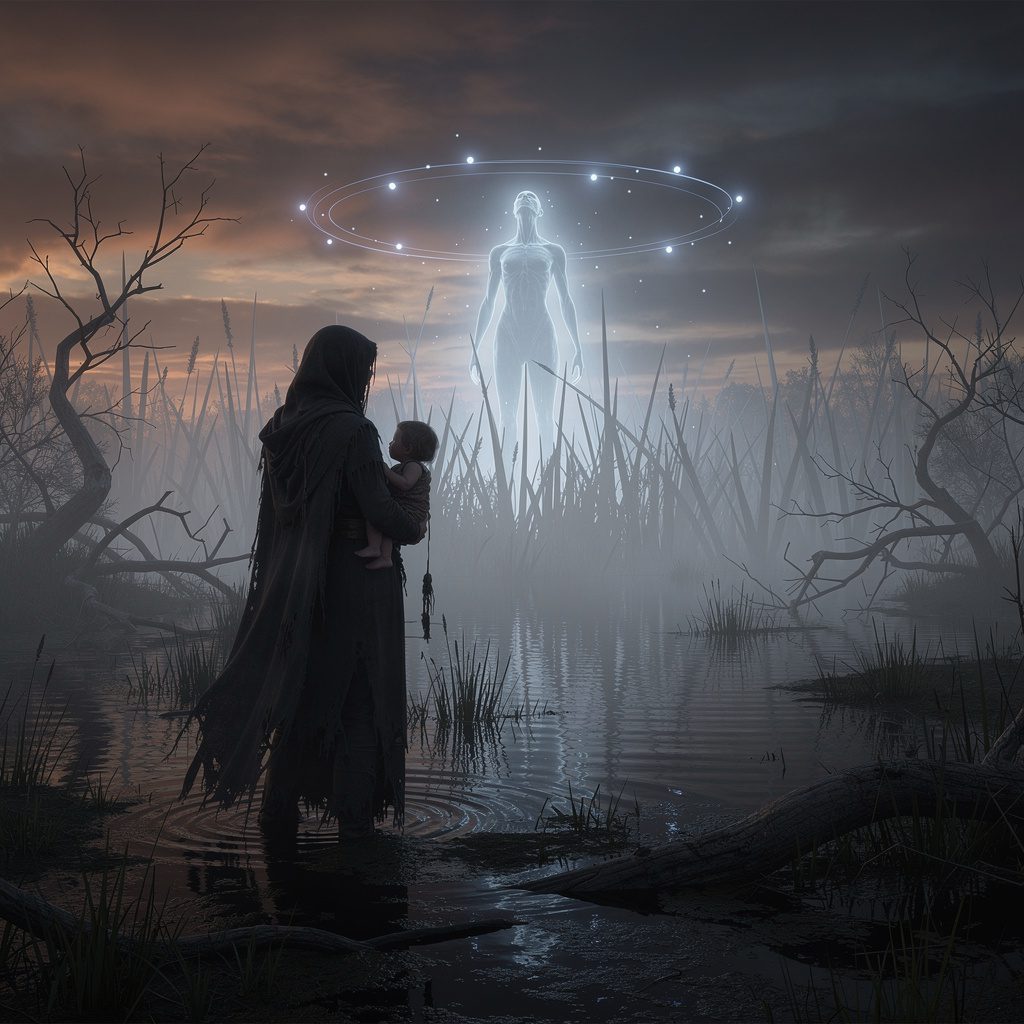
The candle on Aditi’s windowsill has been burning for eleven days without melting. She noticed it the morning she left Ashenveil, the way the wax stayed perfectly cylindrical, pristine, as though the flame fed on something other than tallow. She did not think much of it then. She thinks about it now, crouched in the hollow of a lightning-split oak at the edge of the Duskfen marshes, listening to the thing move through the reeds forty paces ahead of her, and she understands at last what the candle was trying to tell her: some things burn without being consumed, and that is not always a mercy.
She has been a hunter for nine years — long enough to know the difference between a creature and a person by the sound of their footsteps alone. Creatures are efficient. They place their weight with biological certainty, each step a calculation of survival. People hesitate. People pause at the wrong moments, distracted by memory or guilt or the distant call of something they once loved. The thing moving through the Duskfen hesitates. It pauses. And that is the problem Aditi has been carrying in her chest like a stone for the past four days, ever since she picked up the trail outside the village of Sorren’s Hollow, where three goats and one child had gone missing in a single moonless night. The village elders described a shadow with too many joints. The surviving shepherd described something that stood at the tree line for a long moment before it ran, and the way it stood — the way it held its shoulders — reminded him, and he was ashamed to say this, of his own brother who had drowned in the mill-race ten years ago.
Aditi is not ashamed of anything yet. That is a hunter’s discipline: shame is a door you keep closed until the job is finished.
The marsh breathes around her. There is no better word for it — the Duskfen exhales in slow, wet pulses, releasing pockets of rot-sweet air from beneath the peat, so that every few minutes the smell changes from cold mineral mud to something almost floral, almost like the dried marigolds her grandmother kept in a clay pot above the hearth. It is disorienting in the way of things that are almost familiar. The reeds stand eight feet tall and move in a wind she cannot feel from inside the oak’s hollow, their pale seed-heads catching the last copper light of a sun that has been setting for what feels like an hour. The water between the reed-islands is perfectly black and perfectly still. Fireflies — or things that behave like fireflies — drift at knee height above the surface, their light a cold blue-white rather than the warm amber she grew up with, and they do not blink in any rhythm she can pattern. She has been watching them for twenty minutes, half-hoping to use their movement to triangulate the creature’s position, and they have told her nothing useful except that this marsh does not follow ordinary rules.
She hears it again. Not a splash — something more careful than a splash. A displacement, a single deliberate weight-shift in shallow water, and then silence that is somehow louder than the sound was.
Her crossbow is already raised. She built it herself, compact and recurved, the stock worn smooth along the grip from nine years of exactly this posture. The bolt is tipped with saltstone — ground mineral from the quarries above Halvenmoor, effective against most things that shouldn’t exist. She has three bolts left. She used one on a false alarm two nights ago, a river-stag that moved like something cursed but turned out to be merely old and arthritic, and she has not forgiven herself for the waste.
Then the reeds part.

 WhatsApp
 Telegram
 Email






Categories
- AI & Technology
- Contemporary
- Corporate Control
- Creepypasta
- Crime Thriller
- Cyberpunk
- Dark Fantasy
- Enemies to Lovers
- Fairy Tale Retelling
- Fantasy
- First Contact
- Forbidden
- Genetic/Body Horror
- High Fantasy
- Monster Hunter
- Mythic/Folklore
- Paranormal
- Portal/Otherworld
- Post-Apo
- Post-Collapse Society
- Psychological Thriller
- Romances
- SCI-FI
- Second Chance
- Slow Burn
- Space Combat
- Spacepunk
- Surveillance State
- Survival Thriller
- Thrillers
- Time Travel
- Treasure Hunter
- Urban Fantasy
- Witchcraft/Curses
Tags
10min stories atmospheric atmospheric fantasy atmospheric fiction contemporary romance Creepy creepypasta crime thriller dark fantasy debt dystopia emotional fiction enemies to lovers ensemble cast epistolary fantasy female protagonist first person forbidden romance framed narrative high fantasy love story magic Memory mystery Paranormal psychological horror psychological thriller romance sci-fi second chance second chance romance short fiction short story slow burn space station speculative fiction supernatural Survival survival thriller suspense thriller travel romance witchcraft workplace romance
Leave a Reply