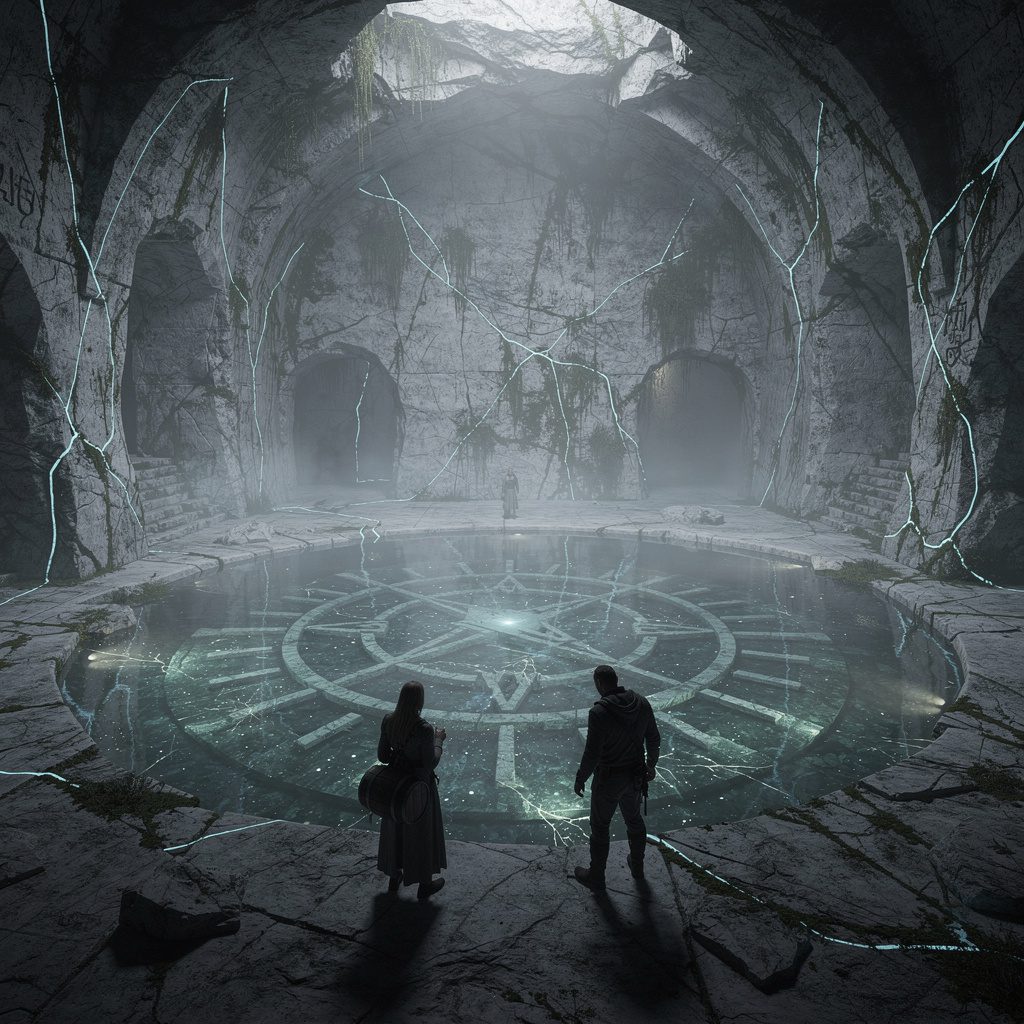
The aquifer’s mouth was not marked on any city map that Yasmin had ever seen, and she had seen most of them. It was accessible through a maintenance passage beneath the river-facing bluffs, down a stair cut directly into the limestone, lit by the faint bioluminescent moss that grew on the walls in thin, blue‑green threads — a species she had catalogued once and filed under useful but not yet understood.
The passage smelled of deep water and old stone and something else that she recognized only when they reached the chamber at the bottom: the same mineral, electric quality as the ink in the cask, but enormously amplified, as though the cask had been a single drop of something and this was the source.
The chamber was roughly circular, its ceiling lost in darkness above the reach of the moss‑light, its floor sloping gently toward a wide, still pool that reflected the blue‑green glow in perfect, undisturbed silence. In the center of the pool, just below the surface, a shape was visible — not a creature, not an object, but a configuration of the stone itself, a knot in the bedrock that looked almost deliberate, almost deliberate in the way that the best natural formations do, the ones that make you understand why people used to believe the earth itself was thinking.
Oskar stopped at the pool’s edge. He turned to look at her, and in the moss‑light his river‑sediment eyes were almost luminous, and for the first time she saw something in them that was not calculation. It was old, stubborn grief — the kind that has been carried so long it has become structural, load‑bearing, impossible to set down without the whole architecture of the person collapsing.
“I need to tell you something,” he said, “before we do this.”
She waited.
“I’ve been here before,” he said. “Not this life. My father came down here, twenty years ago, trying to find a way to break the pact before it woke up. He thought if he could reach the sealed thing first, he could negotiate independently. The Emissary found out. My father didn’t come back up.” He looked at the pool. “I don’t know what’s down there. I don’t know what we’re releasing. I told you it was something old. That’s true. But I don’t know if it’s safe. I don’t know if either of us will be fine after we speak the words. I should have told you that before I brought you here, and I didn’t, and I’m telling you now because I think you deserve to decide.”
The moss breathed its cold blue light. The pool did not move.
Yasmin stood very still for a moment, holding the cask in both hands, feeling the warmth that had been building in it since they entered the chamber — a warmth that was not heat exactly but something closer to intention, the way a living thing radiates purpose even in stillness.
She thought about her workshop. She thought about the eleven years of layered smells, the glass slides, the quill she had reached for automatically when the cask arrived. She thought about her grandmother’s grandmother, who had apparently been a merchant with steady hands and a talent for impossible situations. She thought about Oskar’s father, who had tried to be clever and had not come back up.
“I know,” she said.
Oskar blinked. “You know?”
“I knew you weren’t telling me everything when you sat down at my bench,” she said, not unkindly. “Your knuckles were white. You kept looking at the cask like it owed you something. I catalogued you the same way I catalogued the ink, and what I found was someone carrying more weight than the story he was telling. I came anyway. The city has seven days of water if we don’t do this. That math hasn’t changed.”
She uncorked the cask. The smell rose up enormous in the enclosed space, filling the chamber completely, and the pool’s surface shivered for the first time.
“Stand beside me,” she said. “Witness.”

 WhatsApp
 Telegram
 Email







Leave a Reply