Two hundred and twelve years earlier, in a room that no longer existed above a street that had since been swallowed by the expanding limestone bluffs, a woman named Karin had made a decision that she believed was practical.
The room had smelled of fever and desperation and the specific, acrid sharpness of a city under siege — Ashenveil’s old walls had been holding for nine days, and the wells were running low, and the thing that called itself an Emissary had been sitting in the courtyard of the civic hall for three of those days, perfectly still, perfectly patient, its form shifting just enough at the edges to remind anyone watching that it was not quite made of the same substance as everything else.
It had come with an offer. The offer was simple: it would still the siege. It would drive the enemy from the walls and seal the old aquifer beneath the city so that the wells would never run dry again. In return, it asked for a service. Not now. Not from Karin. From someone in her line, in the Wold line, at a time of the Emissary’s choosing, when the ink in the pact woke up and told them it was time.
Karin had been a practical woman. The city had seven days of water left. She had signed. The other signatory, a merchant named Fakhoury whose warehouses held the last of the city’s grain stores, had signed beside her, his hand steadier than hers.
They had not discussed what the service might be. They had told themselves, in the way that people in desperate situations tell themselves things, that the Emissary would likely never collect. That the ink would sleep forever. That the practical thing, the only thing, was to survive the present crisis and let the future manage itself.
The siege ended that night. The enemy withdrew without explanation. The wells ran clear for two centuries.
The ink had slept for two hundred and twelve years.
Yasmin listened to Oskar Wold explain all of this with the careful, unhurried attention she gave to every new compound she encountered. She let him talk. She watched his hands, which stayed flat on the table and did not gesture, which she found either very controlled or very practiced. She watched his eyes, which kept returning to the cask. He had known the cask was here before he arrived. She was almost certain of that, though she could not yet prove it.
When he finished, she asked him what the Emissary wanted.
Oskar was quiet for a moment that lasted exactly long enough to be meaningful.
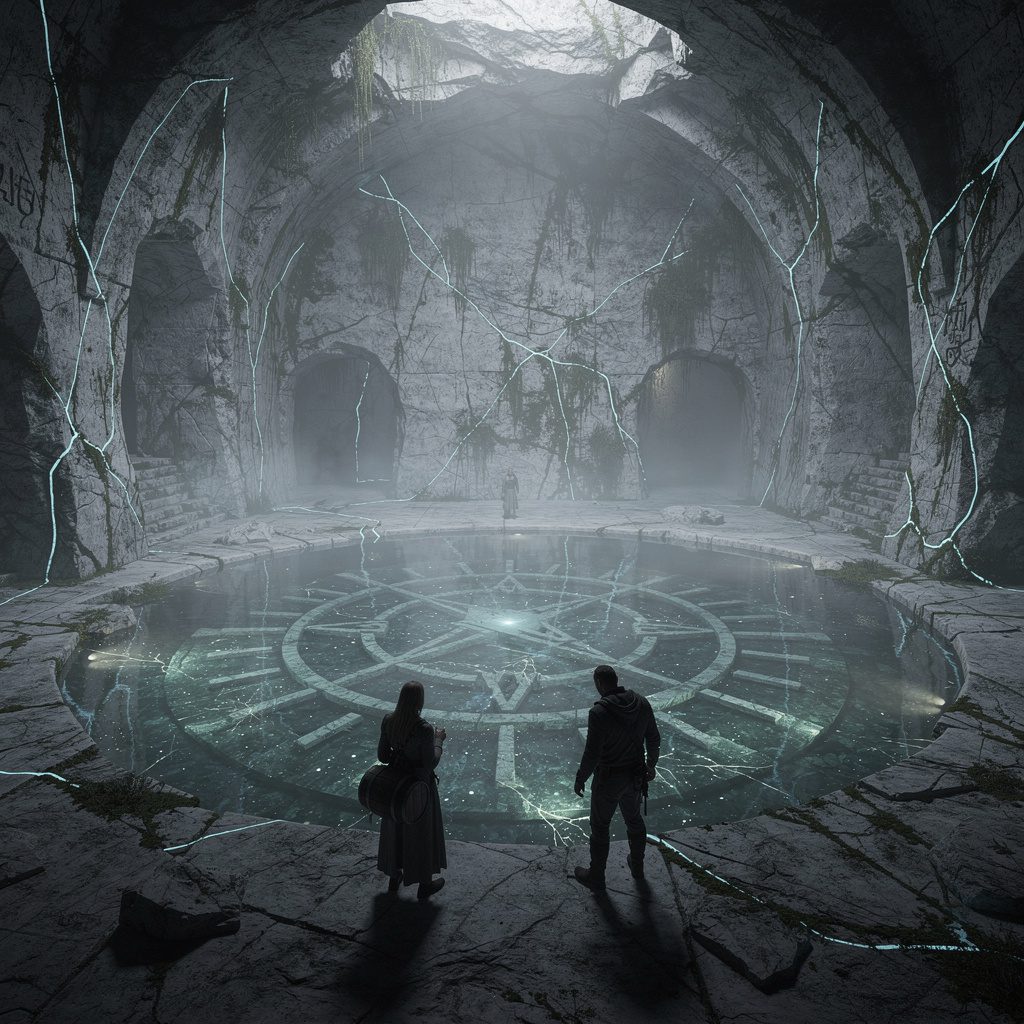
“It wants the aquifer,” he said. “Not the water. The aquifer itself. There’s something sealed inside the stone beneath it — something old. The Emissary sealed it there two centuries ago as part of a different arrangement, one it made before it made ours. Now it wants it back. It needs someone of the Fakhoury line to speak the release, and someone of the Wold line to witness. Together. At the aquifer’s mouth, under the city.”
Yasmin looked at him for a long moment. Then she looked at the cask. The smell coming from it had changed subtly in the hours since she had opened it — less like a storm approaching, more like a storm that had already passed through and left the air rearranged.
“And if we don’t?” she asked.
“The pact unwinds,” Oskar said. “The wells stop running. The aquifer collapses. Ashenveil has seven days of water, same as it did two hundred years ago, except this time there’s no Emissary offering a deal.” He paused. “Or there is, but the terms will be worse.”
She went. Not because she trusted him — she did not, not yet, not entirely. But because she understood the logic of the situation the way she understood the logic of a reaction: certain components, brought together under certain conditions, produced a predictable result whether you wanted them to or not. She was a component. He was a component. The cask was the catalyst. The aquifer was where the reaction would occur.
She packed the cask in her satchel, put on her coat, and followed Oskar Wold down into the lower quarters of Ashenveil, into the damp limestone streets, into the dark.

 WhatsApp
 Telegram
 Email







Leave a Reply