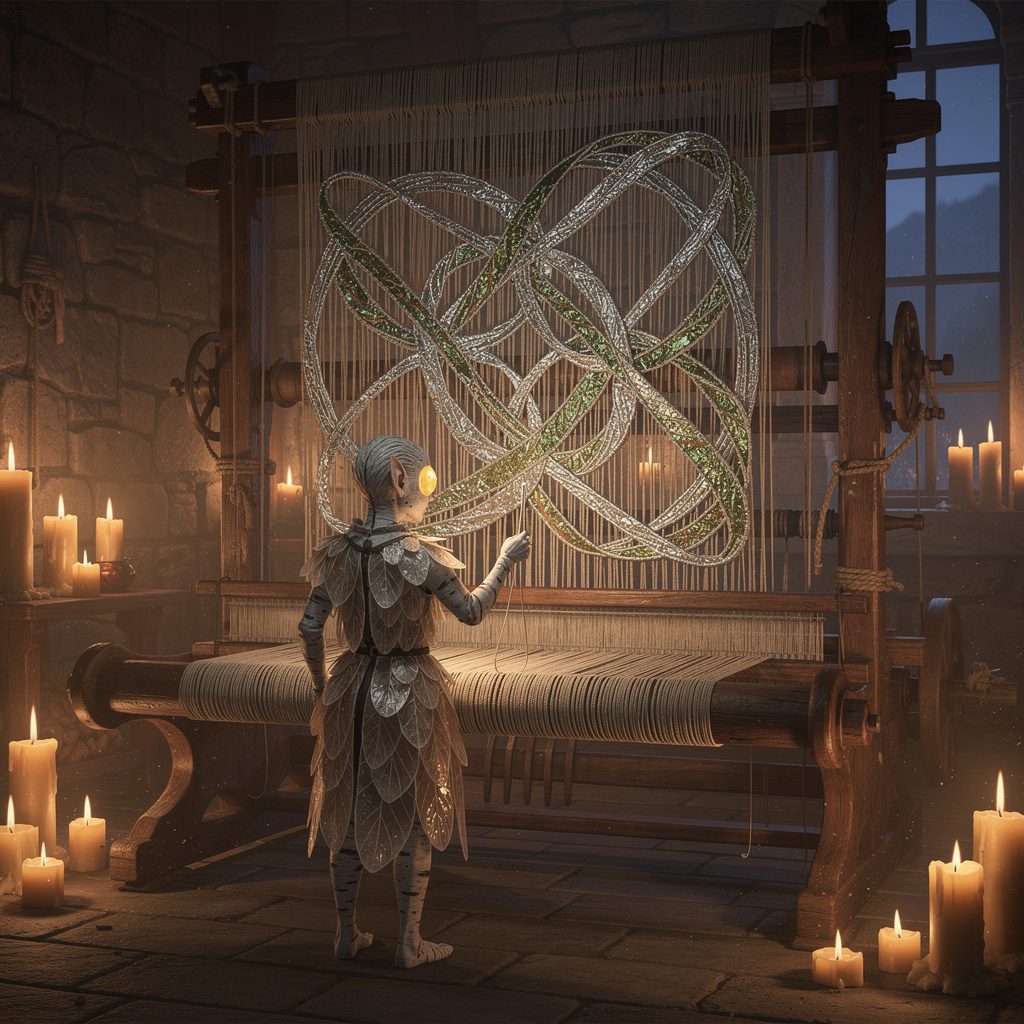
The fae is quiet for a long time. In the silence, the candles flicker, though there is no wind. Outside, the village of Ashveil settles into its evening sounds — a dog, a cart wheel, the distant bell of the mill. Ordinary things. Nabila holds onto them like a lifeline.
“Accepted,” the fae says at last.
It reaches into its coat and produces a small clay disc, marked with a pressed thumbprint. It presses it into Nabila’s palm. The disc crumbles as soon as it touches her skin, leaving nothing but a faint warmth and the smell of turned earth. The knotted cord on the fae’s wrist falls away. All seven knots, even the tight one, simply release.
The debt is gone.
The fae turns back to the tapestry. It reaches out again, and this time it does touch — one fingertip to a silver thread — and the whole tapestry lifts cleanly from the loom as though it has been waiting to leave.
It tucks the tapestry under its arm with the practiced ease of someone who has carried maps across a great many worlds, and moves toward the door.
Nabila watches it go.
“One question,” she says, before it crosses the threshold.
It pauses. It does not turn.
“The original debt. Seven years ago. I was drowning in the millpond. You pulled me out. You said I owed you a debt of equal weight to my life, to be collected at a time of your choosing.” She keeps her voice level. “But you chose to come now. After the tapestry was finished. Not before. Not at any point in seven years when I had nothing to offer you.”
Silence.
“You could have collected any time. A life-debt gives you that right. But you waited.”
The fae turns its head, just slightly. Just enough.
“I told you,” it says, “that I hold a debt until it is paid. I did not say I am in a hurry.”
“You waited because you knew I would build something worth having.”
Another pause. Then, very quietly: “I pulled you from the water because you were twenty-two years old and you were calling out the names of every path through the Thornmere as you went under. You had memorized routes that have been lost for a century. I knew, then, what you were worth. I also knew what you would make, if given time.”
Nabila feels the floor shift beneath her, just slightly, the way it does when understanding arrives and rearranges everything.
The drowning had not been an accident.
The fae had not saved her on a whim.
The debt had not been a burden placed on her without design.
It had been a commission. A seven-year commission, structured as a bargain, delivered through a crisis, and collected precisely on schedule.
She starts to laugh. She cannot help it. It is the laugh of someone who has spent seven years dreading a knock at the door and has just discovered that the knock was also, all along, an invitation.
“You are a very strange kind of patron,” she says.
The fae steps through the door into the evening air. Its moth-wing coat catches the last of the light.
“All patrons are strange,” it says. “The ones who admit it are simply more honest.”
And then it is gone, taking the tapestry and the debt and every knot with it, leaving Nabila Yousef standing in a room full of empty loom and candlelight, feeling — for the first time in seven years — entirely, bewilderingly free.

 WhatsApp
 Telegram
 Email






Categories
- AI & Technology
- Contemporary
- Corporate Control
- Creepypasta
- Crime Thriller
- Cyberpunk
- Dark Fantasy
- Enemies to Lovers
- Fairy Tale Retelling
- Fantasy
- First Contact
- Forbidden
- Genetic/Body Horror
- High Fantasy
- Monster Hunter
- Mythic/Folklore
- Paranormal
- Portal/Otherworld
- Post-Apo
- Post-Collapse Society
- Psychological Thriller
- Romances
- SCI-FI
- Second Chance
- Slow Burn
- Space Combat
- Spacepunk
- Surveillance State
- Survival Thriller
- Thrillers
- Time Travel
- Treasure Hunter
- Urban Fantasy
- Witchcraft/Curses
Tags
10min stories atmospheric atmospheric fantasy atmospheric fiction contemporary romance Creepy creepypasta crime thriller dark fantasy debt dystopia emotional fiction enemies to lovers ensemble cast epistolary fantasy female protagonist first person forbidden romance framed narrative high fantasy love story magic Memory mystery Paranormal psychological horror psychological thriller romance sci-fi second chance second chance romance short fiction short story slow burn space station speculative fiction supernatural Survival survival thriller suspense thriller travel romance witchcraft workplace romance
Leave a Reply