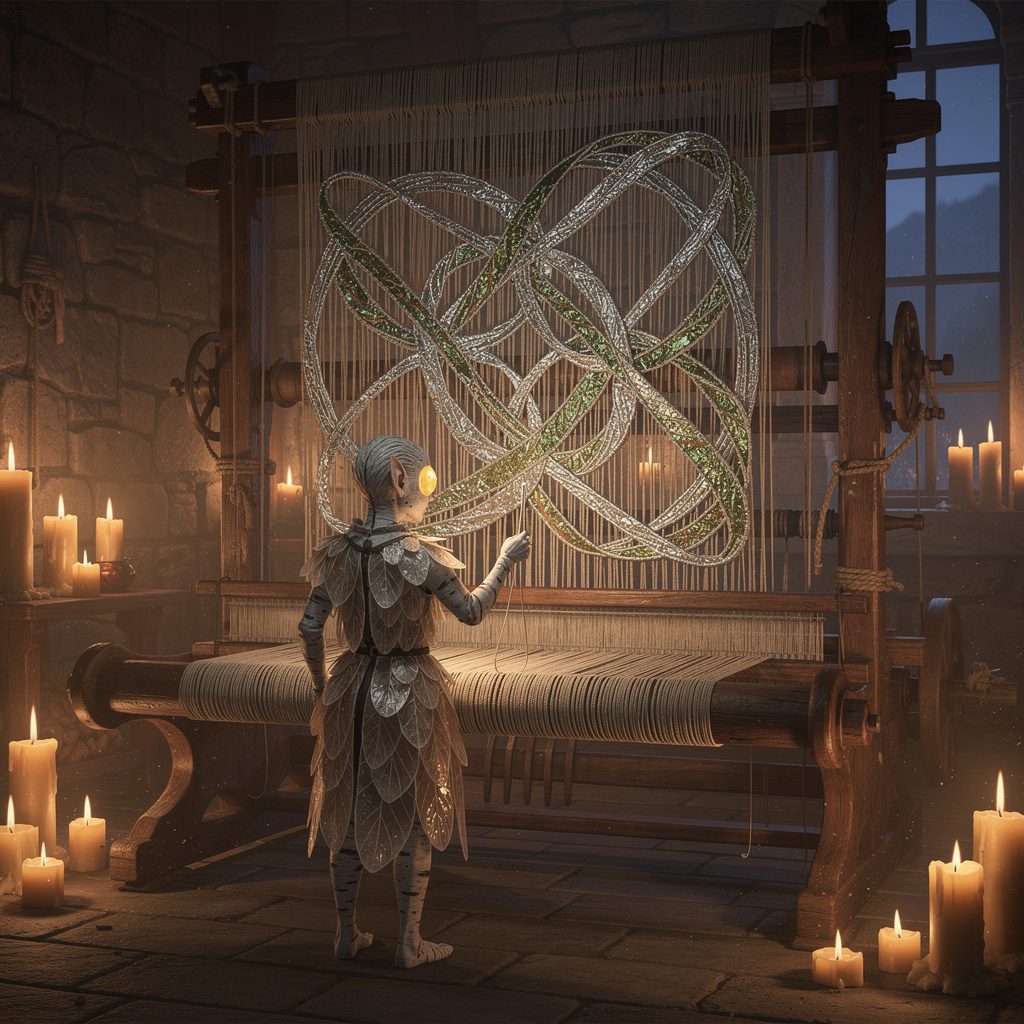
“You are three years late,” the creature says, and its voice arrives before its body does — a sound like coins dropped into still water, each syllable sinking slow.
Nabila Yousef does not turn around. She keeps her eyes on the loom, on the half-finished tapestry she has been weaving since before her daughter could walk. “I know what I am,” she says.
“Then you know why I am here.”
She sets down the shuttle. She turns.
The fae standing in the doorway of her weaving room is not what the old stories promised. The stories said fae were beautiful in the way that knives are beautiful — clean lines, cold edges, a certain terrible elegance. This one is beautiful the way a contract is beautiful: precise, unambiguous, and utterly without mercy. It stands perhaps four feet tall, with limbs that are slightly too long for its torso, jointed once more than they should be at the elbow and the knee. Its skin is the pale grey of birch bark in winter, faintly ridged along the cheekbones and jaw as though something harder lives just beneath. Its eyes are the colour of old amber — deep yellow, clouded at the centre, and entirely still. It wears a coat of layered moth-wing panels, each one translucent, each one catching the candlelight differently, so that when it moves, it seems to shimmer between states of being rather than simply walk. Around its wrist is a length of knotted cord with seven knots. Six are loose. One is pulled so tight it has disappeared into itself.
Nabila has seen it before. She was twenty-two then. She is twenty-nine now, and she has not forgotten a single detail.
“I want to renegotiate,” she says.
The fae tilts its head. The angle is slightly too far, like a door opened past the point where the hinge is comfortable. “You do not have the currency for renegotiation.”
“I have the tapestry.”
A pause. Not hesitation — fae do not hesitate — but a kind of deliberate stillness, the way a ledger-keeper runs a finger down a column before answering a question about a figure three pages back. “The tapestry was not part of our agreement.”
“No,” Nabila agrees. “But you collect debts. And a tapestry that shows every path through the Thornmere simultaneously — every route that exists, every route that was ever sealed, every shortcut that the old cartographers buried in footnotes and forgot — that is worth something to a creature who travels as often as you do.”
Another pause. Longer.
“Show me.”
She steps aside. The loom fills the back wall of the room, floor to ceiling, six feet wide. The tapestry on it is extraordinary — not in the way that art is extraordinary, though it is undeniably art, but in the way that a perfect map is extraordinary, which is to say it makes you feel, looking at it, that the world has been made comprehensible for the first time. Threads of undyed linen mark the main roads. Silver threads trace the old paths, the ones that shift with the seasons. And running through all of it, in a colour Nabila has no name for — not gold, not green, not quite either — are lines that pulse faintly in the candlelight, branching and re-branching, looping back, crossing themselves in ways that should not be geometrically possible but somehow resolve into clarity if you let your eyes go soft and simply look.
The fae steps closer. Its jointed fingers extend toward the weave, stopping just short of touching.
“Seven years of work,” Nabila says quietly. “Started the year after our agreement. I have been making it for you since the beginning.”
“You assumed I would come.”
“I assumed you would come exactly when you did. Fae who hold a debt always collect at the moment of maximum inconvenience. My daughter turned seven last week. I knew.”
Something shifts in the amber eyes. Not warmth, exactly. More like the recognition one professional extends to another.
“What do you want in exchange for it?”
“Cancel the original debt. Completely. No remainder, no interest, no residual claim on my daughter, my house, my name, or my craft.”

 WhatsApp
 Telegram
 Email






Categories
- AI & Technology
- Contemporary
- Corporate Control
- Creepypasta
- Crime Thriller
- Cyberpunk
- Dark Fantasy
- Enemies to Lovers
- Fairy Tale Retelling
- Fantasy
- First Contact
- Forbidden
- Genetic/Body Horror
- High Fantasy
- Monster Hunter
- Mythic/Folklore
- Paranormal
- Portal/Otherworld
- Post-Apo
- Post-Collapse Society
- Psychological Thriller
- Romances
- SCI-FI
- Second Chance
- Slow Burn
- Space Combat
- Spacepunk
- Surveillance State
- Survival Thriller
- Thrillers
- Time Travel
- Treasure Hunter
- Urban Fantasy
- Witchcraft/Curses
Tags
10min stories atmospheric atmospheric fantasy atmospheric fiction contemporary romance Creepy creepypasta crime thriller dark fantasy debt dystopia emotional fiction enemies to lovers ensemble cast epistolary fantasy female protagonist first person forbidden romance framed narrative high fantasy love story magic Memory mystery Paranormal psychological horror psychological thriller romance sci-fi second chance second chance romance short fiction short story slow burn space station speculative fiction supernatural Survival survival thriller suspense thriller travel romance witchcraft workplace romance
Leave a Reply