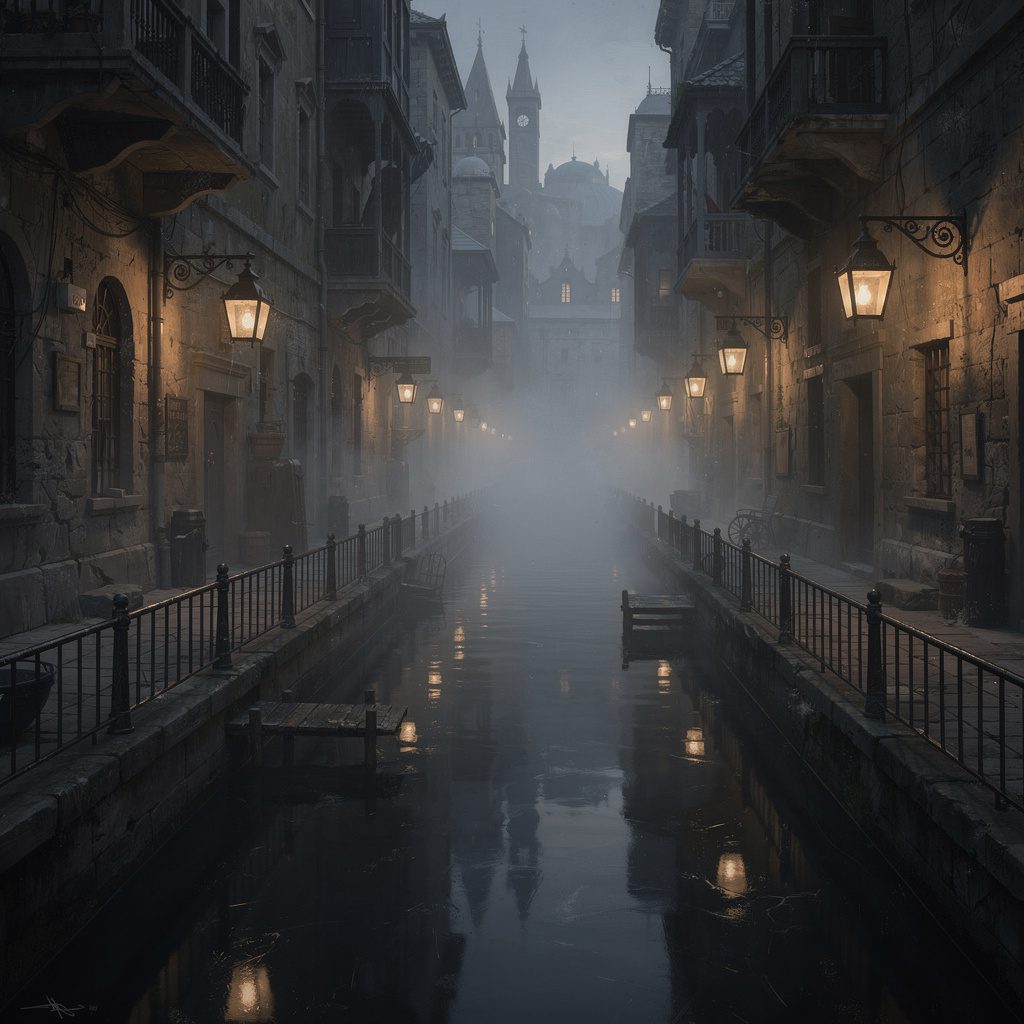
And then I noticed something I had never noticed before, because I had never been looking: the shadows the lanterns cast were wrong. A true flame casts a shadow that moves, that breathes slightly with the heat of the air around the wick. These shadows were static. Perfectly, completely still. As if the light came not from a burning thing but from a fixed point, something that did not consume and did not change and did not live.
I straightened up. A man selling roasted nuts from a cart gave me a curious look. I must have looked strange, bent over a public lantern in the middle of the afternoon, examining shadows.
“They’re lovely this time of day, aren’t they,” he said, pleasantly, the way people make conversation.
“Yes,” I said. “Very steady.”
I walked back to my rented room above the bookbinder’s shop on Cressward Lane and sat at my small table and tried to organize what I knew into something that made sense. The binding-oil was exhausted or nearly so. The Archon’s administration had known this for at least six years and had not announced it. The lanterns were still burning, but some of them — more every day, I now suspected — were burning on something else, something that produced the appearance of the Kindling without the actual protective magic that the Kindling was supposed to sustain. The weave that the city believed was intact was not intact. Had not been intact for years. And I was a record-keeper in the Hall of Measures with a satchel full of flagged ledger pages and an empty inkwell in my supervisor’s abandoned office, and I did not know who else knew, or how far up it went, or what would happen to someone who put it all into a formal report and submitted it through the correct channels.
I sat there until it was dark.
When the dusk Kindling happened — the ward-keepers moving along the canal with their long lighting-poles, touching each wick in the ceremonial sequence — I watched from my window. The lanterns bloomed one by one in the darkening air, amber and steady and beautiful, the whole canal glowing the way it always glowed, the way it had glowed for as long as anyone in the city could remember. People stopped to watch, the way they always did. A child on the far bank pointed and said something to her mother, who smiled.
I watched the shadows.
More than half of them were static now.
I pulled out a clean sheet of paper and began to write. Not the formal report — not yet. Just what I knew, in the order I had learned it, as precisely as I could state it. It took a long time. When I finished, I read it back, and I noticed something I had not noticed while I was writing: a detail I had recorded in the first week of my work on this particular ledger and then moved past without pausing on, because at the time it had seemed like a clerical note of no consequence.
Folake had assigned me this project.
Folake, who had asked specifically for a consumption report going back forty years. Folake, whose office was empty and whose inkwell was dry. Folake, who had given me the exact task that would lead a careful person to find exactly what I had found.
I sat with that for a long time.
He had known. He had known what the ledgers contained and he had known what I would find, and he had given them to me anyway. Not as an accident. Not as an oversight. He had chosen me, specifically, the most precise and careful record-keeper in the Hall, and he had handed me forty years of evidence and asked me to compile it, and then he had left.
I thought about what that meant. I thought about what a person does when they can no longer carry a secret alone — when the institution they serve has become the secret itself. You cannot report it upward, because upward is where the secret lives. You cannot report it outward, because you do not know who else is part of it and who is not. What you can do, if you are very careful and very deliberate, is make sure that someone else holds the knowledge. Someone precise. Someone who writes things down.
Folake had not abandoned his post. He had passed it.
I looked at the sheet of paper in front of me, at my own careful handwriting, at the full shape of what I now understood. Outside, the lanterns burned on, steady and amber and beautiful, casting their static shadows onto the still water of the canal.
The city did not know it was already dark inside its own light.
But I knew. And now I had to decide what a person does with that — not tomorrow, not when it was safer or clearer or less frightening, but tonight, alone at a small table above a bookbinder’s shop, with the cold floor pressing up through my feet and a page full of truth in my hands and the whole sleeping city glowing falsely outside my window.

 WhatsApp
 Telegram
 Email






Categories
- AI & Technology
- Contemporary
- Corporate Control
- Creepypasta
- Crime Thriller
- Cyberpunk
- Dark Fantasy
- Enemies to Lovers
- Fairy Tale Retelling
- Fantasy
- First Contact
- Forbidden
- Genetic/Body Horror
- High Fantasy
- Monster Hunter
- Mythic/Folklore
- Paranormal
- Portal/Otherworld
- Post-Apo
- Post-Collapse Society
- Psychological Thriller
- Romances
- SCI-FI
- Second Chance
- Slow Burn
- Space Combat
- Spacepunk
- Surveillance State
- Survival Thriller
- Thrillers
- Time Travel
- Treasure Hunter
- Urban Fantasy
- Witchcraft/Curses
Tags
10min stories atmospheric atmospheric fantasy atmospheric fiction contemporary romance Creepy creepypasta crime thriller dark fantasy debt dystopia emotional fiction enemies to lovers ensemble cast epistolary fantasy female protagonist first person forbidden romance framed narrative high fantasy love story magic Memory mystery Paranormal psychological horror psychological thriller romance sci-fi second chance second chance romance short fiction short story slow burn space station speculative fiction supernatural Survival survival thriller suspense thriller travel romance witchcraft workplace romance
Leave a Reply