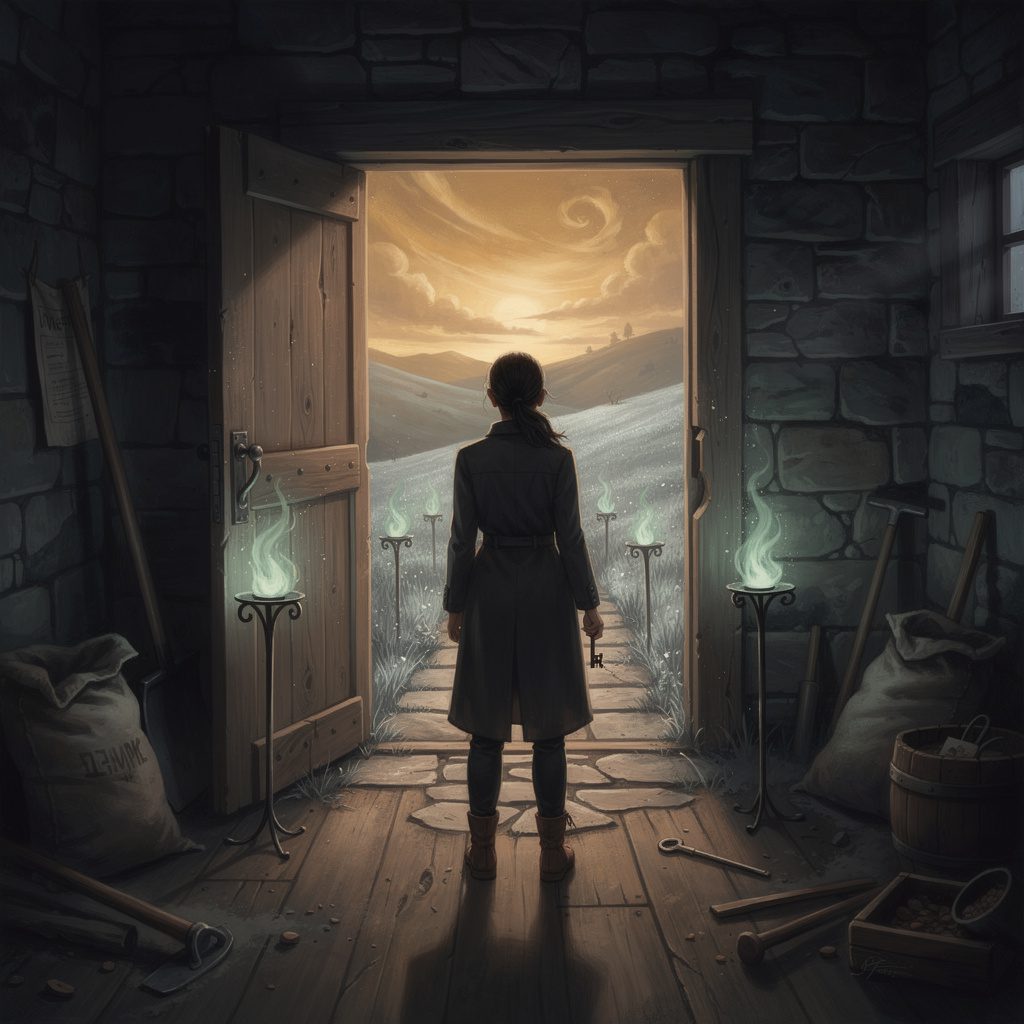
Until three weeks ago, when she had pressed it, almost absently, against the surface of the mill door, and felt it slide into a keyhole that had not been there a moment before.
She had not turned it then. She had not been ready.
She was ready now. Or she was as ready as she was going to be, which was not the same thing, but it would have to do.
Two hours and forty minutes.
Priya set the basket down — not on the threshold, not outside the door, but inside the mill, six feet from the door’s face, in the center of the old millstone floor. The bread. The fat. The wool. The nails. And the personal object: her grandmother’s ledger, the original one, with Sura’s handwriting in it going back fifty years. Priya had kept a copy. The original felt right. It felt like something genuinely surrendered rather than something disposed of.
She straightened. Rolled her shoulders.
Put the key in the lock.
The door opened inward.
What was on the other side was not darkness. That was the first thing she registered, with a kind of distant surprise. She had expected darkness — the swallowing, absolute kind, the kind that old stories described as the mouth of elsewhere. Instead, the other side of the door was lit by a sourceless amber light, warm and low, like the last hour of a long afternoon. The ground beyond the threshold was covered in short silver-grey grass that moved without wind. The sky — if it was a sky — was the same bruised green as the door’s surface, but from inside it looked like stained glass held up to the sun: luminous and strange and somehow peaceful.
A path led away from the door into the amber distance. It was made of flat grey stones, each one slightly different, as if gathered from many different rivers. Beside the path, at regular intervals, stood lanterns on iron poles. They were not lit.
Priya did not follow the path.
She had read enough, in enough old ledgers and careful marginal notes and one remarkable letter her grandmother had apparently written and then folded into the ledger’s back cover and never sent, to know that the path and the lanterns were not for her. They were for something else. Something that used this door in the other direction.
She stood in the doorway and waited.
The wait was long enough that her legs began to ache. Long enough that the amber light shifted, almost imperceptibly, toward something cooler. Long enough that she had time to notice the silence on the other side was not the silence of emptiness but the silence of a held breath — the particular quiet of a space that was listening.
Then the lanterns lit.
One by one, starting from the farthest visible point on the path and moving toward her, they came on: not with flame, but with the same grey-green light as the door’s edge. And with the light came a figure, walking the path at an unhurried pace, growing slowly larger as it approached.
It was tall. That was the first thing. Taller than a person by a full head, and proportioned differently — the limbs slightly too long, the neck slightly too long, the whole figure carrying an impression of something designed for a different kind of gravity. Its skin, if it was skin, was the color of birch bark, pale and faintly textured, marked with dark lines that might have been veins or might have been something written. Its face, when it was close enough to see, was angular and still and absolutely without expression — not cold, not hostile, simply still in the way that water is still before it moves. Its eyes were the amber of the light: warm, deep, and not quite focused on anything in the physical world.
It stopped at the threshold.
It looked at the basket. It looked at Priya.
For a moment, nothing happened.
Then it spoke, and the sound was less like a voice than like the memory of a voice — something heard through a wall, or across a great distance, or in a dream where sound arrives without traveling.
“You stayed.”
“Yes,” Priya said.
“They did not stay. The others. Four generations of others.”
“I know.” She kept her voice level. “I think that’s why the agreement stopped holding. The toll was left but not given. There’s a difference.”

 WhatsApp
 Telegram
 Email







Categories
- AI & Technology
- Contemporary
- Corporate Control
- Creepypasta
- Crime Thriller
- Cyberpunk
- Dark Fantasy
- Enemies to Lovers
- Fairy Tale Retelling
- Fantasy
- First Contact
- Forbidden
- Genetic/Body Horror
- High Fantasy
- Monster Hunter
- Mythic/Folklore
- Paranormal
- Portal/Otherworld
- Post-Apo
- Post-Collapse Society
- Psychological Thriller
- Romances
- SCI-FI
- Second Chance
- Slow Burn
- Space Combat
- Spacepunk
- Surveillance State
- Survival Thriller
- Thrillers
- Time Travel
- Treasure Hunter
- Urban Fantasy
- Witchcraft/Curses
Tags
10min stories atmospheric atmospheric fantasy atmospheric fiction contemporary romance Creepy creepypasta crime thriller dark fantasy debt dystopia emotional fiction enemies to lovers ensemble cast epistolary fantasy first person forbidden romance found text framed narrative high fantasy love story magic Memory mystery Paranormal psychological horror psychological thriller romance sci-fi second chance second chance romance short fiction short story slow burn space station speculative fiction supernatural Survival survival thriller suspense thriller travel romance witchcraft workplace romance
Leave a Reply