Three hours.
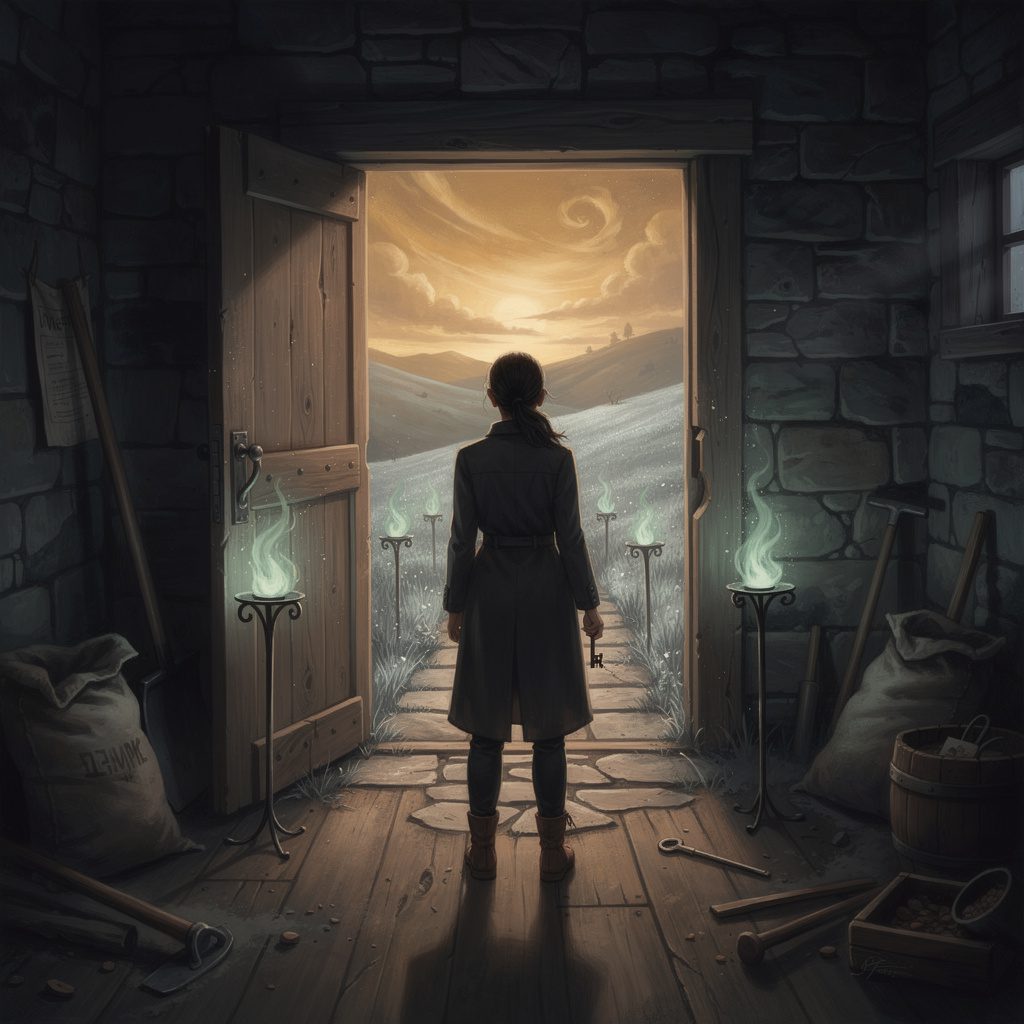
That was how long Priya had before the toll came due, and she was still on the wrong side of the door.
The door — if you could call it that — stood at the center of Ashenmere’s old mill, exactly where no door had any right to be. It occupied the space between two load-bearing beams, framed by nothing, attached to nothing, and yet it held itself upright with the quiet confidence of something that had always been there and always would be. Its surface was the color of deep water before a storm: a shifting, bruised grey-green that moved when you weren’t looking directly at it. Around its edges, the air smelled of pine resin and river silt and something else beneath both of those — something older, without a name in any language Priya knew.
She had been looking at it for forty minutes.
She had been preparing for it for eleven years.
Priya Vaidya was thirty-one years old, the last keeper of Ashenmere’s toll-ledger, and she was entirely alone. The village had emptied two days ago. That was customary. Every year, on the night before the Giving, the families packed their carts and their children and their oldest dogs and they drove the road north to Carrenfield, where they stayed in the granary-hall and drank too much and did not speak of what they’d left behind. They called it the Airing Out. They called it the Old Rest. They called it a dozen careful things, none of which were its name.
Priya called it what it was: an evacuation.
She was the first keeper in four generations to stay.
Her grandmother, Sura, had been the last. Sura had never spoken of what she’d seen inside the mill on that night, not once in the thirty years between her vigil and her death. But she had pressed something into Priya’s hand at the very end — a small iron key, unremarkable, the kind that might open a garden gate or a spice cabinet — and she had said, with great precision: “Do not leave the toll on the threshold and walk away. That is what they want. That is what keeps the door hungry.”
Priya had not understood then.
She understood now.
For as long as anyone in Ashenmere could remember, the toll had been simple. Once a year, on the last night of the harvest month, the keeper placed a basket on the mill’s threshold. The basket held: a loaf of dark bread, a jar of rendered fat, a length of undyed wool, a handful of iron nails, and one personal object freely given — something belonging to the keeper themselves. In the morning, the basket was gone. The door was closed. And Ashenmere had another year of ordinary life: good harvests, mild winters, no children lost to fever, no fires in the grain stores.
No one questioned it.
No one named the thing that took it.
But four years ago, the toll had stopped working.
The first sign had been small: a late frost that killed half the apple crop. Easy to explain away. The second year, three fishing boats on the Ashenmere lake had come back empty, every morning, for six weeks. The third year, two children had wandered into the forest at the edge of the village and been found three days later, unharmed but silent, sitting in the roots of an old ash tree and staring at something no one else could see. They had not spoken properly for a month afterward.
And this year — this year, the mill door had begun to glow.
Not brightly. Not dramatically. Just a faint, grey-green pulse at its edges, like a heartbeat, visible only at night. Priya had catalogued it in the ledger with the same careful handwriting her grandmother had used for grain tallies and weather records. She had written: Door active. Toll insufficient. Threshold arrangement may be the source of the breach.
Threshold arrangement. That was the polite way of saying: they had been leaving the gift and running, for four generations, and something about that had soured the agreement.
Sura’s key had sat in Priya’s coat pocket for eleven years. She had taken it out and held it perhaps two hundred times. She had never known what lock it fit.

 WhatsApp
 Telegram
 Email







Categories
- AI & Technology
- Contemporary
- Corporate Control
- Creepypasta
- Crime Thriller
- Cyberpunk
- Dark Fantasy
- Enemies to Lovers
- Fairy Tale Retelling
- Fantasy
- First Contact
- Forbidden
- Genetic/Body Horror
- High Fantasy
- Monster Hunter
- Mythic/Folklore
- Paranormal
- Portal/Otherworld
- Post-Apo
- Post-Collapse Society
- Psychological Thriller
- Romances
- SCI-FI
- Second Chance
- Slow Burn
- Space Combat
- Spacepunk
- Surveillance State
- Survival Thriller
- Thrillers
- Time Travel
- Treasure Hunter
- Urban Fantasy
- Witchcraft/Curses
Tags
10min stories atmospheric atmospheric fantasy atmospheric fiction contemporary romance Creepy creepypasta crime thriller dark fantasy debt dystopia emotional fiction enemies to lovers ensemble cast epistolary fantasy first person forbidden romance found text framed narrative high fantasy love story magic Memory mystery Paranormal psychological horror psychological thriller romance sci-fi second chance second chance romance short fiction short story slow burn space station speculative fiction supernatural Survival survival thriller suspense thriller travel romance witchcraft workplace romance
Leave a Reply