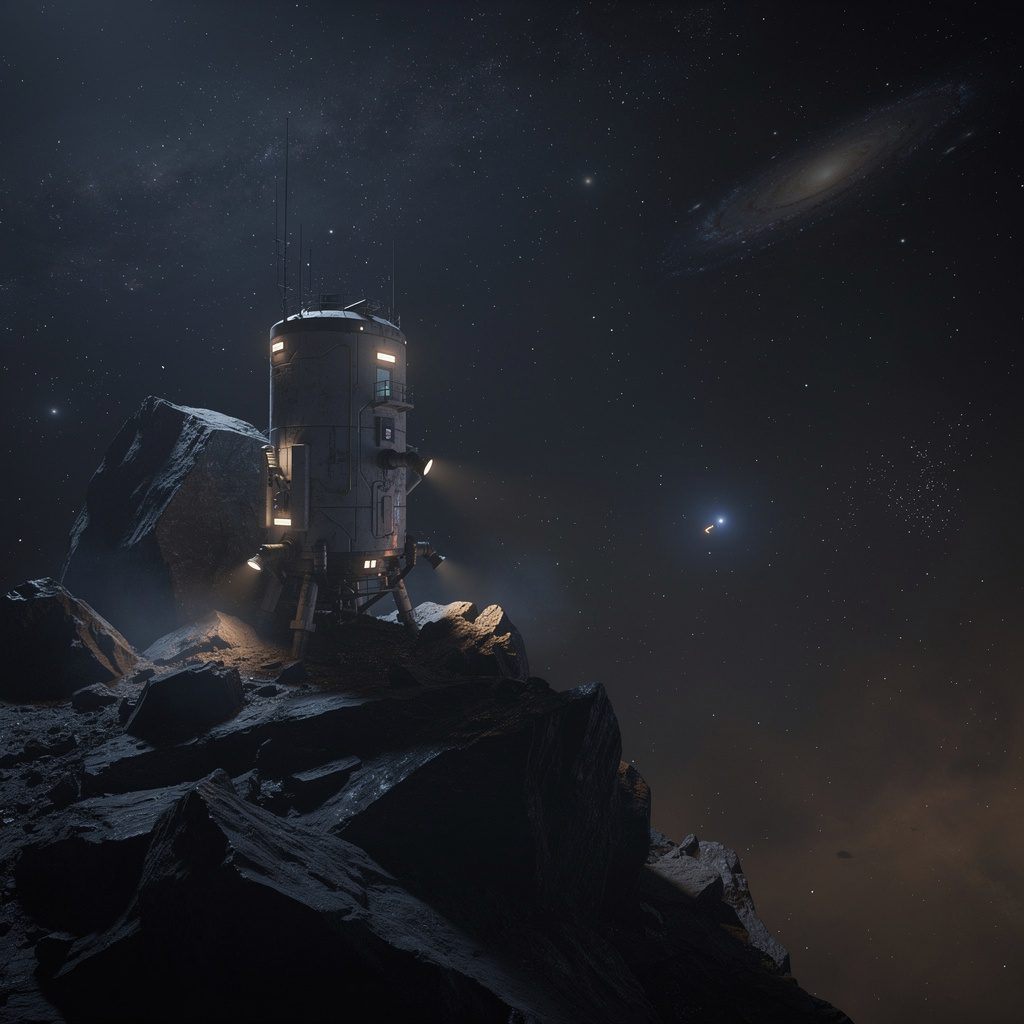
The Meridian Compact’s outer relay stations were, by design, the most forgettable places in the colonized belt. They existed to count things: cargo tonnage, drive signatures, trajectory vectors logged in triplicate and beamed back to the hub every six hours. Station Verada-9 was no different from the eleven others strung along the transit corridor between the Jovian platforms and the outer ice mines — a pressurized drum two hundred meters across, bolted to an asteroid outcrop the color of old iron, staffed by four people who had long since stopped remarking on the view. The stars outside the observation ports were the same stars every morning. The asteroid cast the same shadow every afternoon. The coffee from the recycler tasted like warm rust, and it had always tasted like warm rust, and no one talked about it anymore.
Luca Ferrante had been on Verada-9 for eleven months, which was four months longer than his original rotation. The extension had come through quietly, no explanation, and he had accepted it with the mild resignation of someone who had stopped expecting explanations from the Compact’s administrative layer. He was thirty-four, lean in the way that low-gravity postings made people lean, with dark eyes that had developed the distant, slightly unfocused quality common to people who spent too many hours staring at telemetry screens. His job title was Transit Coordination Specialist, which meant he watched ships go by and made sure they were the ships that were supposed to be going by. He was good at it. He was, in fact, quietly exceptional at it, which was the kind of thing that got you quietly kept in place rather than promoted.
The other three crew members of Verada-9 were Shreya Okafor, the station’s systems engineer, a compact and methodical woman from the Ganymede settlements who communicated primarily through annotated maintenance logs and the occasional dry observation delivered without looking up from her work; Gael Vásquez, the medic and secondary comms operator, who was twenty-six and had brought an embarrassing number of physical books with him and read them with genuine pleasure, which the others found both charming and faintly baffling; and Manoj Thiru, the station commander, who was fifty-one and had been running relay postings for twenty years and who wore authority the way old rock wore lichen — quietly, completely, without drama. These four had achieved the specific social equilibrium of people who knew each other well enough to be comfortable and not well enough to be unkind. It was, Luca thought sometimes, the most functional relationship structure he had ever participated in.
The morning it began, Luca was running the 0600 sweep, a routine pass of the sector’s registered traffic against the actual drive signatures the station’s passive arrays were picking up. The corridor was quiet. Three freighters outbound, two inbound, all matching their filed trajectories within acceptable variance. He was on his second cup of rust-coffee, half-reading a maintenance bulletin about condenser calibration that Shreya had flagged for his attention, when the anomaly appeared in the data — not loudly, not urgently, but the way a wrong note appears in a familiar piece of music: small, and then impossible to unhear.
There was a drive signature at bearing 227 by negative 14, approximately 340,000 kilometers out. It was faint, intermittent, the kind of reading that the system’s automatic filters would have flagged as sensor noise and discarded without note. But Luca had been watching this corridor for eleven months, and sensor noise had a texture he had come to know the way a fisherman knows the feel of an empty line. This was not that texture. The signature pulsed in a pattern — not rhythmically, not mechanically, but variably, almost organically, like something breathing at irregular intervals. And it was not on any registered flight path. It was not near any registered flight path. It was in a region of the corridor that ships had no reason to be in, a gap between the established lanes where there was nothing to go to and nothing to come from.

 WhatsApp
 Telegram
 Email






Categories
- AI & Technology
- Contemporary
- Corporate Control
- Creepypasta
- Crime Thriller
- Cyberpunk
- Dark Fantasy
- Enemies to Lovers
- Fairy Tale Retelling
- Fantasy
- First Contact
- Forbidden
- Genetic/Body Horror
- High Fantasy
- Monster Hunter
- Mythic/Folklore
- Paranormal
- Portal/Otherworld
- Post-Apo
- Post-Collapse Society
- Psychological Thriller
- Romances
- SCI-FI
- Second Chance
- Slow Burn
- Space Combat
- Spacepunk
- Surveillance State
- Survival Thriller
- Thrillers
- Time Travel
- Treasure Hunter
- Urban Fantasy
- Witchcraft/Curses
Tags
10min stories atmospheric atmospheric fantasy atmospheric fiction contemporary romance Creepy creepypasta crime thriller dark fantasy debt dystopia emotional fiction enemies to lovers ensemble cast epistolary fantasy first person forbidden romance found text framed narrative high fantasy love story magic Memory mystery Paranormal psychological horror psychological thriller romance sci-fi second chance second chance romance short fiction short story slow burn space station speculative fiction supernatural Survival survival thriller suspense thriller travel romance witchcraft workplace romance
Leave a Reply