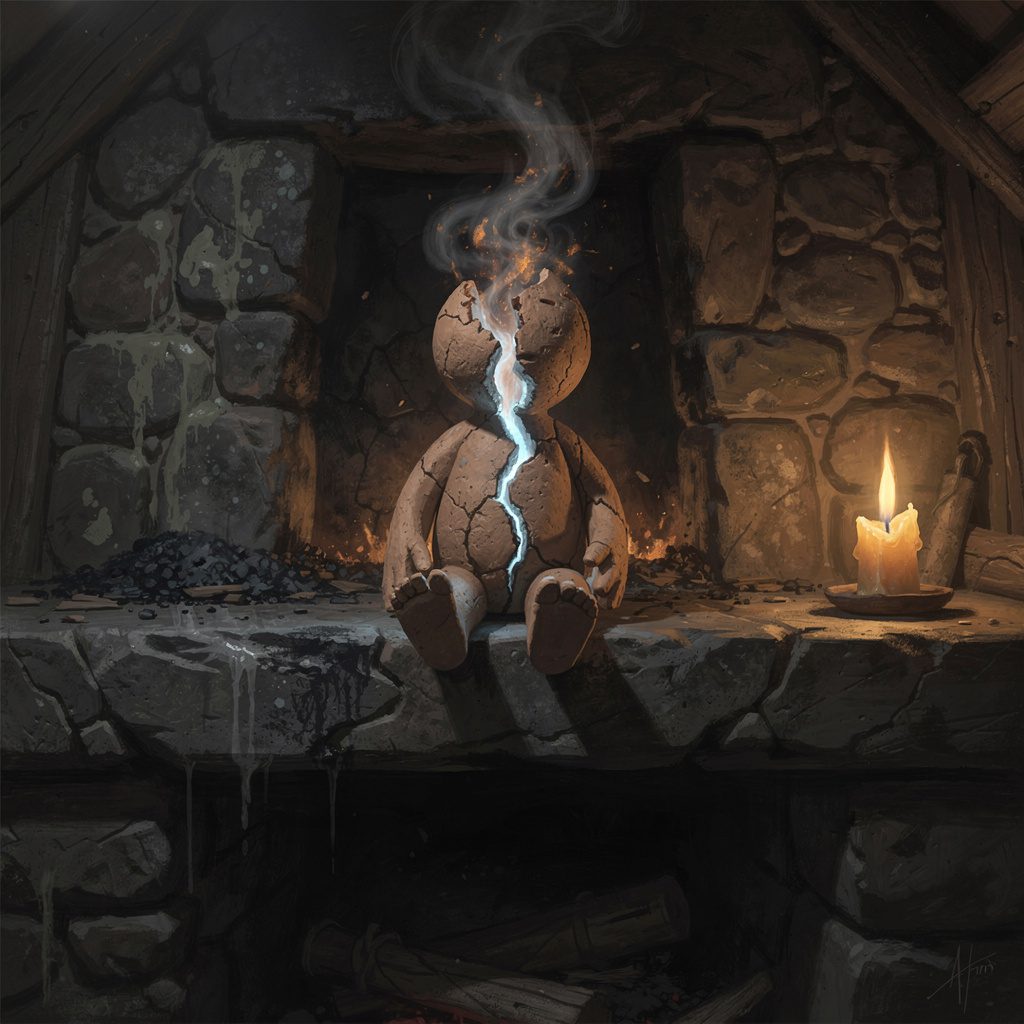
The village of Ashkeld sat at the bottom of a long valley like something forgotten at the bottom of a pocket — small, worn smooth, unremarkable. Its houses were timber and pale plaster, their roofs dark with old moss. The market square held a well, a bread stall, and a farrier’s shed that smelled permanently of scorched hoof. Pallavi had been watching it for three days from the ridge above, eating cold salt-pork and cataloguing the rhythms of the place the way she always catalogued a new job: who rose earliest, who lingered at the well, which houses kept their shutters closed through the warmest part of the afternoon. She had learned that the baker, a broad woman with red forearms, started her fires before dawn. She had learned that the village headman walked the perimeter of the square each evening at dusk with a lantern in one hand and a string of iron beads in the other, and that he muttered something under his breath the entire time, the same cadence repeated, like a ward or a prayer or both. She had learned that no one went near the tanner’s cottage at the eastern edge of the settlement, even though the tanner himself had been dead for eleven years. The cottage still stood. Its chimney still smoked.
That was the detail that had brought her here. Not the headman’s letter, which had been vague and desperate in equal measure, full of words like affliction and shadow-thing and God help us. Not the coin he had sent, though it was generous. The chimney smoke. She had asked the courier who delivered the letter whether the tanner’s cottage was occupied, and the courier had gone very still before saying, “Not by anything living, as far as anyone can tell.” Pallavi was a curse-hunter by trade and by inheritance, trained from childhood in the old disciplines of detection and unbinding, and she had learned that the most important information was always the thing people said in the spaces around their actual words. The cottage smoked. No one went near it. No one had torn it down. These three facts together told her more than the headman’s entire letter.
She came down from the ridge on the fourth morning and presented herself at the headman’s door before the bread stall had even opened. His name was Osborne — a heavyset man in his late sixties with a face full of broken veins and eyes that had the particular redness of someone who had not slept properly in a long time. He let her in without ceremony and poured her tea without asking whether she wanted it, which she took as a sign of how badly he needed her. His house smelled of dried herbs and something beneath them that she identified after a moment as fear — not metaphorical fear, but the actual physiological smell of a body that had been producing stress hormones for weeks, the slightly sour, slightly animal scent of chronic dread. He told her the story in pieces, circling back, correcting himself, losing the thread and finding it again. A child had gone missing eight weeks ago. Then a goat. Then a second child, who had returned three days later unable to speak, with a circular mark burned into the skin of her left palm — not painfully, the healer said, the skin was not damaged, but the mark was there and it would not wash off. Since then, the smoke from the tanner’s chimney had increased. It rose at odd hours. It was the wrong color — sometimes grey, sometimes a deep amber that caught the light in a way that smoke should not catch light. And the children in the village had begun sleepwalking, all of them, every night, always in the direction of the eastern edge.

 WhatsApp
 Telegram
 Email







Categories
- AI & Technology
- Contemporary
- Corporate Control
- Creepypasta
- Crime Thriller
- Cyberpunk
- Dark Fantasy
- Enemies to Lovers
- Fairy Tale Retelling
- Fantasy
- First Contact
- Forbidden
- Genetic/Body Horror
- High Fantasy
- Monster Hunter
- Mythic/Folklore
- Paranormal
- Portal/Otherworld
- Post-Apo
- Post-Collapse Society
- Psychological Thriller
- Romances
- SCI-FI
- Second Chance
- Slow Burn
- Space Combat
- Spacepunk
- Surveillance State
- Survival Thriller
- Thrillers
- Time Travel
- Treasure Hunter
- Urban Fantasy
- Witchcraft/Curses
Tags
10min stories atmospheric atmospheric fantasy atmospheric fiction contemporary romance Creepy creepypasta crime thriller dark fantasy debt dystopia emotional fiction enemies to lovers ensemble cast epistolary fantasy female protagonist first person forbidden romance framed narrative high fantasy love story magic Memory mystery Paranormal psychological horror psychological thriller romance sci-fi second chance second chance romance short fiction short story slow burn space station speculative fiction supernatural Survival survival thriller suspense thriller travel romance witchcraft workplace romance
Leave a Reply