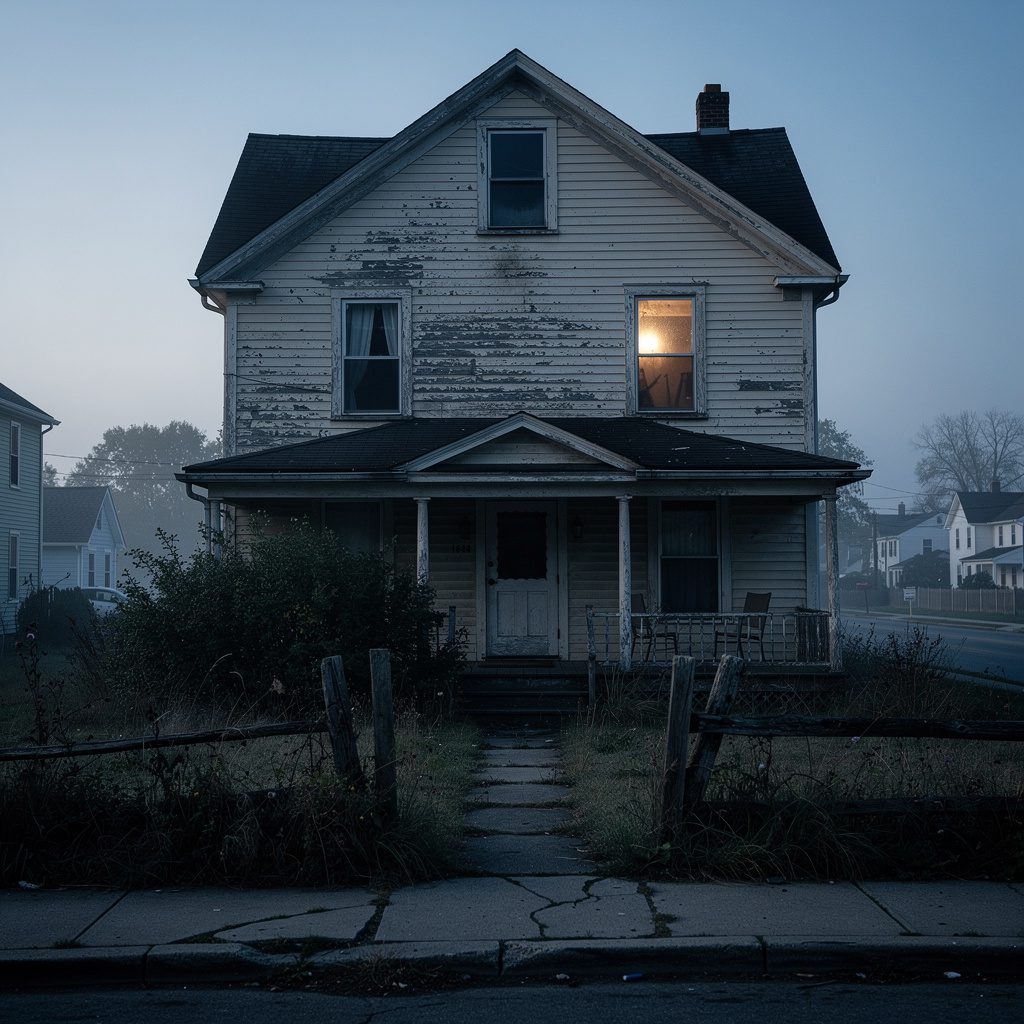
The door was already open when Livia got there.
Not unlocked. Open. Six inches of darkness spilling out onto the porch like something had just left, or was waiting to.
She pressed her back against the doorframe, breathing through her nose, and listened. Inside: the tick of pipes. The low moan of a house settling. Nothing that should have frightened her. Everything that did.
She had her phone in her left hand and her keys laced between the fingers of her right, which she understood was ridiculous — she was a forensic data analyst, not a cop — but the drive from the records office had taken forty minutes and she had spent every one of them telling herself she was overreacting. She was not overreacting. The open door said so plainly.
Get out, she thought. Call Renata. Call the actual police.
She stepped inside.
The house smelled like old wood and linseed oil and something faintly chemical underneath, the way a darkroom smells, or a place where developing fluid has dried on a surface and been wiped but not cleaned. Livia had been in the house twice before — once in daylight, once at dusk — and both times it had felt merely abandoned. A 1940s colonial on the eastern edge of Providence, Rhode Island, two streets back from the water, its clapboard siding the gray of weathered bone. The estate attorney had called it “a property with history.” The city records had been more specific.
Seven owners in eleven years. Three of them had filed police reports within sixty days of moving in. Two had left without forwarding addresses. The last registered occupant, a man named Fenwick Osei, had simply stopped existing in the public record fourteen months ago — no death certificate, no change of address, no DMV renewal, no tax filing. He had owned the house, and then he had not, and the house had sat.
Livia had pulled those records because that was her job: cross-referencing property histories for a civil litigation firm, finding the paper trails that owners and sellers preferred stayed buried. She was not supposed to come here. She was absolutely not supposed to be standing in the front hall with her keys between her fingers and the door open behind her.
But three days ago she had found the photograph.
It was embedded in a scanned deed transfer, a background detail no one had thought to redact — a printed image that had been left face-up on a desk when someone photographed the documents. The image showed the interior of this house. The kitchen, she thought, though she hadn’t seen the kitchen yet. And standing at the counter, turned three-quarters away from the camera, was a woman. The woman was wearing the same green canvas jacket Livia had worn to work the day the photograph was taken.
She had told herself it was a coincidence. Mass-produced jacket, wrong lighting, her own tired eyes playing tricks. She had told herself that for seventy-two hours.
The hall stretched ahead of her, darker toward the back. To her left, a sitting room: dust-sheeted furniture, a fireplace with the grate rusted shut. To her right, a staircase. At the top of the staircase, a rectangle of pale gray light where a door stood partly open.
She had not seen anyone come down.
Her phone screen read 4:47 p.m. Sunset in forty minutes. She opened her contacts, found Renata’s name, and left the call screen ready without dialing. A backup, she told herself. In case.
She moved toward the back of the house.
The kitchen was exactly as it appeared in the photograph — the same avocado-green cabinets, the same cracked linoleum in a pattern of brown hexagons, the same window above the sink looking out at a yard gone completely to bramble. The counter where the woman in the photograph had stood was bare except for a ring of grime where something circular had sat for a long time. A jar, maybe. A cup. Livia stood at the counter and looked out the window and understood, with the slow horrible clarity of a thing you already know before you know it, that the angle was right. Someone standing at this window, turned slightly left, coat on — yes. That was the frame. That was the shot.
But the photograph was in a document that had been scanned and filed fourteen months ago.

 WhatsApp
 Telegram
 Email







Categories
- AI & Technology
- Contemporary
- Corporate Control
- Creepypasta
- Crime Thriller
- Cyberpunk
- Dark Fantasy
- Enemies to Lovers
- Fairy Tale Retelling
- Fantasy
- First Contact
- Forbidden
- Genetic/Body Horror
- High Fantasy
- Monster Hunter
- Mythic/Folklore
- Paranormal
- Portal/Otherworld
- Post-Apo
- Post-Collapse Society
- Psychological Thriller
- Romances
- SCI-FI
- Second Chance
- Slow Burn
- Space Combat
- Spacepunk
- Surveillance State
- Survival Thriller
- Thrillers
- Time Travel
- Treasure Hunter
- Urban Fantasy
- Witchcraft/Curses
Tags
10min stories atmospheric atmospheric fantasy atmospheric fiction contemporary romance Creepy creepypasta crime thriller dark fantasy debt dystopia emotional fiction enemies to lovers ensemble cast epistolary fantasy female protagonist first person forbidden romance framed narrative high fantasy love story magic Memory mystery Paranormal psychological horror psychological thriller romance sci-fi second chance second chance romance short fiction short story slow burn space station speculative fiction supernatural Survival survival thriller suspense thriller travel romance witchcraft workplace romance
Leave a Reply