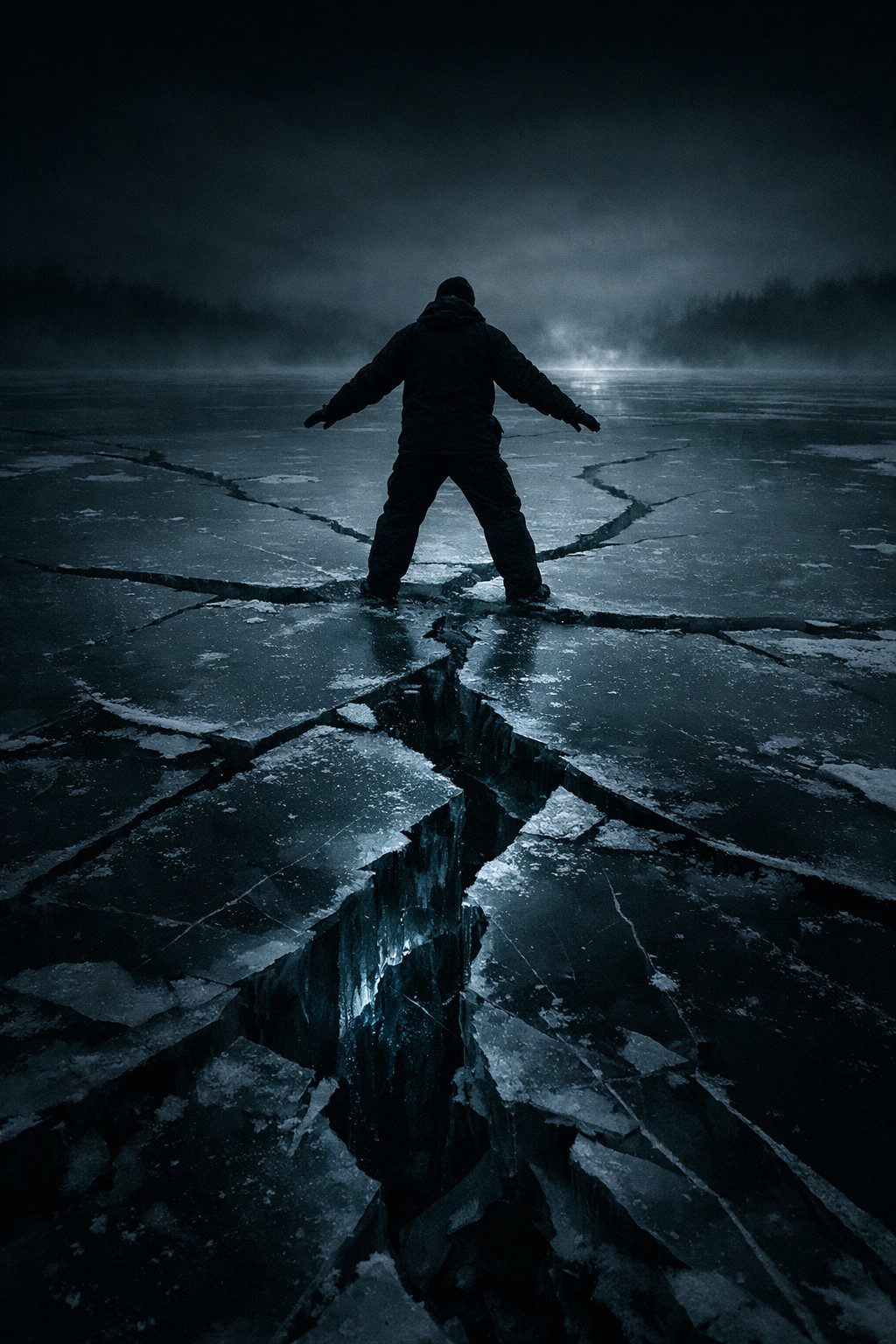
The ice made a sound I had never heard before — not the usual groan or crack of a frozen lake shifting under weight, but something lower and more deliberate, almost like a word. I stopped moving instantly, weight distributed, arms out, the way I had been trained. Then the sound came again, and I understood that it was not the ice settling.
It was the ice telling me something was already wrong.
My name is Hana Solt. I was forty-four, I had been a winter rescue technician for sixteen years, and I had crossed frozen water more times than I could count. I had a comprehensive knowledge of how ice failed — the conditions that weakened it, the sounds it made under different kinds of stress, the way colour and texture changed at a dangerous crossing. I trusted my training the way I trusted my own hands.
What I was doing on Lake Harro at seven in the morning, alone, with a temperature of minus seventeen and a pack on my back, was looking for a fourteen-year-old boy named Kasper who had been missing since the previous afternoon. His family had reported him at six p.m. His last known position, from the GPS tracker his parents had insisted he carry, had pinged at the lake’s eastern shore at three fifteen. The lake was eleven hundred metres across at its widest point.
The other members of my team were working the perimeter. I had taken the ice because I was the most experienced on frozen water and because the GPS signal had pinged once more at four forty-five, from a point that was, by my estimation, roughly four hundred metres from the eastern shore. The middle of the lake.
I had done a surface assessment before I stepped on. Ice colour good — clear blue-grey, the right transparency. I had drilled a test hole at the shore edge: twenty-two centimetres. More than adequate for a single person on foot. I had my ice picks on my wrists, my dry suit on underneath my outer layer, my throw rope coiled and accessible. I had done everything right.
The sound came again. I stood still and listened with my whole body, the way ice crossing required — not just ears but feet, legs, the soles of my boots reading the surface through my soles, feeling for vibration and resonance and the particular quality of ice that was about to tell you something important.
It was coming from ahead. Not beneath me — ahead, perhaps thirty metres, in the direction I had been walking. A low, almost subsonic pulse, followed by a faint crackling that was not random. It had a pattern. Slow, then fast, then slow again, like breathing.
Breathing. I moved toward it carefully, weight forward, sliding each foot rather than stepping, never committing my full weight until I had confirmed the surface. The cold was hard and bright and the morning light was just reaching the lake surface, throwing long shadows across the ice. I could see two hundred metres in every direction. There was nothing on the surface ahead of me. And yet the sound continued.
I understood three seconds before I reached it. The surface ahead was slightly different — a faint greyish tinge, barely visible in the early light, the colour of ice over moving water where a spring or inlet disturbed the freeze from below. Grey ice. Thin ice. And in the centre of the grey patch, a hole approximately forty centimetres across, the edges ragged and re-frozen, the kind of hole a person made when they went through.
I went flat immediately. On my stomach, weight distributed, I pulled out the probe rod and tested the grey section foot by foot before I moved. The ice was thinner here — eight centimetres in places, less than half what the shore had shown. A thermal vent beneath the lake, most likely, or a submerged current, keeping the water slightly warmer and the ice slightly weaker over a patch that was invisible from the shore.

 WhatsApp
 Telegram
 Email







Leave a Reply