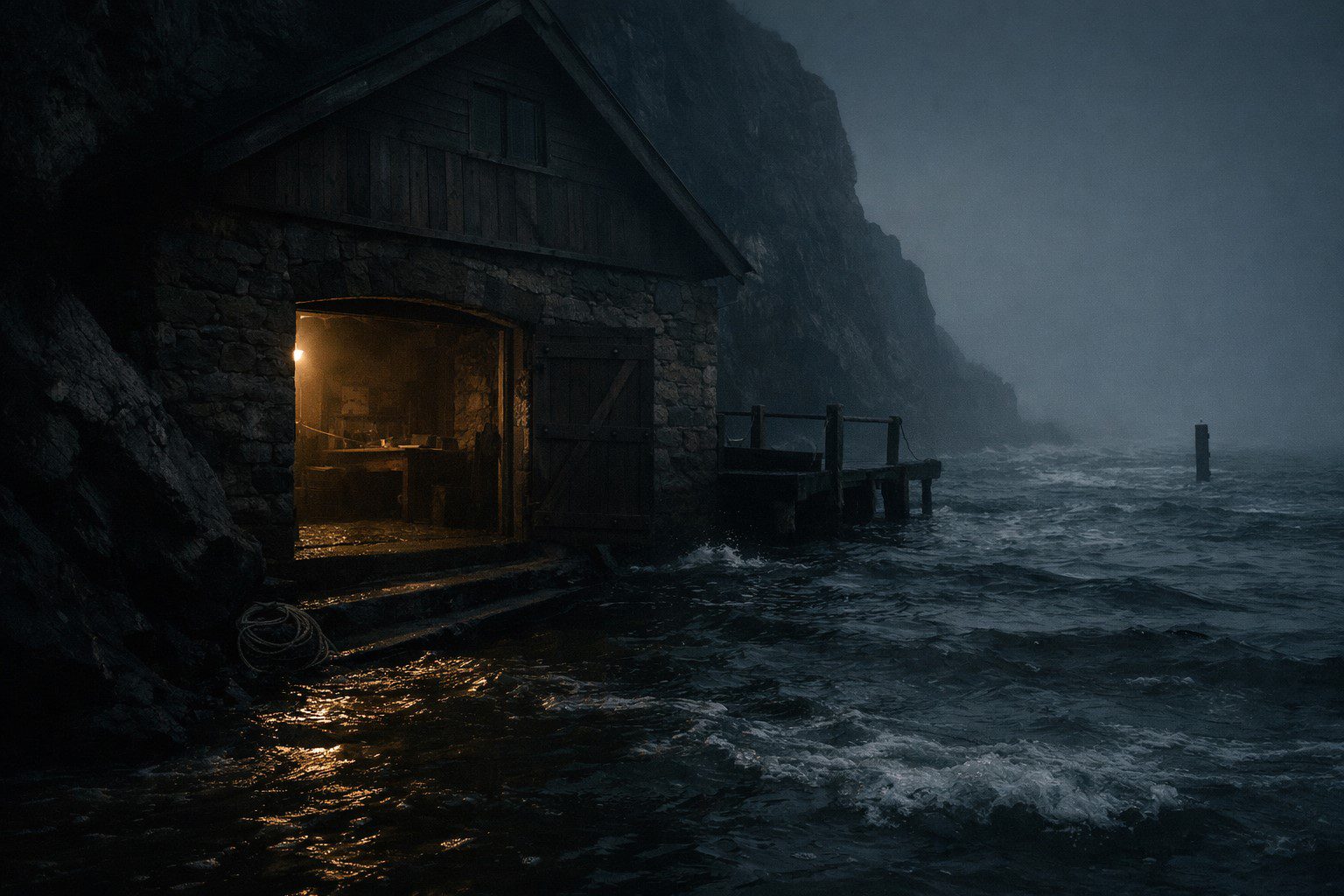
The sea chart said high tide at nine forty-seven. It was nine twelve when the water reached my knees, which meant either the chart was wrong or something had changed, and in twenty-two years of coastal work I had learned that charts were almost never wrong. Something had changed. I just didn’t know what yet, and the water was rising faster than it should have been, and the causeway back to the mainland was already under.
I was on the island alone. That had been the plan. Now it was the problem.
My name is Finn Adler. I worked as a coastal heritage surveyor — old structures, mostly, sea walls and slipways and buildings that had been fighting the tides for a century or more. The island of Caldey Holm sat three kilometres off the mainland coast and could be reached on foot via a tidal causeway for approximately four hours around low tide. The window was well-documented, the crossing was straightforward, and I had done it twice before. I had arrived at seven forty-five and planned to leave by nine-fifteen at the latest.
At nine-oh-five I had been photographing the old stone boathouse at the island’s eastern edge when I noticed the water level at the causeway marker post was higher than the morning’s tide table had indicated it should be. I had walked to the causeway and stood at the edge and watched the water for three minutes before I accepted that the crossing was no longer viable.
The nearest shelter was the boathouse, ten metres behind me.
I went back to it.
The boathouse was Victorian, stone and timber, built against the natural rock of the eastern shore. The main structure was solid — I had been assessing it for an hour and had noted sound foundations and walls with only minor deterioration above the waterline. The loft level was accessible via an internal ladder and sat approximately four metres above the normal high tide mark. In normal conditions, the loft would be well clear of any water.
These were not normal conditions.
I climbed to the loft and took stock. My kit: a survey bag with camera, measuring tools, notebook, a half-litre of water, a protein bar. My phone had signal — two bars, enough. My satellite communicator, which I carried for exactly this kind of situation, was in my bag and functioning.
I activated a non-emergency alert on the communicator: my location, a note that I was safe but unable to leave due to anomalous tidal conditions, and a request for someone to confirm what they were seeing from the mainland. Then I sat on the loft floor with my legs folded and watched the water through the gaps in the boathouse door below.
The water came steadily. Not dramatically — no surge, no sudden rush — just a persistent, inexorable rise, the way tide always moved when you were watching it: slow enough that each individual moment seemed manageable and fast enough that the aggregate was alarming. By nine-thirty the boathouse floor below me was under water. By nine-forty-five it was half a metre deep.
High tide was supposed to be at nine forty-seven.
At nine forty-seven the water did not stop.
My satellite communicator chimed. A response from the coastguard coordination centre: Confirmed anomalous conditions. Met office reporting low-pressure system moving faster than forecast — surge event. Tide approximately sixty to seventy centimetres above predicted. Your island will see maximum levels by ten twenty. What is your elevation?
I measured the loft floor to the roof timbers. Three metres of clearance. I estimated the loft floor at four metres above normal high tide. A surge of seventy centimetres would put the high waterline at four-seventy. I had roughly three and a half metres of air.

 WhatsApp
 Telegram
 Email







Leave a Reply