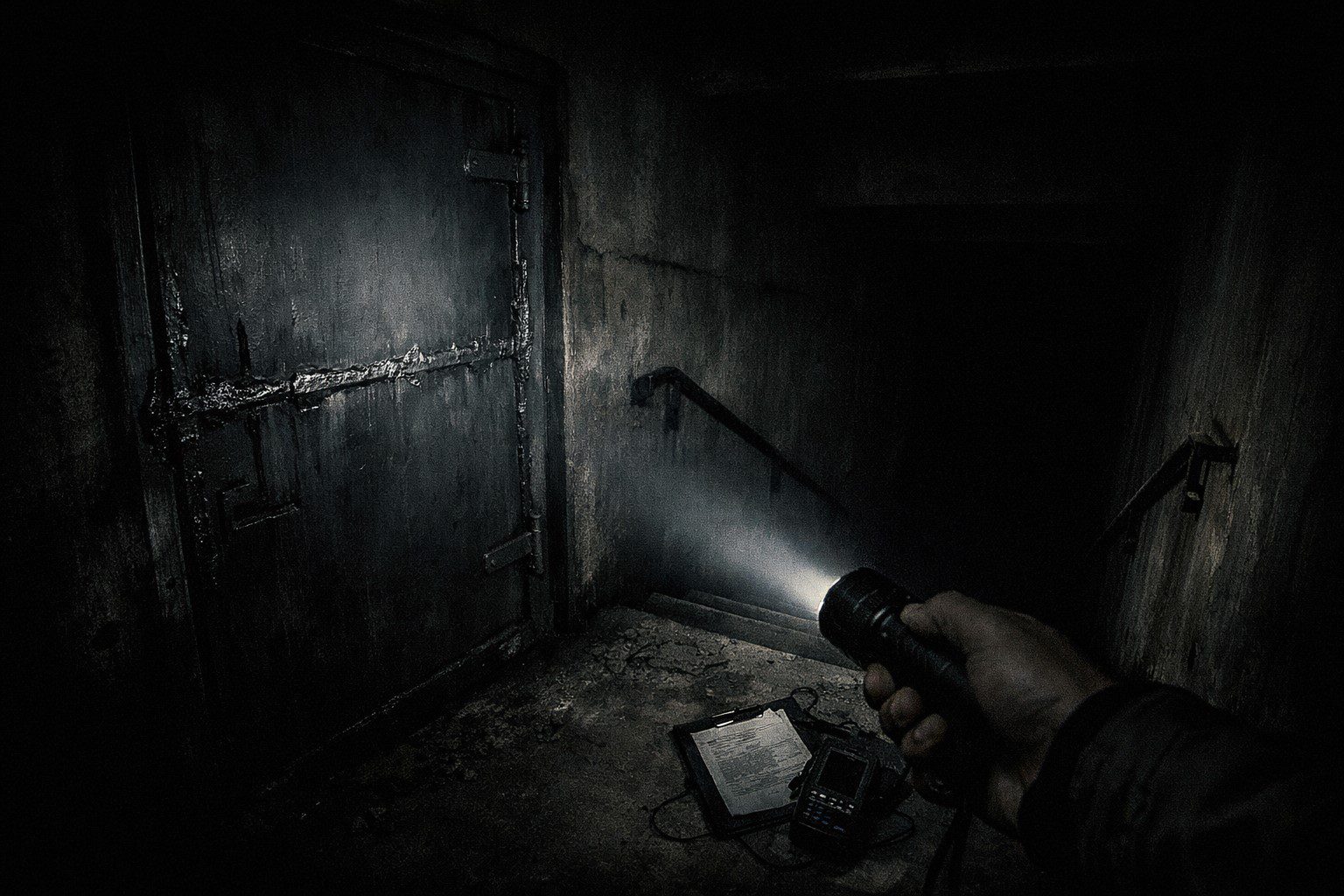
The door had been welded shut from the outside. I discovered this at the exact moment the lights went out, which meant whoever had done it had planned the timing, which meant I was not alone in the situation I was in — someone else was managing it from the other side of a wall I could no longer see.
I stood in the dark and breathed and did not panic. That was the first decision and it was the right one.
My name is Yael Stern. I am a structural safety inspector for a firm that assessed decommissioned military infrastructure — old bunkers, disused command posts, Cold War remnants that local authorities needed documented before they could be sold, converted, or demolished. The work was unglamorous and largely solitary, which suited me. I had been doing it for nine years. I understood old buildings the way most people understood familiar streets — by feel, by pattern, by the logic of how they had been designed to function.
The bunker beneath the Hartfield site had been listed in my assignment file as decommissioned in 1987 and last inspected in 2009. It was a standard two-level structure: personnel quarters on the upper level, operations and communications below. I had entered via the main stairwell at ten forty-three in the morning with a full kit: torch, backup torch, gas monitor, structural assessment equipment, water, and a satellite communicator that I checked before I descended.
The satellite communicator had shown three bars on the surface. Twelve steps below ground it showed zero, which was expected and noted. I would surface periodically to send progress updates, which was standard protocol for solo underground inspections.
I had been below ground for forty minutes when the main door sealed and the lights went out.
My torch was in my hand before I finished registering what had happened — muscle memory from nine years of working in spaces where the power was unreliable. The beam cut through the dark and I moved it systematically: walls, ceiling, floor, the stairwell entrance ahead of me. Solid concrete throughout, no change in structure, nothing fallen. The building was intact. The darkness was not structural failure.
I went up the stairwell and examined the main door. A standard blast door, original equipment, steel and concrete construction, hinged to open inward. I put my palm against it and pushed. Solid. I examined the seam with my torch and found what I had suspected: the door had been welded, four points along the frame, with work that looked recent. The smell of the weld was still faintly present in the stairwell air.
Someone had welded the door shut while I was below ground. That required equipment, preparation, and knowledge of when I would be inside and for how long. This was not random. This was planned.
I went back down the stairs and sat on the bottom step and thought.
I had two immediate assets: the torch and the backup torch, both fully charged. I had water for eight hours. I had my full kit, which included a structural assessment toolkit that contained, among other things, a small pry bar, two types of drill bit, and a hand-crank percussion tool I used for core sampling on concrete walls.
I had no communication. I had no way to call for help. What I had was knowledge of the structure I was in, because I had spent forty minutes assessing it before the lights went out, and I had nine years of understanding how these buildings were designed.
Cold War bunkers were not built with one exit. They were built with a primary exit and at least one emergency egress — sometimes two. The primary was the main blast door, which was now sealed. The emergency egress was always secondary, usually concealed, and designed to allow personnel to exit under conditions where the primary was compromised.

 WhatsApp
 Telegram
 Email






Leave a Reply