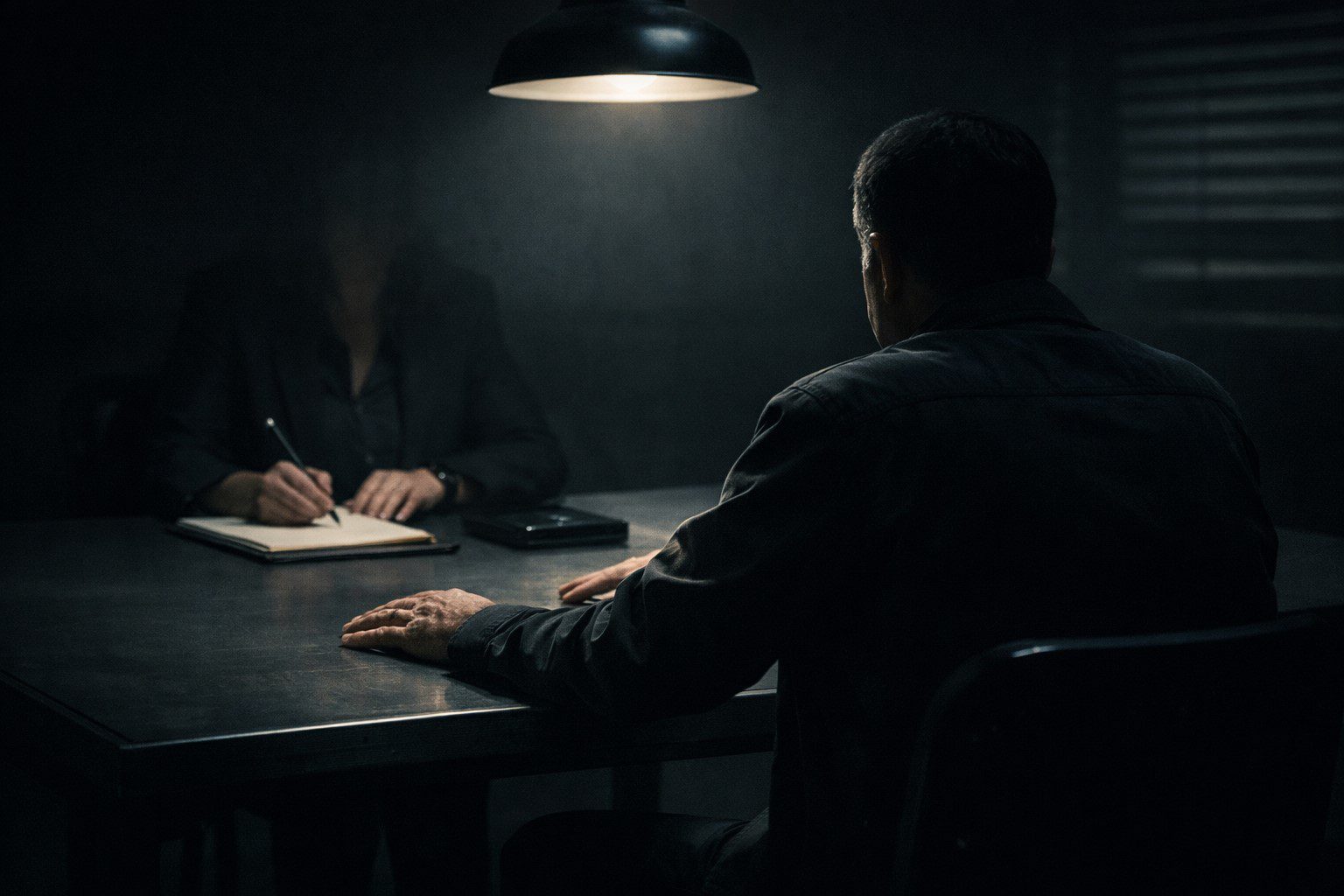
The man walked into the police station at eight forty-seven on a Wednesday morning and told the desk sergeant he wanted to confess to a murder. The problem, Detective Lena Marsh discovered when she sat down across from him forty minutes later, was that the murder hadn’t happened yet.
He was calm. That was the first thing. People who came in off the street with confessions were usually one of three things: disturbed, attention-seeking, or genuinely guilty and tired of carrying it. This man was none of those. He sat in the interview room with his hands flat on the table and his eyes steady and he spoke with the even tone of someone delivering information he had already organised.
His name was Thomas Callard. He was fifty-six. He had a home address, a job in logistics management, no criminal record. He looked like someone’s accountant.
He had come to confess, he said, to the murder of a man named Gerald Voss. He provided an address, a physical description, and a motive with the efficiency of someone who had rehearsed the delivery. Gerald Voss had defrauded the small investment fund that Callard’s elderly father had put his retirement savings into. The fund had collapsed three years ago. His father had lost everything at seventy-four and had died last year, and Callard believed, in the specific and airless way of a man who had been sitting alone with an idea for too long, that Gerald Voss was responsible for that death as surely as if he had been in the room.
“You said this murder hasn’t happened yet,” Lena said.
“Correct.”
“Then what you’re describing is an intention.”
“I’m describing a plan,” he said. “I’m going to kill Gerald Voss on Friday evening at his home. I thought you should know in advance.”
Lena looked at him for a moment. Then she looked at her notebook, where she had written the address and the name.
“Why are you telling us?” she asked.
He considered the question as though it were reasonable, which it was.
“Because I want you to stop me,” he said. “And because I’m not sure I can stop myself.”
She ran the name immediately. Gerald Voss: fifty-one, financial consultant, three civil judgments against him in the past four years, twice investigated by the Financial Conduct Authority, twice cleared on technicalities. A man who operated in the gap between legal and criminal with apparent comfort. The investment fund was real, the collapse was documented, and the list of people who had lost money in it was long and included several who were significantly more vulnerable than Callard himself.
She went back into the interview room.
“Mr. Callard, I want to be direct with you. You haven’t committed a crime. Expressing an intention is not an offence. I can’t hold you here.”
“I know,” he said.
“What I can do is take this seriously and act on it.”
“That’s why I’m here.”
She studied him. The steadiness of him was not the steadiness of a man who had made peace with something. It was the steadiness of a man who was holding himself very still because he did not trust what happened if he moved.
“Is there anyone you can stay with?” she asked. “Tonight and tomorrow?”
“My sister,” he said. “She doesn’t know.”
“Would you be willing to go to her?”
He thought about it. “If you tell me you’re going to do something about Voss.”
“I’m going to look into it,” she said. “That’s what I can promise.”

 WhatsApp
 Telegram
 Email







Leave a Reply