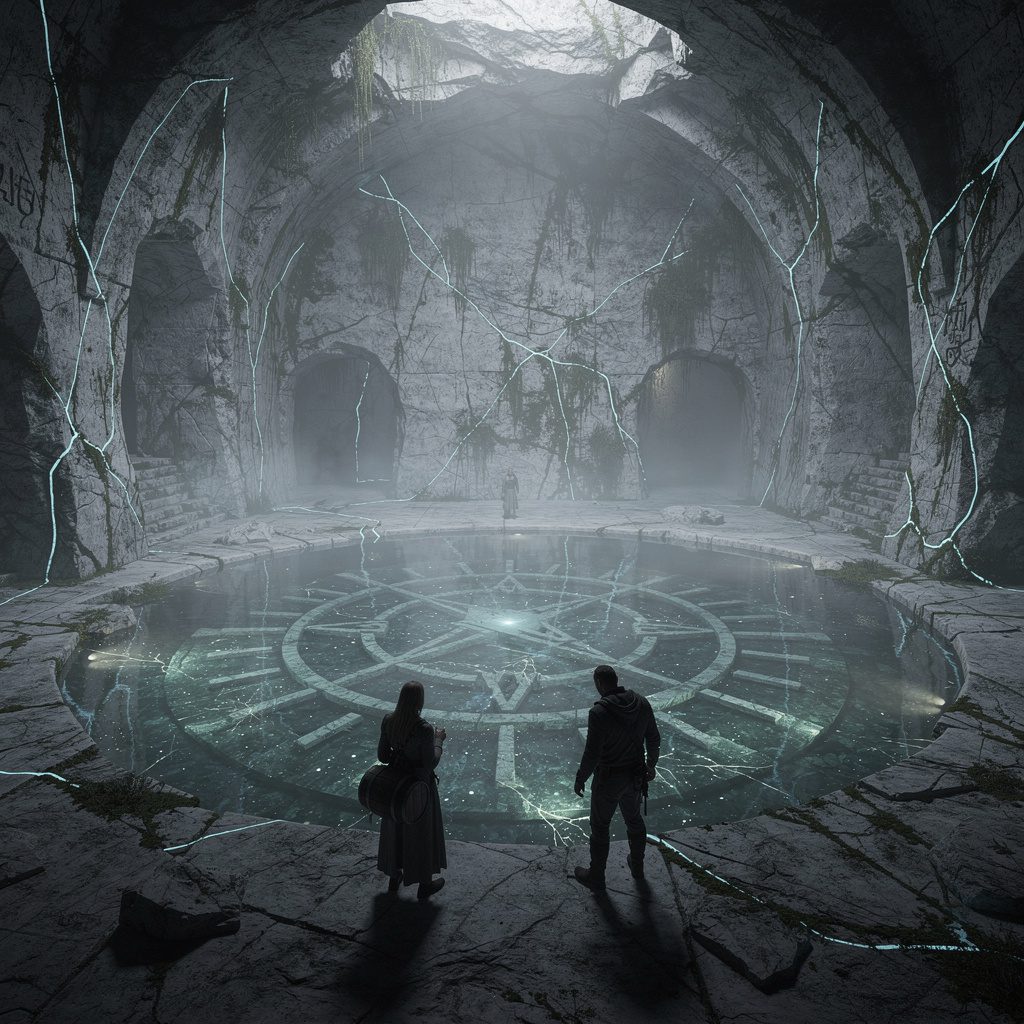
The ink on the old pact had been made from crushed nightbloom petals and the rendered fat of a marsh‑eel — Yasmin Fakhoury knew this because she had spent the better part of three years identifying the compound under a magnifying lens no wider than her thumbnail. She knew the nightbloom’s faint violet residue, knew the way eel‑fat darkened to amber when it aged past a century. What she had not known, until the morning the sealed cask arrived at her workshop door without a messenger, without a note, without so much as a footprint in the frost outside, was that the ink had also been mixed with something she could not name. Something that smelled, when she uncorked the cask and held it beneath her nose, like the precise moment before a storm breaks — electric, mineral, alive in a way that living things are not supposed to be after two hundred years.
Yasmin’s workshop occupied the upper floor of a converted granary at the edge of Ashenveil, a city that had grown like moss over the ruins of something older and less comfortable. The city’s lower quarters were carved directly into the pale limestone bluffs overlooking the Silt River, and the streets there were narrow and perpetually damp, smelling of river clay and the rendered‑tallow candles that the residents burned in lieu of the alchemical lanterns they could not afford. The upper quarters, where merchants and guild masters kept their houses, smelled of pressed wood and money.
Yasmin’s workshop smelled of neither. It smelled of dried fennel and iron filings, of the sharp green bite of crushed sorrel, of the slow, woody exhale of oak‑gall ink drying on parchment. She had spent eleven years building the smell of that place, layering it the way a forest layers its floor — one season at a time, each stratum telling the story of a different experiment, a different failure, a different almost.
She was not a woman who frightened easily. She was a woman who catalogued things, measured them, pressed them between glass slides and held them up to the light. So when the cask arrived and the smell hit her and her hands went cold despite the brazier burning two feet away, she did not run. She set the cask on the workbench, found a clean quill, and began to write down everything she noticed.
Three hours later, a man arrived at her door. His name, he said, was Oskar Wold, and he had come a long way. He was tall in the way that suggested his height had been useful once and had since become inconvenient — he stooped slightly under the workshop’s low lintel, and he moved with the careful deliberateness of someone who had learned not to knock things over. His coat was travel‑worn, oiled canvas the color of old bark, and his hands, when he set them on the edge of her workbench without being invited to, were calloused in patterns she did not immediately recognize. Not a swordsman’s callouses. Not a laborer’s either. Something in between, or something else entirely.
His face was long, with deep‑set eyes the color of river sediment — that particular grey‑brown that is neither one thing nor the other — and a scar along the left jaw that had healed cleanly enough to suggest someone had known exactly what they were doing when they stitched it. He looked at the cask on her bench, and something moved behind his eyes that he controlled before she could read it properly.
„You opened it,” he said. Not an accusation. An observation with weight behind it.
„It arrived at my door,” Yasmin replied. „I assumed it was meant to be opened.”
Oskar Wold pulled out a chair without asking and sat down. He folded his hands on the table, and Yasmin noticed that his knuckles were white.
„The pact names the Fakhoury line,” he said. „Specifically. Your grandmother’s grandmother signed it. The other signatory was my grandmother’s grandmother. The debt is generational. It comes due when the ink wakes up.”
He paused.
„Which it has, apparently, done.”
The fire in the brazier popped. Outside, the Silt River moved in its slow, indifferent way, carrying silt toward the sea.

 WhatsApp
 Telegram
 Email
About the Author







Leave a Reply