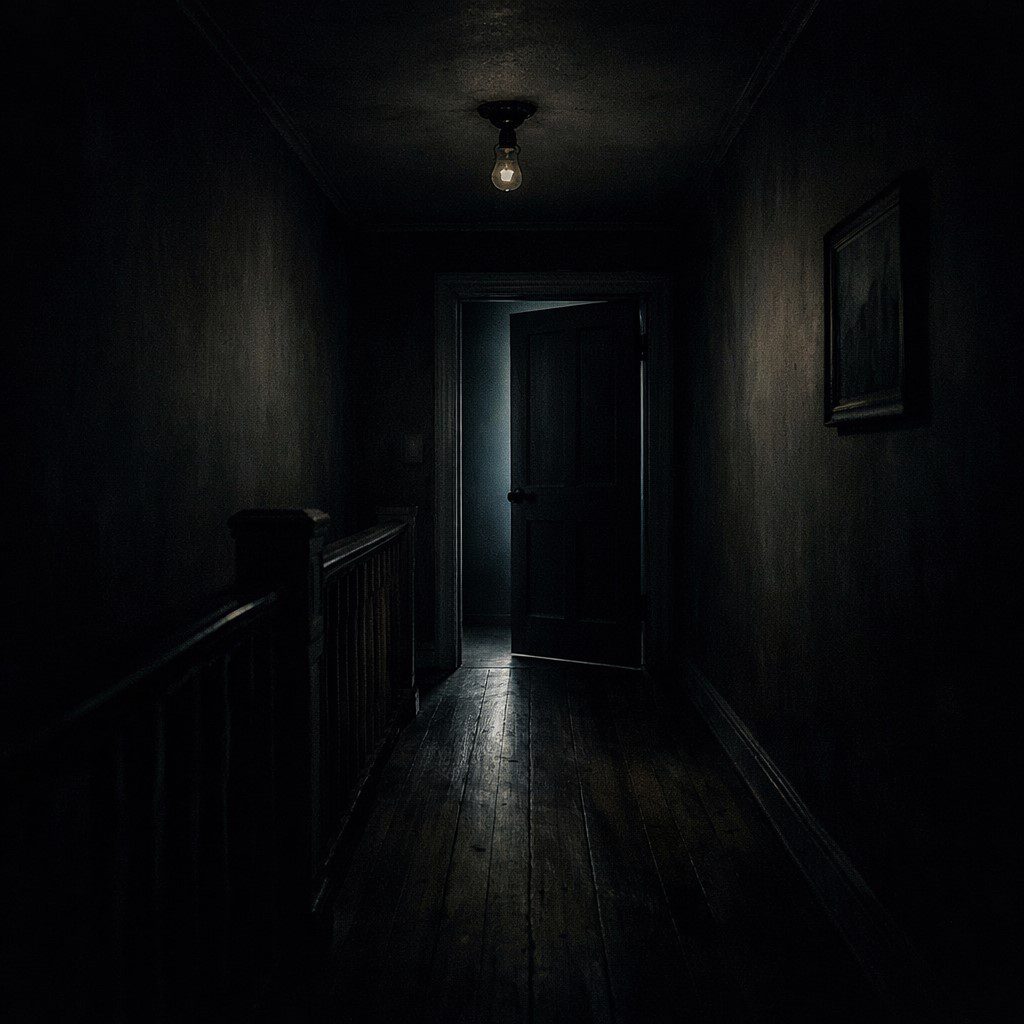
The house had four rooms when I moved in on a Saturday. By Wednesday it had five. I know how that sounds, and I know that the sane explanation — the one my sister offered when I called her — is that I had simply not noticed the fifth room during my initial walkthrough. I had spent eleven years as an architect. I notice rooms.
The fifth room was at the end of the upstairs hallway, behind a door that I was certain had not been there before. It was unlocked. I did not go in. Not that first time.
My name is Miriam Feld. I had moved to Greaton after a marriage that ended quietly and a job that ended less so, in the way of someone who needed a complete change of surface. The house on Carre Lane had been listed below market — I had noted that and asked the estate agent about it, and she had said something careful about the previous owner having relocated abroad quickly and wanting a fast sale. I had bought it because it was within my means and because it had the right bones, which was a thing architects said when what they meant was that they could see what a place was supposed to be underneath what it had become.
The bones were fine. Three bedrooms, a study, a kitchen, a sitting room. A hallway upstairs that ran the length of the first floor. I had walked every inch of it on the Saturday I viewed it and again on the Saturday I moved in, with the specific attentiveness of a person who was about to live alone in a place they had not yet learned.
On the Saturday: four rooms upstairs. A landing, a hallway, four doors, all of which I had opened and stood in and assessed. I was certain. This was not the kind of thing I was uncertain about.
On the Wednesday: five doors.
I examined the fifth door before I opened it. The door itself was consistent with the others — same paint, same hardware, same faint scuff at the base where a long-ago foot had pushed it open one too many times. It was not new. It did not have the look of something that had been installed recently or in haste. It had the look of something that had always been there.
I took photographs. I measured the hallway. The addition of a fifth door had not compressed the space between the others — the measurements were consistent with a hallway that had always contained five doors rather than four. Either the architecture had accommodated the new door without adjustment, or the door had always been there and I had been looking at a hallway with five doors since the Saturday I first walked it and had, through some lapse I could not account for, failed to register one of them.
I sat on the hallway floor and looked at the door and thought about what I knew about perception and attention and the ways that the human eye moved through familiar or semi-familiar spaces. There were documented phenomena — inattentional blindness, change blindness — that could account for missing a detail in a busy visual field. A quiet hallway with five painted doors was not a busy visual field. I was an architect. I had been trained to see what was there.
I knocked on the door. From the other side: nothing. No echo that suggested a large space. No sound of any kind.
I opened it.
The room was small. Perhaps three metres by four. A single window on the far wall, looking out onto the back garden — I could see the apple tree I had already noted from the kitchen. A bare floorboard floor. One wooden chair in the centre of the room, facing the window. Nothing else.

 WhatsApp
 Telegram
 Email







Leave a Reply