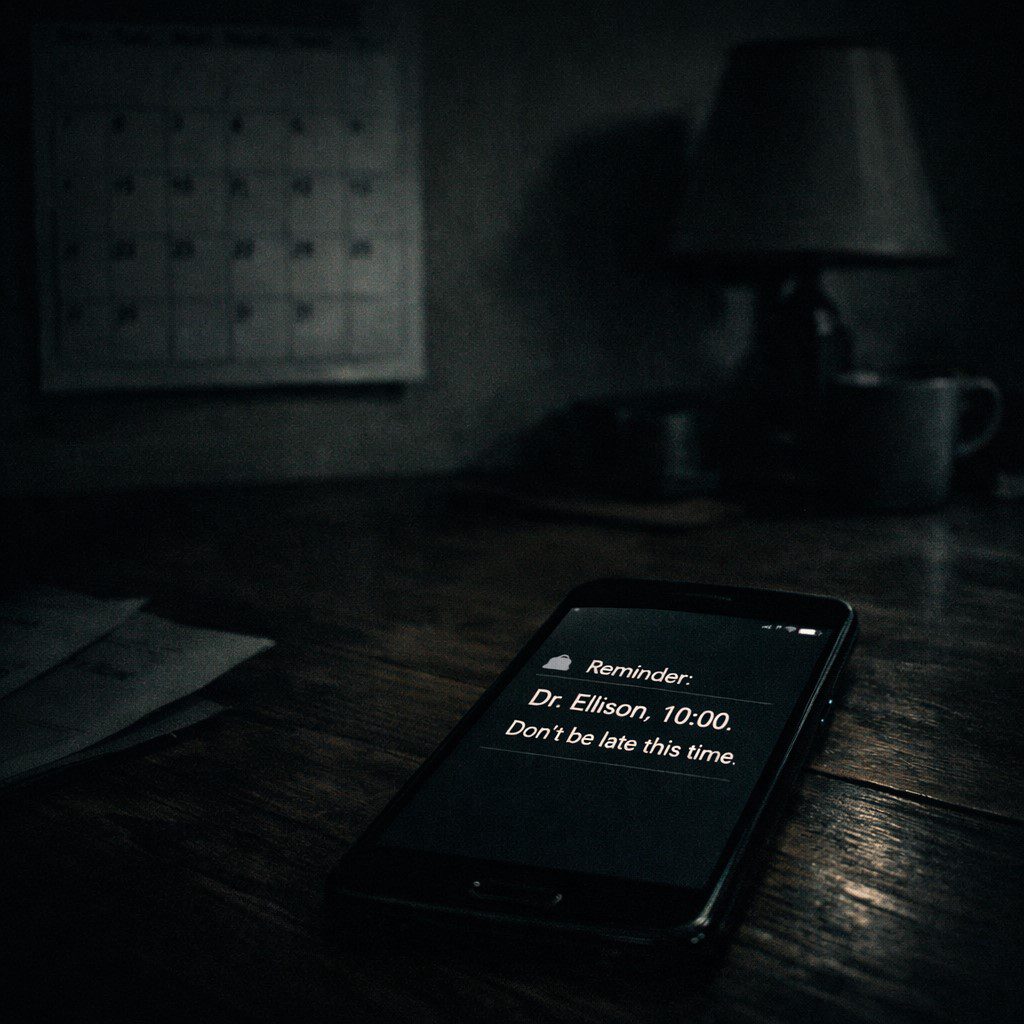
The reminder appeared on my phone at 7 a.m. on a Wednesday: Dr. Ellison, 10:00. Don’t be late this time. I had never heard of Dr. Ellison in my life, and I had definitely never been late to an appointment I didn’t know existed.
I checked my calendar. Nothing. I checked my email. Nothing. The reminder had come from my own phone, my own reminders app, in my own words.
My name is Clare Ashford. I am thirty-six years old, I am a secondary school librarian, and I am, by any reasonable measure, a grounded person. I do not sleepwalk, I do not have blackouts, and until last Wednesday I would have told you with complete confidence that I had a reliable and untroubled relationship with my own memory. I remembered things. I was the person in my friend group who recalled what everyone ordered at restaurants two years ago and whose birthday fell on a bank holiday. Memory was one of the things I trusted about myself.
The reminder unsettled me in a way I couldn’t quite account for, so I did what grounded people do: I looked for the simple explanation. I had set the reminder and forgotten it. I had a doctor with an unusual name I had temporarily blanked on. It was early, I hadn’t had coffee, and the brain does odd things in the first minutes of the day.
I made coffee. I googled Dr. Ellison. A therapist, private practice, twenty minutes from my flat by bus.
I had no memory of ever looking that name up before. But there it was in my search history, eight days ago, along with a result I had apparently clicked: Dr. Ellison — specialising in dissociative disorders and recovered memory.
I put the phone down on the counter and looked at it for a while.
I called the number on Dr. Ellison’s website. A receptionist answered on the third ring, pleasant and efficient, and told me yes, I had an appointment at ten, I had booked it myself three weeks ago, and they had sent me a confirmation email to the address I gave them, which was my address. She offered to resend it. I said yes and waited and watched it arrive in my inbox with my name in the header and a reference number and everything exactly in order.
I went to the appointment.
Dr. Ellison was in her mid-fifties, calm in the particular way of people who have spent decades being professionally calm in the face of things that would unsettle anyone else. Her office was on the first floor of a converted townhouse — bookshelves, two chairs, a window overlooking a small garden where something was just beginning to come into leaf. She shook my hand and gestured to the chair across from hers and said, “It’s good to see you again, Clare.”
I sat down carefully and said, “I think there may be some confusion. I don’t remember making this appointment.”
She looked at me for a moment with an expression that was attentive but not surprised. “Tell me about that,” she said.
She did not tell me, in that first session, what I had come to see her about three weeks ago. She said that before she shared anything from our previous conversation, she wanted to understand where I was starting from now — what I remembered, what I didn’t, and how I was feeling about the gap. She said this in the measured tone of someone following a considered professional protocol, and I found, to my own surprise, that I trusted her. She had the quality of someone who had heard difficult things and held them without flinching, and sitting across from her I felt the specific relief of a person who has been carrying something alone and has just sat down.

 WhatsApp
 Telegram
 Email







Leave a Reply