I should tell you, before we begin, that I was there. Not watching from a distance, not piecing this together from scattered accounts. I was in that corridor with them, my hands still smelling of wormwood and charred sage, my notebook soaked through with rain. I am getting ahead of myself. That is a habit I have never managed to cure.
Let me start with the door.
—
Three weeks before the door was found, Josette Manswell was standing in the ruins of the Aldenmere apothecary, cataloguing what the fire had left behind. Not much. A few iron hooks. A blackened shelf still bolted to the crumbling wall. The ghost of a smell — sweet, medicinal, and underneath it something older and stranger, like the earth after a hard frost has broken.
The apothecary had belonged to her mother.
Josette was not grieving. She told herself this frequently. She was assessing. She was practical. She had a leather satchel over one shoulder, a wax pencil behind her ear, and a list of things to salvage. She was not standing in the ash looking for a sign of her mother in the pattern of the char. She was not.
She found the door by accident, the way most terrible things are found.
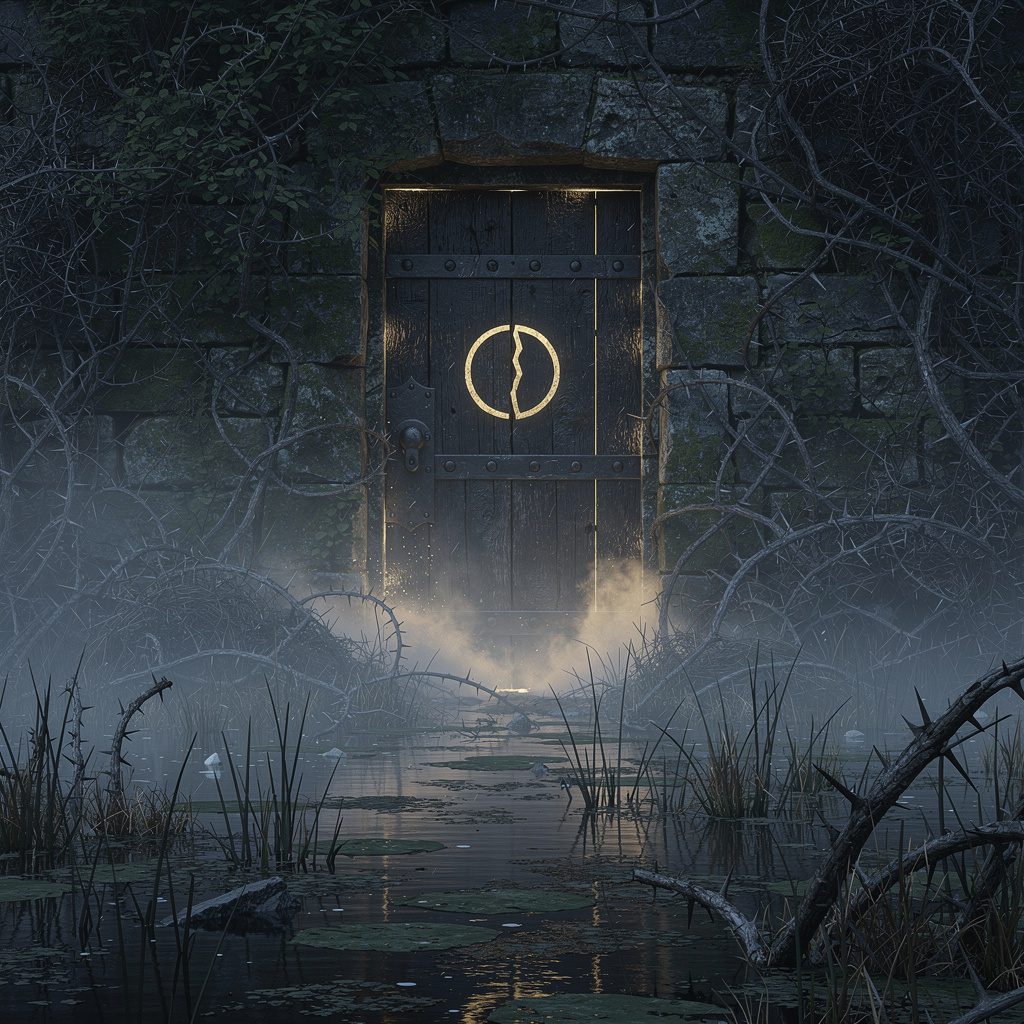
It was set into the back wall, behind where the large oak cabinet had stood — the one that had burned so completely it left only a rectangular shadow of soot on the stone. The door itself had not burned. It was narrow, dark wood, almost black, bound with iron that had gone the deep red-brown of old blood. No handle. No visible hinge. Just a surface of grain and knot, and at its center, carved so finely it might have been grown there rather than cut, a single symbol: a circle broken at the top, like a bowl tipped to spill.
Josette pressed her palm flat against it.
Nothing happened.
She wrote it in her notebook and walked away.
—
At roughly the same time — or perhaps a day earlier, the sequence has always troubled me — Callum Buchanan was sitting in the back of a boat crossing the Vethara Marshes, arguing with Daichi Jang about whether the map they had paid an extraordinary sum of coin for was, in fact, completely fabricated.
“The scale is wrong,” Daichi said, holding the map at arm’s length as though distance might improve it.
“The scale is approximate,” Callum said.
“There is no river marked here. We are on a river.”
“There are many rivers in the marshes.”
“Callum.”
“Daichi.”
Verona Neblett, who was rowing, said nothing. She had been saying nothing for most of the journey, which was unusual for her. Callum had noticed but had not asked. Daichi had noticed and had asked twice, both times receiving a response of such complete blandness that he had retreated into the map argument as safer territory.
Verona had lost her apprenticeship three months ago. The guild had not explained why — they rarely did, when they revoked a standing. She had simply arrived one morning to find her key no longer fit the lock and a sealed letter on the step with her name on it in formal script. The letter said: with regret. The letter said: the guild’s decision is final. The letter said nothing that actually explained anything.
She had spent those three months finding a new purpose. This expedition was it. Or was supposed to be.
“There,” she said, and pulled the oar in. The boat drifted toward a low bank where a cluster of blackthorn grew so thick it formed a wall. Behind the blackthorn, barely visible, was a shape. Rectangular. Dark.
All three of them went still.

 WhatsApp
 Telegram
 Email






Categories
- AI & Technology
- Contemporary
- Corporate Control
- Creepypasta
- Crime Thriller
- Cyberpunk
- Dark Fantasy
- Enemies to Lovers
- Fairy Tale Retelling
- Fantasy
- First Contact
- Forbidden
- Genetic/Body Horror
- High Fantasy
- Monster Hunter
- Mythic/Folklore
- Paranormal
- Portal/Otherworld
- Post-Apo
- Post-Collapse Society
- Psychological Thriller
- Romances
- SCI-FI
- Second Chance
- Slow Burn
- Space Combat
- Spacepunk
- Surveillance State
- Survival Thriller
- Thrillers
- Time Travel
- Treasure Hunter
- Urban Fantasy
- Witchcraft/Curses
Tags
10min stories atmospheric atmospheric fantasy atmospheric fiction contemporary romance Creepy creepypasta crime thriller dark fantasy debt dystopia emotional fiction enemies to lovers ensemble cast epistolary fantasy female protagonist first person forbidden romance framed narrative high fantasy love story magic Memory mystery Paranormal psychological horror psychological thriller romance sci-fi second chance second chance romance short fiction short story slow burn space station speculative fiction supernatural Survival survival thriller suspense thriller travel romance witchcraft workplace romance
Leave a Reply