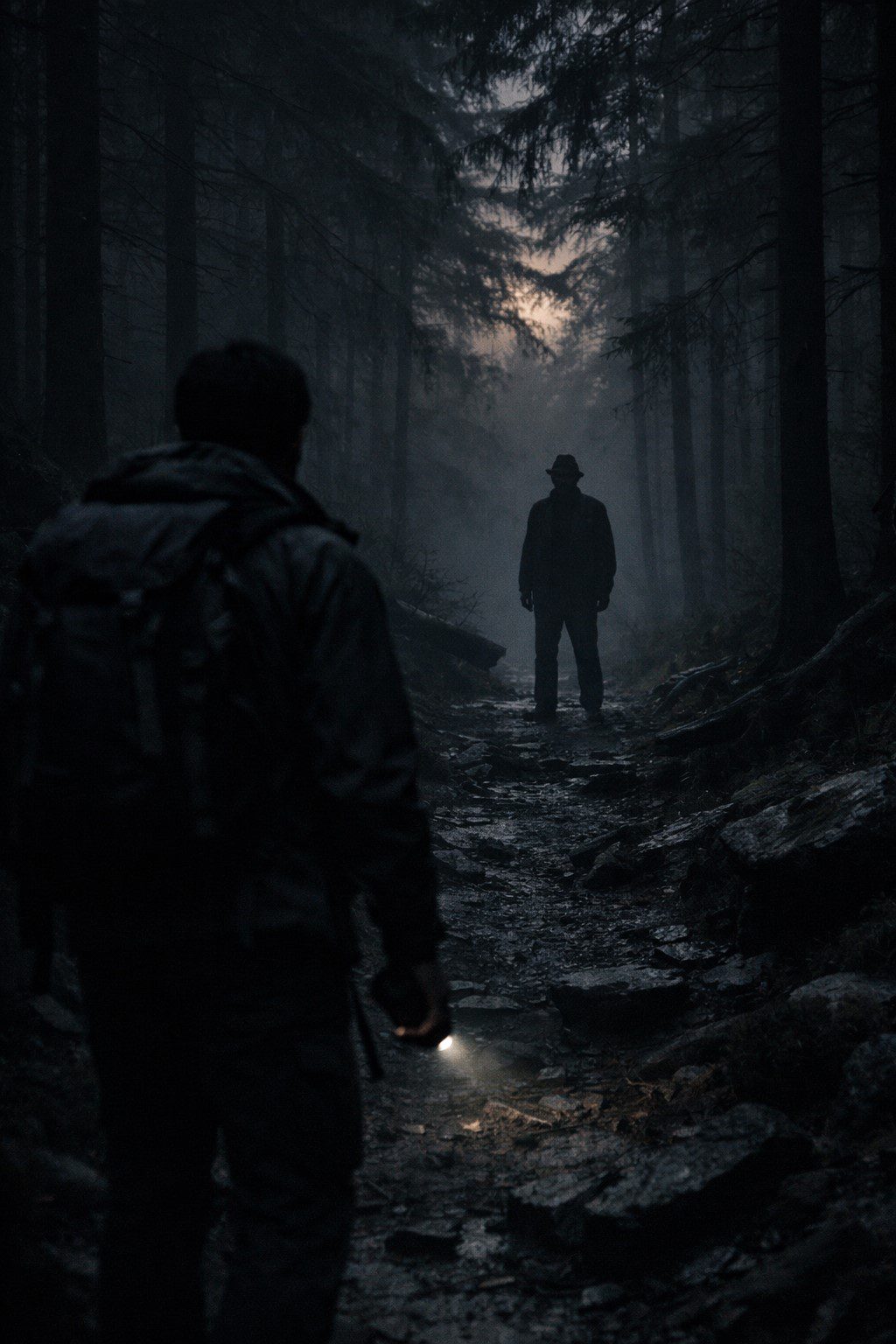
I had been hiking for six hours when I recognised the tree. The same split trunk, the same burned scar running down its left side — the one I had passed four hours ago, three miles in the opposite direction.
I stopped walking. The forest did not.
My name is Daniel Frey. I am not a reckless person. I had filed a route plan with the ranger station before I set out that morning. I had a map, a compass, a fully charged emergency beacon, and eleven years of solo hiking behind me. I had chosen the Carrow Ridge trail because it was graded moderate, well-marked, and fifteen kilometres in a clean loop.
I should have been back at the trailhead by two in the afternoon.
It was now past five, the light was going amber and thin through the canopy, and I was standing in front of a tree I had already passed twice.
I checked the compass. North was where north should be. I checked the map. The split tree was marked — I had noted it myself on the way out, circled it in pencil as a reference point. According to the map I was holding, the tree was behind me.
I turned around slowly.
The trail behind me curved away into shadow. I could see perhaps thirty metres before the forest closed it off. Nothing moved. Nothing made a sound.
That was the part that bothered me most. This far into the afternoon, there should have been birdsong. Wind in the upper branches. The ordinary noise of a living forest.
There was none.
I made myself sit down, drink water, eat something. Panic is a navigation problem before it is anything else — it closes off the part of your brain that reads terrain, and without that you are finished. I had told my hiking students that for years. I made myself believe it now.
I retraced the logic. I had turned left at the ridge junction, following the yellow markers. I had descended into the valley, crossed the footbridge over the creek — I remembered the sound of the water clearly — and then climbed back up through the pine section to rejoin the main loop.
Except the pine section was where the tree stood.
And the pine section was, according to my map, a kilometre north of the footbridge I had crossed.
I looked at my boots. Red clay soil, packed into the treads.
The ground around me was dark loam and pine needles. There was no clay here, and no clay anywhere on the route I had just walked. Which meant I had crossed the clay section without remembering it, or I had been somewhere the map said I hadn’t been, or the map was wrong.
None of those options were comfortable.
I reached for my emergency beacon. The light blinked green — powered, connected. I held it without activating it. Not yet. Not until I understood what was happening.
I took bearings from three different points and triangulated my position. The result placed me on the trail exactly where the map said the split tree stood. That part was consistent.
What wasn’t consistent was the sun.
I had been checking my position against the sun all day — basic navigation habit. At five in the afternoon in early September at this latitude, the sun should be in the southwest, dropping toward the treeline.
It was in the southeast.

 WhatsApp
 Telegram
 Email







Leave a Reply