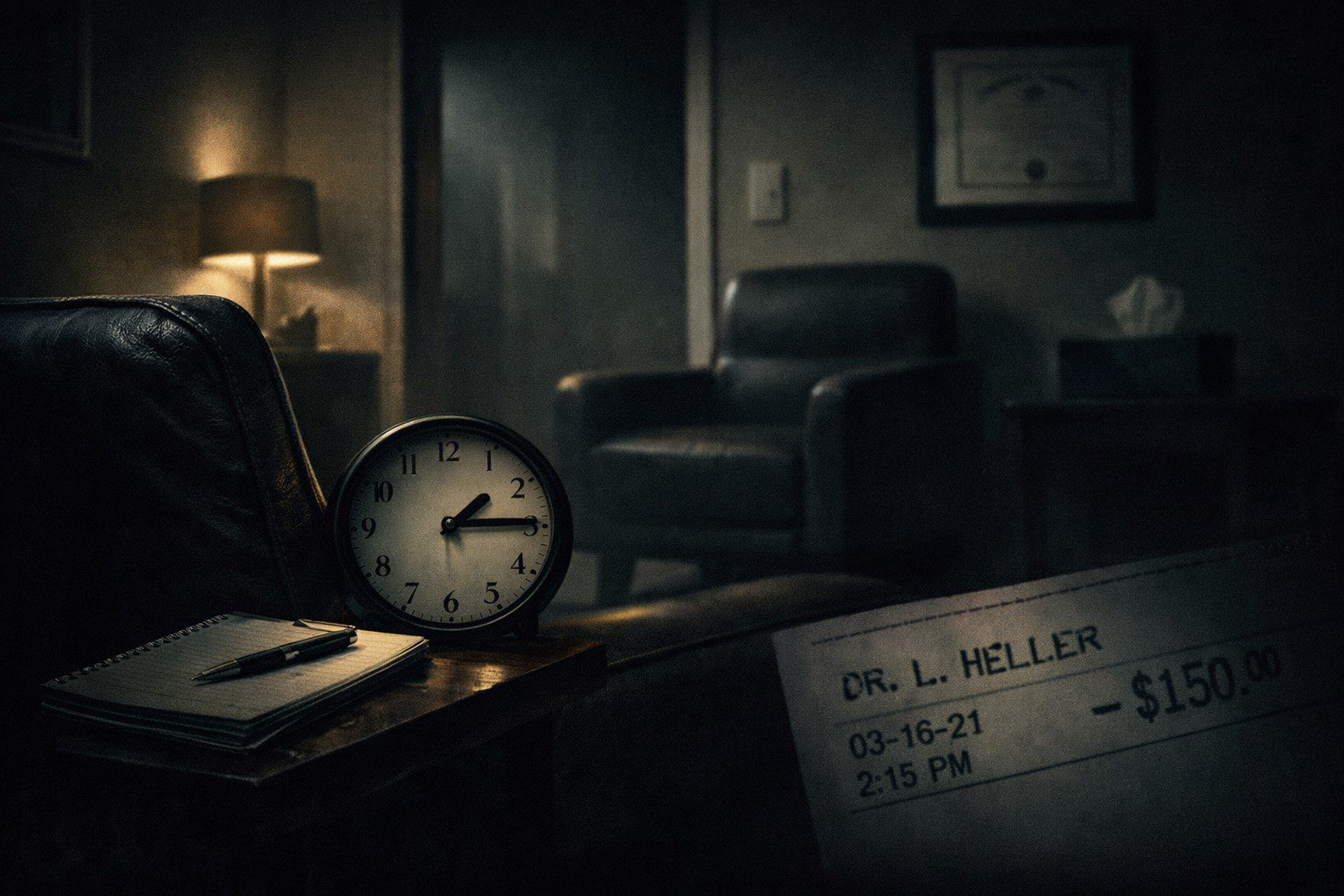
I went to see Dr. Heller the following week — a scheduled session, one I had booked and confirmed and would remember. I arrived at two-oh-three as always. I sat in the chair by the window. She greeted me in the hall and we went through to her office and I sat across from her and said, without preamble: “I need to talk about the Tuesday appointment.”
“All right,” she said.
“I have no memory of it.”
She was quiet for a moment. Not surprised — that was the detail I noticed. Her expression was thoughtful rather than concerned, the expression of someone processing information they had been expecting rather than receiving something new.
“You’ve had episodes like this before,” she said. “You mentioned one last month, in our first session. A day at work where you had strong evidence of having done things you couldn’t recall.”
I had no memory of saying that either.
“Tell me what you do remember,” she said. “From that Tuesday.”
I described my Tuesday. The desk, the deadline, the ordinary continuous day. She listened carefully. Then she said: “What you’re describing is consistent with what you told me in our first session that brought you to therapy. You called it the gap. A version of yourself that moves through the day and does the things that need doing, but that you’re not present for.”
The gap. I looked at her. “I said that?”
“Those were your words,” she said. “You said you’d been living with it for two years. That some days felt borrowed. That you were often surprised by what you’d done and had no sense of having decided to do it.”
I drove home instead of walking and sat in my car outside my building for a while. I thought about the phrase some days felt borrowed. It was exactly the phrase I would use. It was more precise than anything I had consciously formulated about the experience, but it was not wrong. It was the right phrase and I had apparently said it and I could not access the moment of having said it at all.
I went upstairs and opened a notebook — the physical kind, not digital — and wrote down everything I could remember about the first session with Dr. Heller. The office, the light, the plant on the windowsill, the way she had asked her opening questions. I wrote for forty minutes and what I produced was a clear and detailed account of a session that had definitely happened and that I fully remembered.
Then I wrote down what I had thought were the first two sessions and compared the accounts.
Both clear. Both detailed. Both mine.
But if she was right — if there had been a third session that Tuesday, a session I had attended and engaged with and not retained — then I had three sessions documented in my memory as two. The texture of them felt complete. There were no visible seams.
Whatever was happening to me, it was not chaotic. It was not distressing in the way a fracture would be distressing. It was quiet and continuous and it had apparently been going on long enough for me to have developed language for it.
Some days felt borrowed.
I spoke to Dr. Heller about it directly in the session after that. I told her I wanted to understand the full shape of what she knew about me — what I had told her in sessions I couldn’t remember. She said she was glad I was asking. She said it was the most direct I had been about it.

 WhatsApp
 Telegram
 Email







Leave a Reply