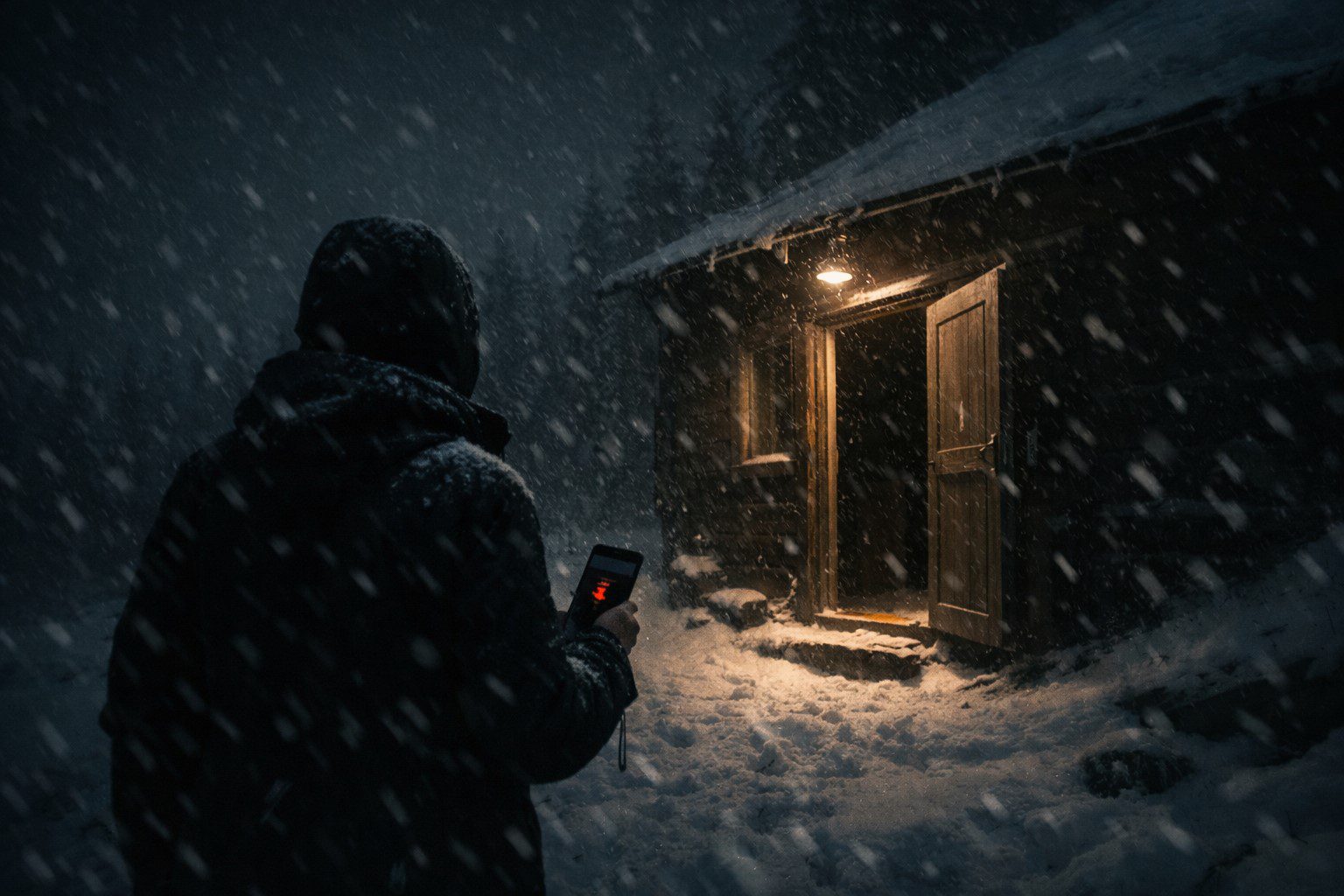
I turned off the lamp so I wouldn’t be visible from outside and sat in the fire’s orange light and listened. The sounds moved slowly across the roof from east to west — from the back of the cabin toward the front — and then stopped above the door.
I did not move.
A long silence. Then the door handle moved.
It moved down, slowly, the way a handle moves when someone on the other side is pressing it carefully, testing it. I had locked the door when I came in — a simple bolt, nothing serious, but it held. The handle returned to level. Silence. Then the footsteps again, retreating west, back along the roof, fading into the wind.
I sat in the dark with my hands flat on the table and breathed and thought.
There were three possibilities. An animal — but nothing local moved like that, with that cadence and that patience. A person — but no one should be out in this storm, and no one should be on the roof of a mountain cabin at nine in the evening in the dark. Or something structural: ice accumulation, a loose panel, the particular way old timber moved under weather load. I was a structural engineer. I knew how buildings talked to themselves in storms. And what I had heard did not sound like a building.
I checked the windows one by one, staying to the side of each frame so I wouldn’t be backlit by the fire. Snow, wind, darkness. Nothing visible.
I checked my phone. Twelve percent. A signal bar had appeared — thin and unreliable, but there. I called Miro. It rang four times and went to voicemail. I left a message that I tried to make sound less alarmed than I felt: the door had been open when I arrived, there was something on the roof, could he call me back. Then I sent a text version of the same message in case the call hadn’t connected.
I added more wood to the stove. I moved the kitchen knife from the counter to the table beside me, not because I had a plan but because having it there made the space feel marginally more navigable. Then I sat and I waited and I did what I was trained to do: I assessed what I knew, what I didn’t know, and what I could act on.
What I knew: something had been on the roof. It had tried the door. It had not forced entry.
What I didn’t know: what it was, whether it was still close, whether it would come back.
What I could act on: almost nothing, until morning.
I did not sleep. I sat in the chair pulled close to the stove and I watched the door and the windows and I listened to the storm work itself through the structure of the cabin — the flex of the boards, the rattle of the glass, the low note of the wind under the eaves. I had told myself I would stay awake until first light, and first light in the mountains in November came late, and the night was very long.
At around two in the morning the sounds returned. This time not on the roof — at the side window, the one facing north into the deepest dark. A shape against the glass, visible for a moment in a lull between snow gusts: tall, indistinct, the wrong proportions for something I could easily name. It did not move while I could see it. It simply stood there, the way things stand when they are observing rather than acting, and then the snow closed in again and it was gone.

 WhatsApp
 Telegram
 Email







Leave a Reply