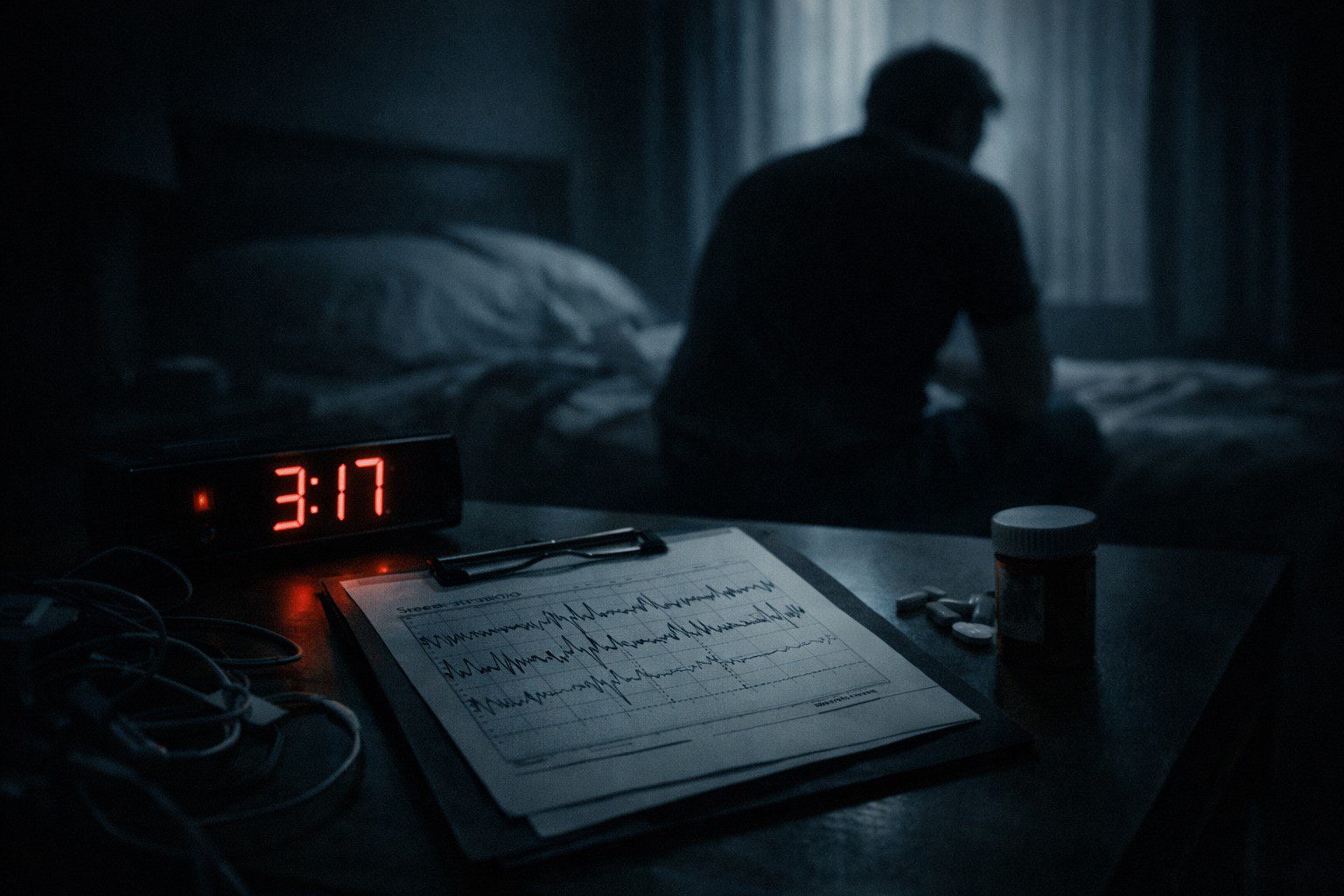
“Sol,” Dr. Farr said carefully. “Some of what you’re describing — the discrepancy between your experience and the recorded data — suggests more than sleep misperception. The activity, the lost time. I’d like to refer you to a colleague.”
The colleague was a psychiatrist named Dr. Obi, who had a quality of stillness I associated with people who had spent years being the most patient person in a room full of frightened people. He had my study results and Dr. Farr’s notes, and he spent our first session not asking about the sleep but asking about my life — my routines, my relationships, my work, the months before the tiredness had begun.
I answered everything. I was a precise person with a good memory and I gave him precise, complete answers. At the end of the session he thanked me and said he would like to see me again the following week. He did not yet tell me what he was thinking.
The second session began the same way: me, answering questions, Dr. Obi listening. Then he asked me something different.
“You mentioned your colleague Beth last week,” he said. “You said she had covered one of your classes in October.”
“Yes,” I said. “I had a meeting with the head of department that ran long.”
“Can you tell me more about Beth?”
I told him about Beth. My colleague, a history teacher, ten years older than me, someone I had shared a staffroom with for four years. I described her clearly — her manner, her appearance, specific exchanges we had had, a lunch we had shared the previous spring.
Dr. Obi made a note. Then he said: “I’d like you to speak to someone at your school for me. I’d like you to ask them about Beth.”
I asked the school administrator on a Thursday afternoon. I framed it casually — I wanted to get in touch with Beth, did she have a current email? The administrator looked at me with an expression I couldn’t immediately read.
“Beth Alder?” she said.
“Yes.”
A pause. “Sol, Beth left the school three years ago. She moved abroad. She’s not been in contact with anyone here since.”
Three years ago. I had described a lunch with Beth from the previous spring. I had described her covering my class in October. I had described four years of a shared staffroom as a present and continuous experience.
I sat in my car in the school car park for twenty minutes before I drove home.
I called Dr. Obi from the car. He answered, which surprised me — it was after hours. I told him what the administrator had said. He was quiet for a moment.
“I expected something like this,” he said. “Not this specifically, but something like it. I want to explain what I think is happening, and I want you to stay calm while I do, because what I’m going to describe is manageable.”
He told me that the sleep study data, the missing time, the pacing at three a.m., and now this — a colleague remembered as present who had been absent for three years — were consistent with a pattern he had seen before. Not common, but documented. A form of dissociative experience in which the brain constructed a continuous, plausible version of daily life to fill gaps in conscious awareness, gaps that had opened over months or possibly longer. The constructed version felt real because the brain built it from real materials: real memories, real relationships, real experiences from other times, assembled into a false present.

 WhatsApp
 Telegram
 Email







Leave a Reply