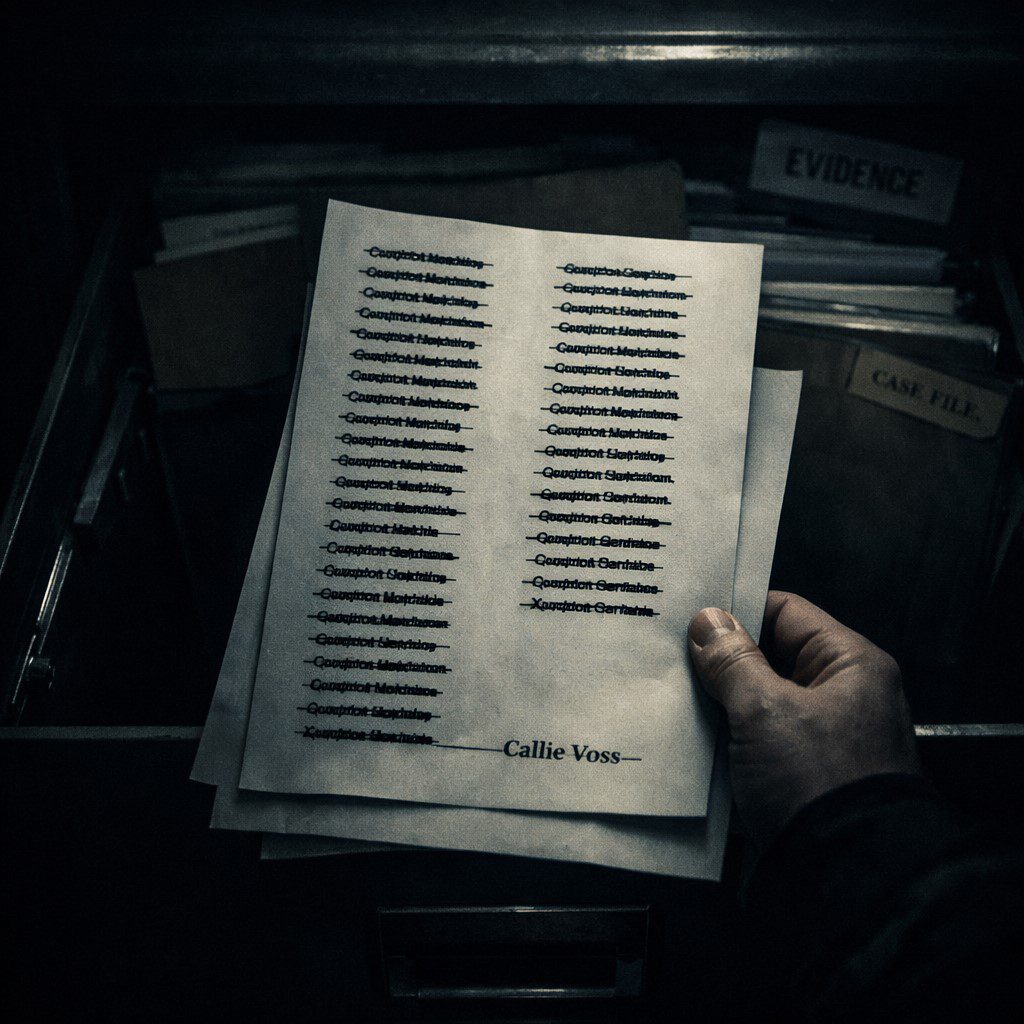
The first list had forty-three names on it and every one of them was dead. The second list had forty-four names, and the forty-fourth was mine. I found both lists in a filing cabinet that wasn’t supposed to be in the evidence room, which meant someone had put it there, which meant someone wanted it found.
I was not yet sure whether that someone was trying to help me or trying to make sure I was next.
My name is Callie Voss. I had been an investigative journalist for twelve years, which is long enough to learn that the most dangerous stories were never the ones people tried to hide from you. They were the ones that were left somewhere you’d know to look. Someone had decided I would know to look in the evidence room of the Aldgate district police station, and they had been right, because a source inside the building had called me the previous evening and said four words before hanging up: cabinet seven, bottom drawer.
That source had called from a number I had used exactly once before, two years ago, when I was investigating a procurement fraud case that had quietly resolved itself in ways I had never been satisfied with. I had recognised the number immediately. I had gone to the station that morning under a different pretence, and I had found the cabinet exactly where I had been told to find it.
Forty-three dead names and my own.
I photographed everything before I touched it. Both lists, front and back, and the folders they came in, and the cabinet itself. Investigative habit: document the scene before you change it. I noted the time on my phone and the position of the folders and the way the cabinet drawer had been left fractionally open — not careless, not all the way. Just enough so that someone looking would see the gap.
I took the photographs and left the originals. My name was on a list of dead people, and removing evidence from a police building was the least of my problems, but it was still a problem I didn’t need.
I went to a café two streets away and opened my laptop and started with the first name on the first list.
The forty-three names were not random. That became clear within the first hour. They were linked by profession — not the same profession, but adjacent ones: financial analysts, compliance officers, a risk consultant, two auditors, a mid-level civil servant who had worked in the contracts division of a government department. People who worked with numbers and with the processes that were supposed to ensure that numbers went where they were supposed to go.
The deaths were varied. A road accident. A sudden cardiac event. Three suicides, according to their coroners. One drowning, recorded as accidental. The spreadsheet of names I was building told me that over sixty-three percent of them had died within eighteen months of taking on a new role or position — a new employer, a new contract, a new client account.
I thought about the procurement fraud case that had resolved itself two years ago. The case had involved a mid-size contractor with government connections. The person inside the department who had initially flagged the irregularity had been one of the civil servants on the list. She had died eleven months ago. Her name was listed as a suicide.
I had been at her press conference, two years ago, when she gave her initial statement about the irregularities she had found. She had looked like someone who was frightened but who had decided that being frightened was not a good enough reason to stay quiet.
I had written her name at the top of my notebook. I still had the notebook.

 WhatsApp
 Telegram
 Email







Leave a Reply