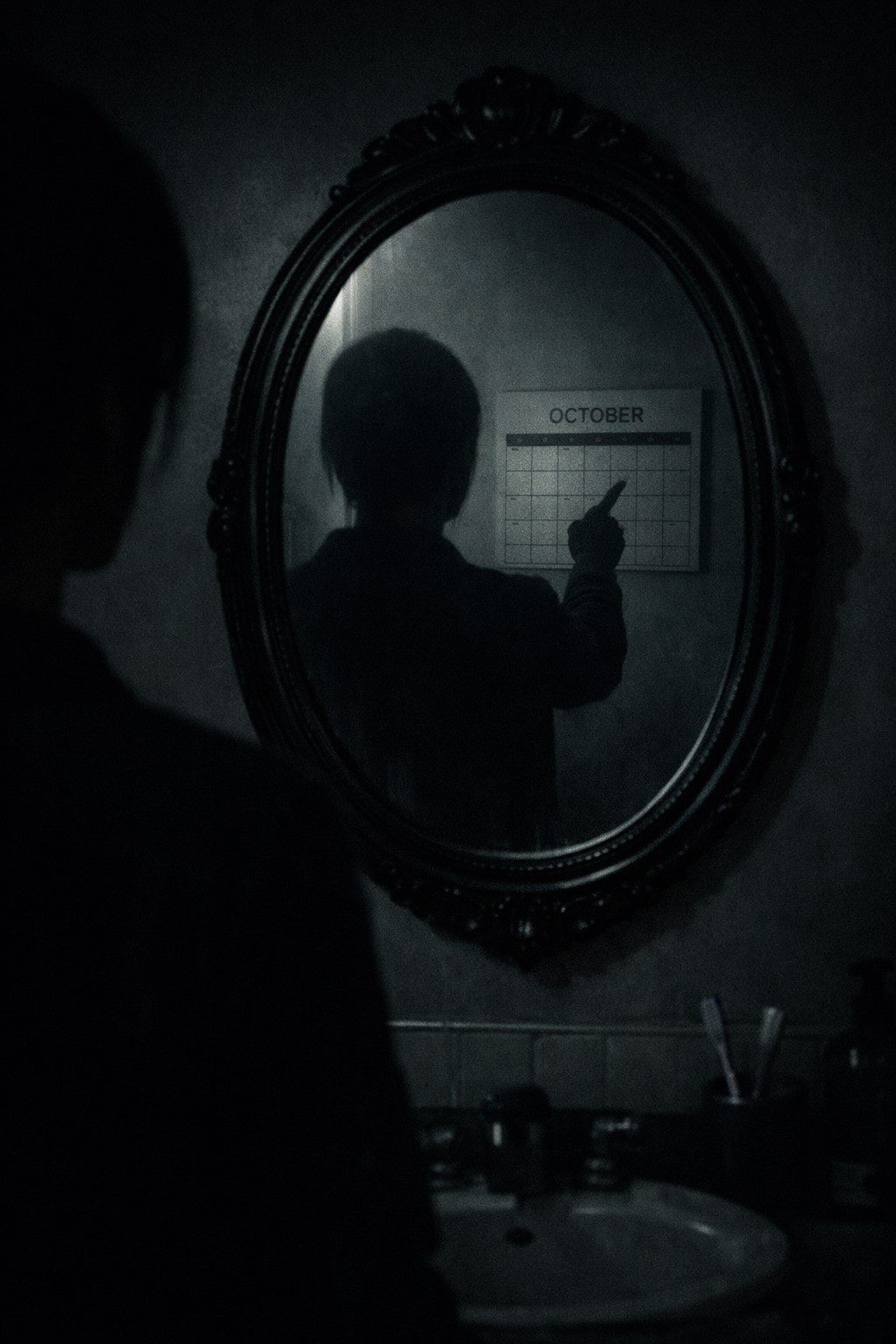
Every morning I checked my reflection and every morning it was fine. On the last Tuesday of October it was not fine, because the reflection was doing something my hands were not — and what it was doing, slowly and deliberately, was pointing at the calendar on the wall behind me.
I turned around. The calendar showed October. Nothing marked. Nothing unusual.
When I turned back, the reflection had stopped pointing. It was standing exactly as I stood, hands at its sides, face arranged in an expression of careful neutrality that I did not think I was wearing.
My name is Nora Kells. I am a secondary school geography teacher, divorced, forty-one, and I live in a mid-terrace house in a small city that doesn’t ask much of me and to which I contribute very little drama. I mention this because the mirror has been in my life for eight months and I am aware that what I am about to describe does not sound like the testimony of a grounded, mid-career professional in a quiet city. I can only tell you that it happened, and that by the time I understood what the mirror was trying to show me, it was the day before.
The mirror had belonged to my mother. Victorian, oval, a dark walnut frame with a small chip at the lower left that she had touched up with brown paint so many times that the repair had become part of the object. When she died in February, I brought it from her house because it was the thing I had looked into most often as a child, standing on the chair in her bedroom to see myself in it. It felt like the right thing to carry forward.
I hung it in my bathroom. Nothing happened for six months.
The pointing happened on a Tuesday, as I said. I stood in front of the mirror for a long time after, trying to reproduce the gesture — positioning my arm, checking the angle, making sure it wasn’t a trick of early light or a half-awake misread of my own reflection. It was not. I had been standing still. My right arm had been at my side. The reflection’s right arm had been extended, finger pointing at the calendar.
I went to work and taught three lessons and thought about it all day in the way you think about something that doesn’t fit.
That evening I stood in front of the mirror again and watched. Nothing. My reflection behaved itself — mimicking me with the slightly-too-perfect synchrony of a good mirror, moving when I moved, stopping when I stopped. I stood there for twenty minutes and felt gradually more foolish and went to bed.
In the morning the reflection pointed again. Same gesture, same calendar, same careful expression on a face that was wearing mine. I took a photograph of the mirror with my phone. The photograph showed me, standing in front of the mirror, arm at my side. Reflection also arm at side. Nothing unusual.
I put the photograph and the experience into the mental folder I used for things I could not yet categorise and went to work.
I began to keep a record. Not obsessively — I had enough going on to prevent obsession — but carefully. A small notebook by the bathroom sink where I noted each morning whether the reflection had behaved normally or not. Most mornings it was normal. But once or twice a week, across the following month, it was not.

 WhatsApp
 Telegram
 Email







Leave a Reply