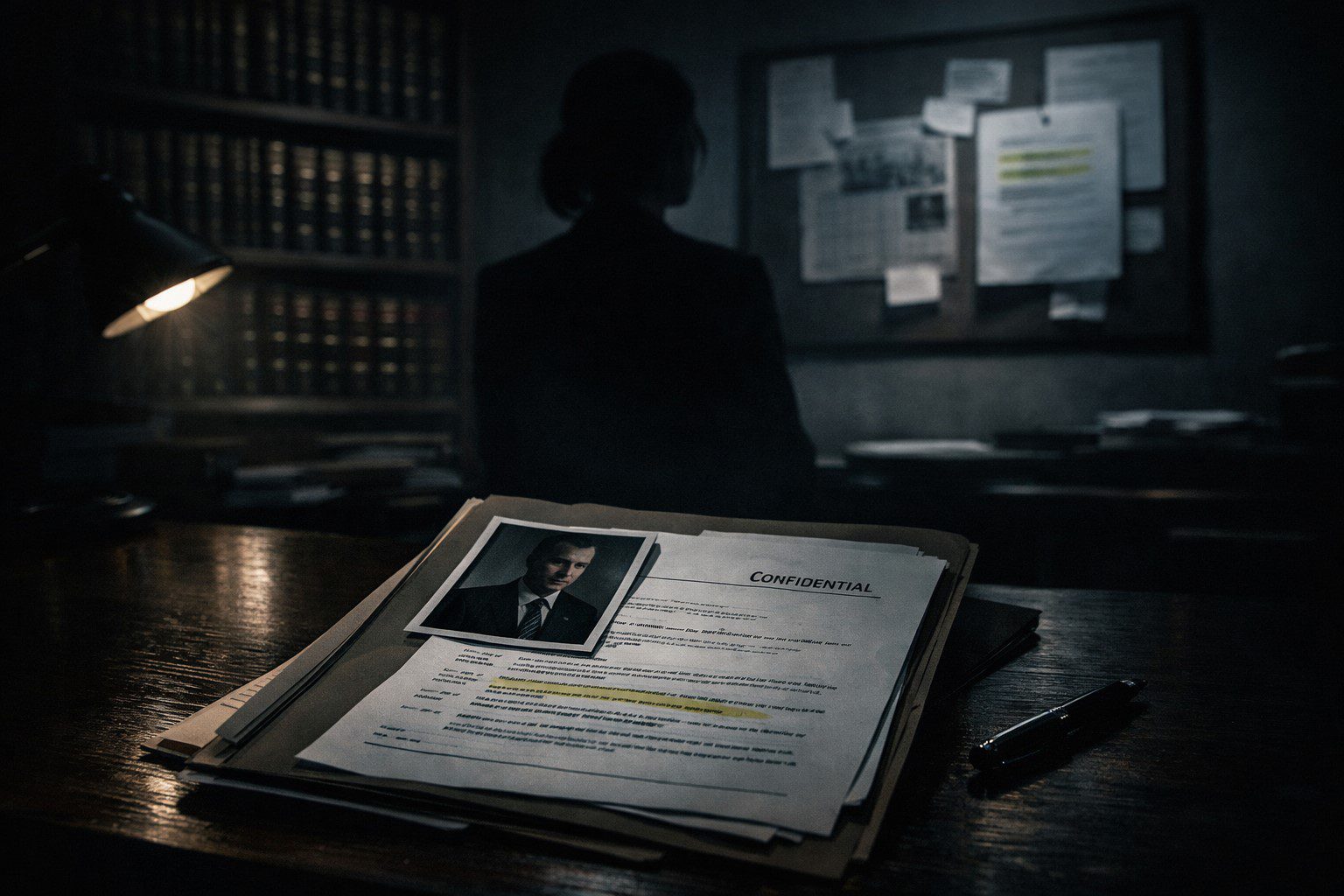
I have thought carefully about what to do with this information. I am a barrister. I have professional obligations that are precise and bounded, and operating outside them — even in the pursuit of something that feels important — is not something I can do without consequences. I have no client relationship with Marcus Fell, and therefore no duty to him. I have no evidence of a crime, only a pattern that does not fit.
What I have is a business card from a man who does not appear to exist, who attended an academic conference under a false name, who asked me questions I now know were targeted, whose alibi strategy was too sophisticated to have been self-taught, and whose prosecution file contains a transcript of our conversation that someone had to have provided.
Someone monitored Marcus Fell before he was charged. Someone knew he would seek legal advice about alibi evidence. Someone made sure that advice could be tracked back to a named barrister at a named chambers.
That someone also, apparently, helped him build a better alibi than the one I described.
I keep coming back to that. Both things are true: Marcus Fell was being watched, and he was also being helped. By the same person, or by different people who each had different interests in the outcome of his case.
The trial begins on Thursday. I am not in it. My colleague is prepared and competent and will give Fell a fair defence.
What I am left with is the card. The nonexistent consulting group. The number that no longer exists. And the question of who benefits from a fraud trial in which the defendant’s alibi is precisely calibrated, the barrister who advised him has been disqualified by prior contact, and the monitoring that caught both has produced a disclosure document that reads as though someone wanted the connection found.
I do not have an answer.
I have an office, and a twelve-year career, and a clip of notes from a conference in March that I keep opening and closing without adding anything to them.
And I keep thinking about the thirty minutes at the conference, the precise questions, the man who was too interested to be incidental.
He had known exactly what to ask.
Someone had told him exactly what to ask me.
I am still working out who, and why they needed it to be me.

 WhatsApp
 Telegram
 Email







Leave a Reply