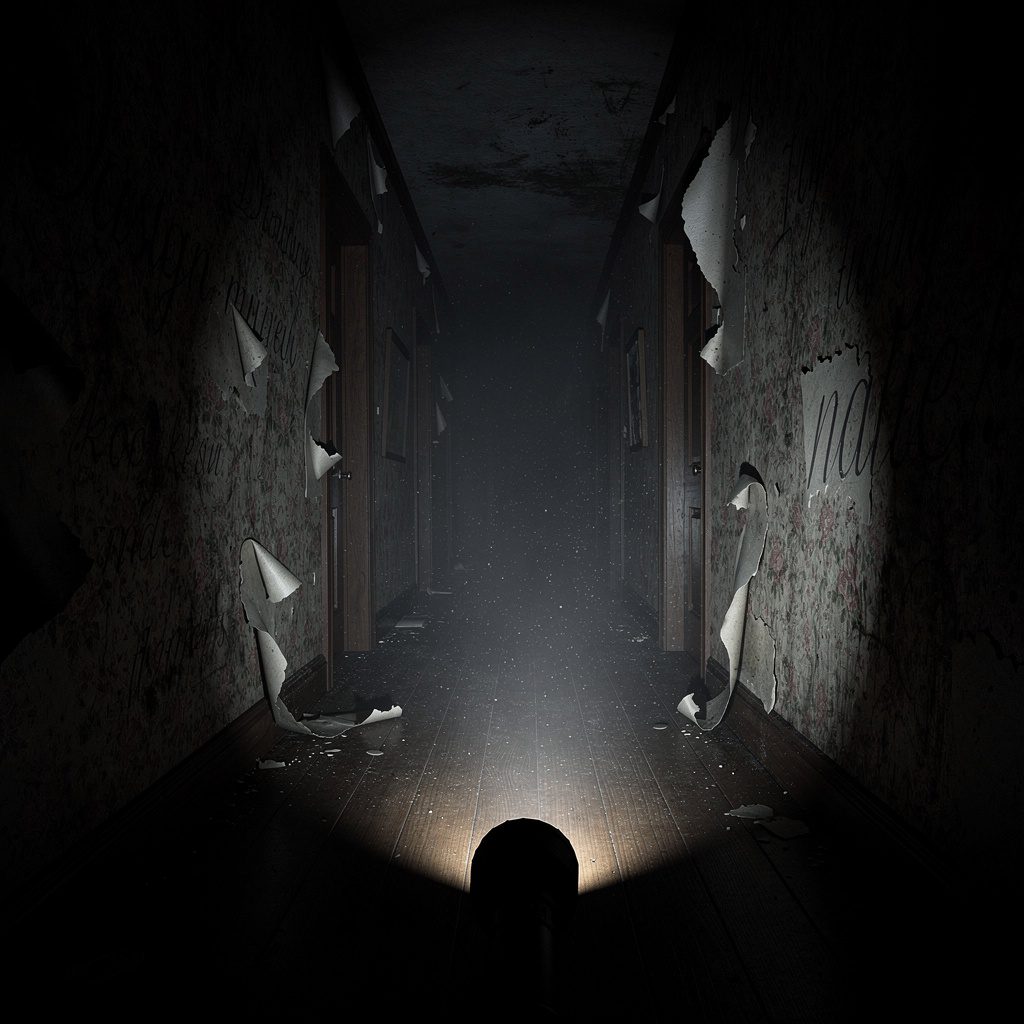
The floor is moving.
Not shaking — moving. A slow, deliberate settling, like a chest rising with breath, and Josette Innocent presses her back against the hallway wall and tells herself it is just the foundation. Old timber. Cold night. She has said this four times already. She stops believing it less each time.
Somewhere ahead of her in the dark, Shun is not answering.
She calls his name again, low and tight, the way you call into a space you are not sure you want a response from. The hallway stretches in front of her — twelve feet, maybe fifteen — and at the end of it the door to the east bedroom sits open at an angle that is wrong. Not fully open. Not closed. Held, somehow, at exactly the angle that lets nothing through but shadow.
“Shun.”
Still nothing.
The flashlight in her hand is a cheap one, the kind you grab from a site office supply locker at the start of a job. It throws a cone of yellow light that makes everything outside its reach look darker by contrast. The wallpaper — old floral, brown with age — absorbs the beam rather than reflecting it, and Josette has the crawling sense that the walls are drinking the light in.
She thinks of how they got here. She does this in fragments, the way memory works when the body is running on adrenaline and the mind is trying to make sense of everything at once.
Three days ago: the work order. Structural assessment on a property in the hill district north of the city, a Victorian-era residence that a heritage trust had acquired at auction. She and Shun were contracted through the firm — routine pre-renovation survey, two days maximum, overnight stay on-site because the nearest hotel was forty minutes out and the client wanted preliminary findings by morning. Shun had suggested it. Shun had said it would be fine.
Two days ago: the first thing she noticed. Not a structural problem. Something subtler. The temperature in certain rooms dropped without explanation. Not a draft — she had checked every window, every door frame, every cracked plaster joint with the systematic attention her training demanded. Industrial Safety Engineering had given her an eye for what was wrong before it failed. She knew how buildings breathed. She knew what was normal settling and what was a building trying to tell you something. This was the second kind.
Yesterday: Shun had started taking notes she was not supposed to see. She had caught the angle of his clipboard wrong once, seen pages of handwriting that did not look like structural notation. Dense, cramped. Numbers and what looked like dates. When she asked, he had turned the clipboard over and smiled with his whole face, which was, she now understood, exactly the kind of smile that means nothing behind it.
Now: the hallway. The breathing floor. The door that will not commit to being open or closed.
She moves.
Not because she is brave — she is not, particularly — but because Shun has the only set of keys to the vehicle and the radio is in the vehicle and her phone has been without signal since they turned off the main road two days ago, a fact she had logged in her site report and immediately stopped thinking about because there was work to do.
The floorboards announce every step. There is no way to move quietly in a house like this. The wood has memory in it, compressed by a century of footfall, and it pushes back against her weight the way something does when it has been waiting for pressure to return.
She reaches the door. Pushes it.
Shun is inside, standing at the window with his back to her, perfectly still. The room smells of something mineral and old — like the inside of a mine shaft, like iron and time compressed together. It is a smell Josette knows. She grew up near the processing plants in the industrial quarter of Port-au-Prince before her family moved, and that specific smell — metal and depth and age — is written somewhere below her conscious memory, in the part of the brain that handles danger.
“Shun.” Her voice is steadier than she expected.
He turns slowly. His expression is not frightened. It is something closer to absorbed. Like a man who has been reading something fascinating and resents the interruption.
“You need to see this,” he says.
“I need to get out of this house.”
“Josette.” He steps aside from the window, and she sees what he has been looking at. On the wall beside the window — beneath the wallpaper, visible through a section he has peeled back with careful precision, the kind of precision that suggests he has done this before — there is writing. Not graffiti. Not vandalism. Thin, deliberate lines of text pressed into the plaster itself, as though inscribed from inside the wall. Names. Dozens of them, arranged in columns, with dates beside each.
She steps closer before she can stop herself.
The dates go back over a hundred years. The most recent is three weeks ago.
“Who wrote these?”
“That is the question,” Shun says, and there is something in his voice she cannot name. Not fear. Satisfaction, almost.
She pulls back. Her training surfaces cleanly, the way good training does in a crisis — not as words but as instinct. Assess. Identify what is wrong before it fails. What is wrong right now is not the wall. What is wrong right now is Shun.
“How long have you known about this?”
He is quiet for a beat too long.
“The firm sent you here before,” she says. It is not a question. The handwriting on the clipboard. The way he had known which rooms to avoid in the early hours, steering her toward the west wing without explanation. The way he had seemed, from the very first hour, to be looking for something specific while she surveyed the structure with honest professional attention. “They sent you before and you didn’t finish whatever you came to do.”
“It’s more complicated than —”
The house breathes again. Louder this time. A long, low groan that begins somewhere beneath them and travels upward through the walls and the floor and into Josette’s sternum, and every instinct she has — industrial, physical, animal — fires at once.
“We are leaving,” she says. “Right now. You are going to give me the keys.”
“Josette, if you understood what this place —”
“The keys, Shun.”
He looks at her for a long moment. Then he reaches into his jacket pocket and holds them out. She takes them without closing the distance between them any further than necessary, and she backs toward the door, and she does not turn her back on him.
The hallway is worse than before. The temperature has dropped — she can see her breath now, a thin ghost of vapor that the flashlight catches and disperses. The wallpaper along the left side has begun to separate from the wall in a long slow peel, like skin lifting, and beneath it the plaster is dark with moisture that should not be there. It is a structural problem, finally. A real one. Water infiltration through a compromised exterior wall, saturation in the substrate — she catalogs it automatically, the professional mind ticking over even now, because that is what her mind does, because that is what she has trained it to do through years of walking damaged structures and making them legible.
She has always understood buildings better than people.
She reaches the staircase. Starts down.
Behind her she can hear Shun following, and she does not know if that is better or worse than silence. She keeps moving. The stairs protest every step and the bannister is cold under her hand and the front door is at the bottom and beyond it is the gravel path and beyond that is the vehicle and beyond that is the main road and beyond that is everything that is not this house.
She hits the ground floor and crosses the entrance hall at a near-run and her hand finds the front door latch and she pulls and the door opens — cold air, real air, the smell of pine and wet earth and distance — and she is through it.
Gravel under her boots. Sky above her, heavy with cloud but open. She unlocks the vehicle with shaking hands and gets in and starts the engine and only then does she look back at the house.
Shun is standing in the open doorway, watching her. He does not move toward her. He does not call out. He stands in the threshold with his hands at his sides and his face in shadow, and the house frames him from behind like something that has been expecting him to stay.
She pulls out.
The headlights sweep across the front of the house as she turns on the gravel, and for one second — a single, unambiguous second — she sees the wallpaper in the ground floor window. The pattern. Floral. Brown with age. And pressed into it from inside, barely visible, the outline of a name.
She does not stop to read it.
She drives.
The road unspools ahead of her in the dark, and she grips the wheel and keeps her eyes forward and does not let herself think about the names on the wall, or Shun in the doorway, or the sound the house made. She thinks instead about what she will write in the site report. How she will describe the moisture infiltration. The structural concerns. The compromised substrate. The recommendation to halt renovation pending full assessment.
She is good at this. Making the dangerous legible. Translating what a building is trying to say into language that other people can act on.
That is why they hired her.
She knows this with a certainty that has carried her through every difficult job, every hazardous site, every structure that wanted to fail. She knows what she is for.
She is twenty minutes down the road, the hill district behind her, the first weak signal bar appearing in the corner of her phone screen, when it arrives. Not a thought. A recognition. The kind that has been sitting below the surface the entire time, patient, waiting for the adrenaline to thin enough for it to rise.
She had seen her own name on that wall.
Not at the bottom of the list. Not as the most recent entry.
Halfway down. With a date beside it that was eleven years ago. The year she had done her first solo structural assessment — a different property, a different city, a job she had almost forgotten because nothing had gone wrong. A job she had logged, filed, and moved on from, the way you do when you are young and building a record and the world is full of structures waiting to be understood.
She had not told Shun that. She had not told anyone.
The house had known anyway.
She keeps driving. The road ahead is straight and empty and lit only by her own headlights, and she is very good at moving forward, and she does not stop.

 WhatsApp
 Telegram
 Email
Email







Leave a Reply