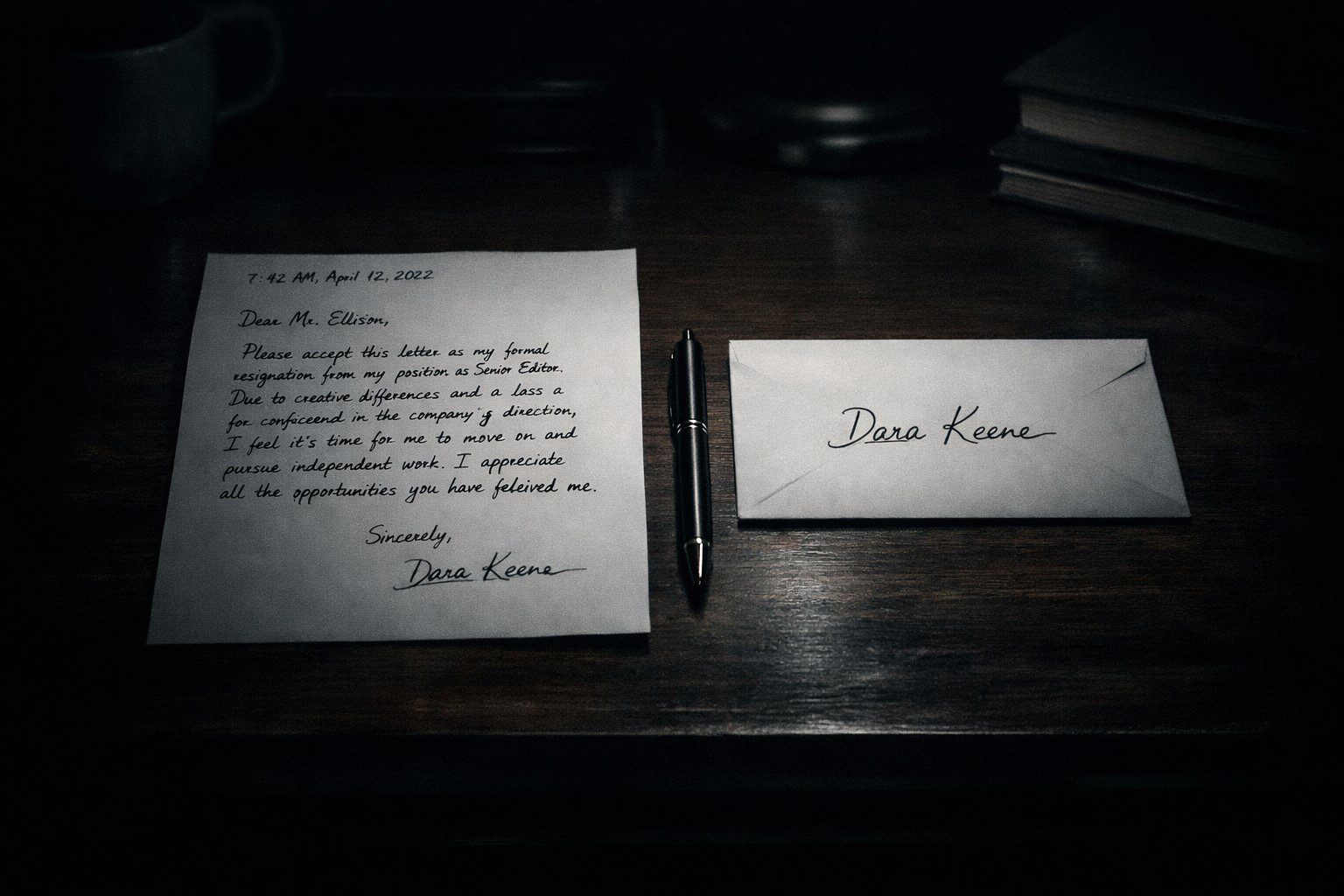
I called Marc again. He asked whether I had any memory of coming home between going to work and finding the letter. I said no. He said he would expedite the specialist referral. I said thank you and hung up and sat at the table for an hour, reading the letter to Paul in a way that was less clinical each time and more like listening.
I did not send that one either. But I read it four times, which told me something.
The following week I found a third letter, and this one frightened me in a different way than the others had. Not because of what it contained — though what it contained was difficult — but because of what it was addressed to. It was not addressed to an employer or a partner. It was addressed to me.
I sat down and read it at the kitchen table.
It was long — three pages, front and back, in my own handwriting, the loops and slants I had looked at in the mirror of comparison enough times now that I knew them as well as my own face. It began: You are waiting for something to give you permission to do the things you already know you need to do. You have been waiting for three years. I am tired of waiting with you.
I read all six pages. I am not going to reproduce what they said, because some of it was mine and not for here. But the shape of it was this: a precise and compassionate account of the ways I had been managing my own life at arm’s length. The job I had stayed in past the point of satisfaction because leaving felt like admitting I had wasted the eight years it took to get there. The relationship I was conducting with my full competence and half my feeling, because the other half was being kept somewhere safe. The friendship I had allowed to thin out over two years because the friend in question asked questions I didn’t want to answer, and it was easier to let the distance grow than to be known that specifically.
Three pages of things I had not said to anyone. Not Marc, not Paul, not myself, in the light, at a time when I was accountable for hearing them.
I sat at the table for a long time after I finished.
I went back to the specialist Marc had referred me to. Her name was Dr. Osei, and she had a quality of attention I associated with people who had heard many difficult things and had not been diminished by any of them. I brought all three letters. She read them with the focused stillness of someone reading something important, and when she finished she set them on the desk and looked at me with an expression that was professional and kind in equal measure.
“Do you believe you wrote these?” she said.
“The handwriting is mine,” I said. “I’ve compared it enough times. The paper is from my flat. The pen, I think, is the one I keep by the bed.”
“I’m not asking about the handwriting,” she said. “I’m asking whether you believe you wrote them.”
I thought about that carefully.
“Yes,” I said. “I think I do.”
She nodded. “Then the more interesting question,” she said, “is not how. It’s why now. Something in you has decided that the waiting is finished. Something has chosen to put the things you haven’t said into a form you can’t ignore.” She looked at the letters again. “In my experience, this kind of thing doesn’t come from nowhere. It comes from a self that has run out of patience with being managed.”

 WhatsApp
 Telegram
 Email







Leave a Reply