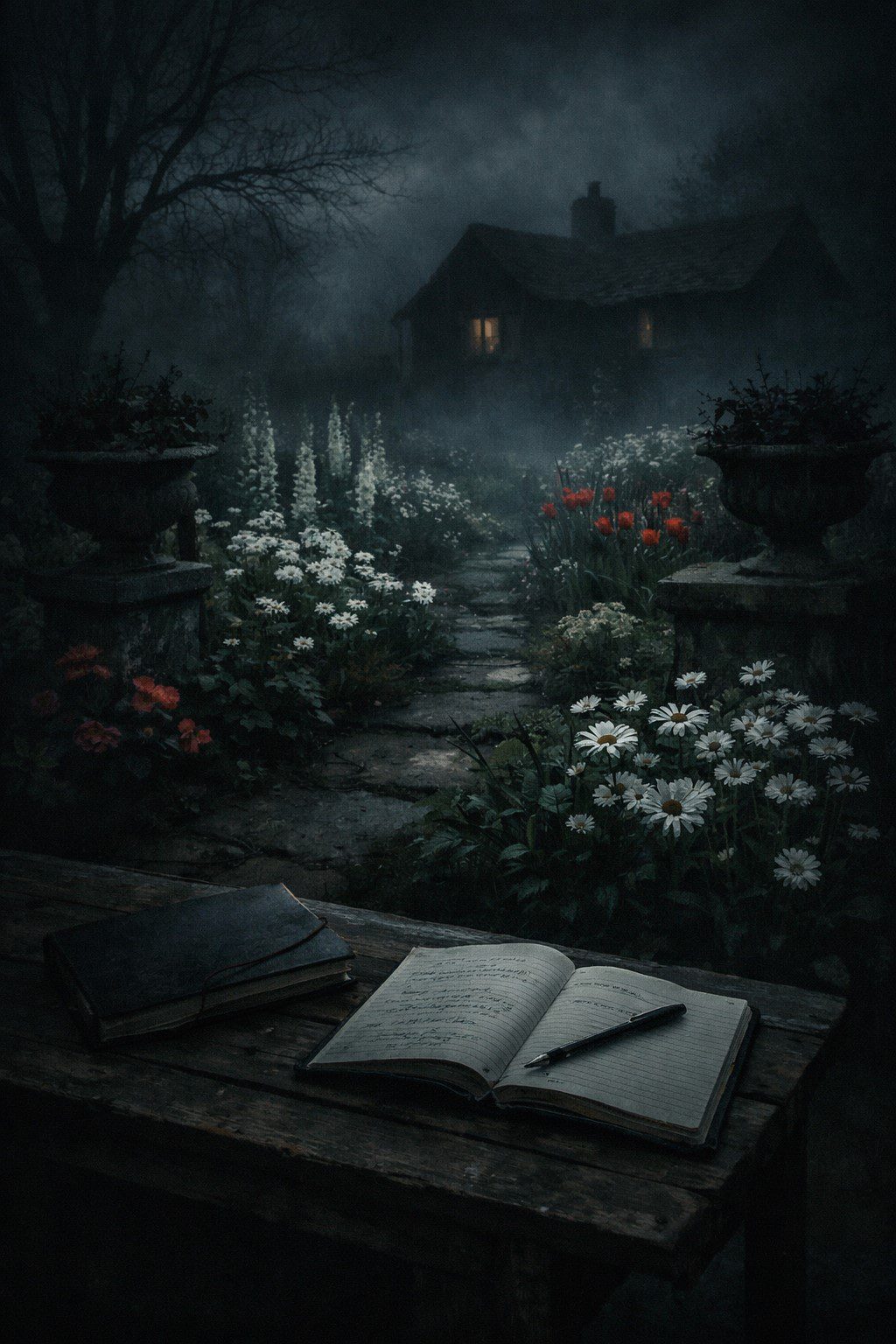
The camera had not captured what happened. It had only confirmed the before and after.
I played the twelve minutes of footage seventeen times. The transition happened in a frame gap I could not identify — not a jump, not a cut, simply the smallest possible unit of time between two frames, the way change actually happened if you looked closely enough at anything: imperceptibly, and then all at once.
I had by this point found my grandmother’s letters — a box of correspondence with her sister, who had lived in Canada, covering thirty years of weekly writing. She described the garden in every letter, in the specific and loving detail of someone who knew their audience did not have a garden of their own and would appreciate the vicarious pleasure. I read them in order, which took two weeks, and I built a picture of the garden across three decades.
In 1978 she had grown sweet williams in the central bed, deep red, closely planted. In 1983 she had moved to a different arrangement and tried yellow roses along the south wall. In 1991 she had returned to the sweet williams. In 1997 she had added lavender along the path edges.
The flowers that appeared without planting corresponded, in the order of their appearance across three springs, to the garden as it had existed in my grandmother’s letters. Not the most recent version. Earlier versions. The garden was, somehow, going backward through its own history.
Gil had lived nearby long enough to have a long memory for the village and its people, and I had come to trust his willingness to look at things steadily without needing to resolve them. I showed him the letters. I showed him the camera footage. I spread the correspondence across the kitchen table and we traced the garden’s history together while the tea went cold.
“She loved this garden more than she loved most things,” Gil said. He was looking at a letter from 1985 in which my grandmother described the first year she had grown climbing roses against the north wall. “She’d have known it better than she knew herself, by the end.”
“What do you think is happening?” I asked.
He was quiet for a moment. “I think some places hold what they’ve been,” he said finally. “I don’t know how to say it better than that. The garden remembers itself. And now that she’s gone it’s — finding its way back to the versions it knows.”
“Finding its way back,” I repeated.
“Or finding its way to her,” he said. “Depending on how you look at it.”
The third spring came, and with it a development that I was not prepared for. The sweet williams appeared again in the central bed. The lavender was back along the path edges. And in the corner of the south bed, in a spot that had been bare clay since I arrived, something I did not recognise: a compact, spreading plant with small white flowers and a distinctive silver-green leaf.
I photographed it and sent the photograph to Gil. His reply came within minutes: That’s silver thyme. Your grandmother grew it in the early 1960s. She stopped growing it before I knew her. I’ve never seen it in this garden in thirty years.
The garden was not cycling through the versions I had documented in the letters. It had gone further back than the letters. It was reaching into a period before my grandmother wrote to her sister, before she had a neighbour who could remember, before any record I had access to. It was returning to something I could not verify — a garden from sixty years ago, when my grandmother had been a young woman in this same space.

 WhatsApp
 Telegram
 Email







Leave a Reply