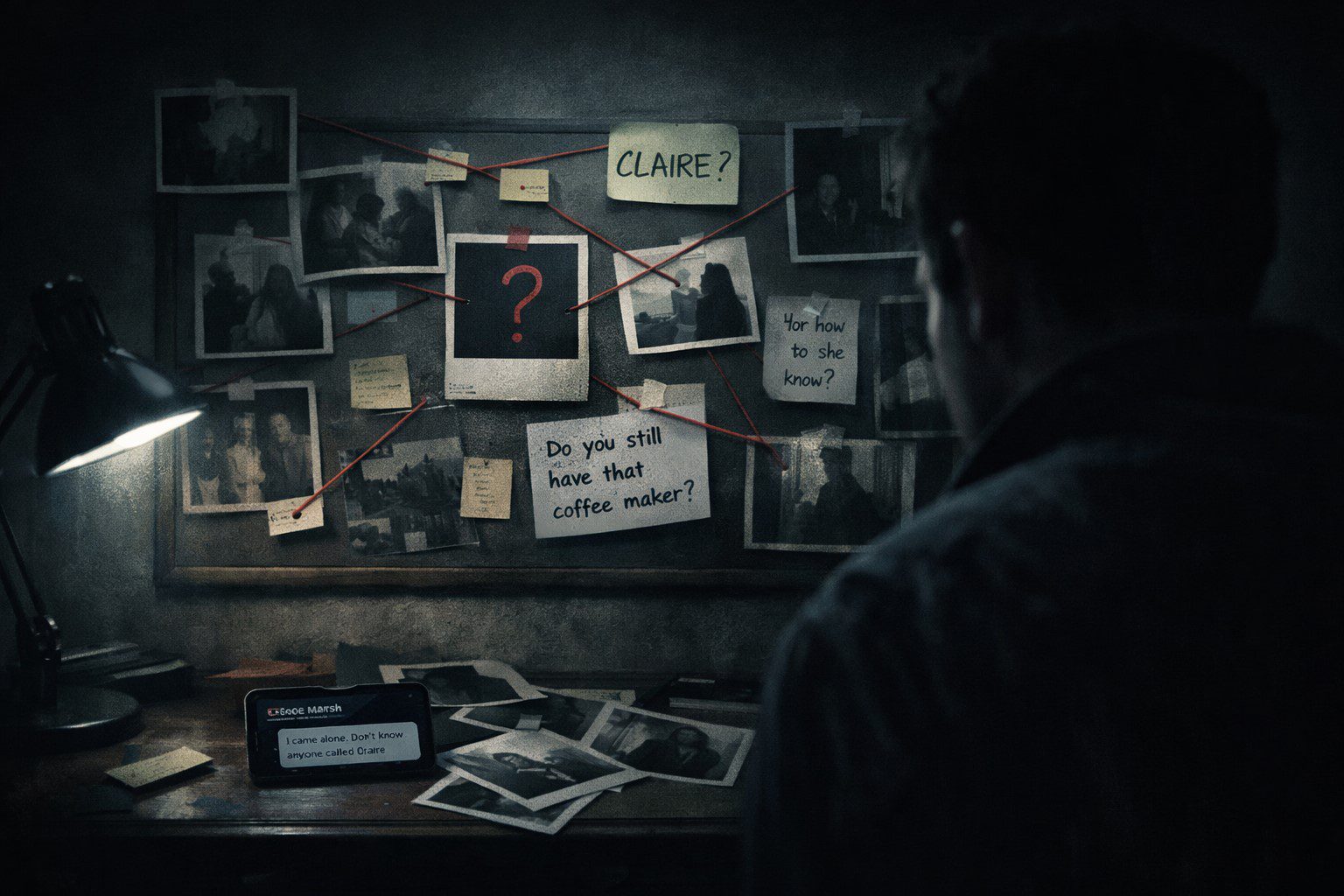
“No one would know that.”
“No.”
Another pause, shorter. “Leo,” she said. “That’s not a coincidence. That’s research.”
I sat with that word for a long time. Research. Someone had researched me well enough to know a nickname from my primary school years, the name of my childhood dog, a private joke about a coffee maker, and my sister’s first name. That was not publicly available information. That was not something you learned from social media or a professional profile or a chance conversation with a mutual acquaintance.
That was someone who had access to things that were not accessible.
I thought about who might know those things. Close childhood friends, some of whom I had lost contact with. Family members. My ex-partner, who had known me for six years and who I had separated from two years ago. Former flatmates. Teachers, perhaps, though the coffee maker was more recent.
I began making a list. It took me an evening and covered two pages of a notebook. At the end of it I was looking at twenty-three names — people who might, collectively, have known all the things Claire had known. But no single person on the list knew all of them. The nickname was from childhood. The coffee maker was recent. The dog had died when I was twelve. These were separate periods, separate circles.
Unless someone had spoken to multiple people in multiple circles. Unless someone had gathered the information intentionally.
The word research kept coming back.
I hired someone. I am aware that sounds dramatic, and in my ordinary life it would have been — Leo Marsh, urban planner, does not retain private investigators. But something about the dinner party had lodged in me in a way I couldn’t shift, and Anya had said the word research and she was right, and I needed to know what I was dealing with.
The investigator’s name was Serena Falk. She was dry and methodical and she told me at our first meeting that most cases like mine resolved quickly — a mistaken identity, a prank by someone in my circle, a confused or troubled individual who had attached themselves to a stranger. She asked me to give her the list of twenty-three names and anything else I could remember about the evening. I gave her everything.
She came back in ten days.
The dinner party guest list, she had confirmed through Petra, was eleven confirmed guests plus Claire — making twelve in the room. Of the eleven confirmed guests, she had spoken to nine. All nine remembered Claire. All nine confirmed the same physical description. Four of them reported that Claire had also known something personal about them — a detail they hadn’t shared publicly, a name or a memory that was specific and accurate.
Four separate guests. Four separate private details. All accurate.
Claire had not targeted me specifically. She had done this to everyone.
I asked Serena what she thought it meant. She was quiet for a moment, in the way of someone who had a theory they were deciding whether to offer.
“There’s a practice,” she said, “used in certain professional contexts — intelligence, corporate intelligence, psychological research — called deep profiling. You build a full picture of a subject from multiple sources: public records, social media, interviews with associates, observation. Done well, it creates an impression of intimate familiarity that feels inexplicable to the subject.” She paused. “It’s usually done for a purpose.”
“What purpose?”
“That’s what I can’t tell you yet. The technique is the means. I don’t know the end.”

 WhatsApp
 Telegram
 Email







Leave a Reply