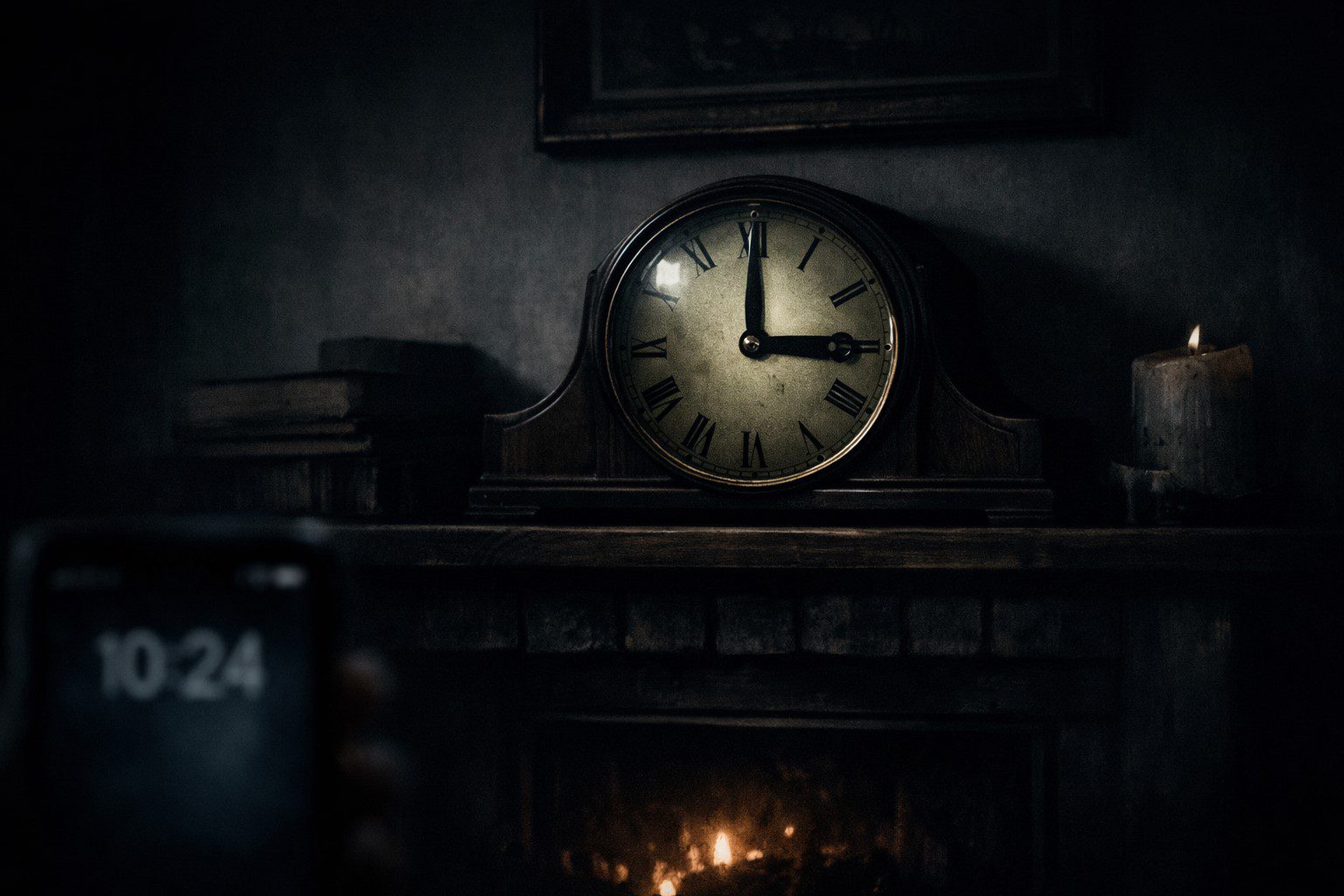
I started keeping a log. Not obsessively — I was not in the flat all the time — but I began noting when the clock stopped and trying to record what I had been thinking or doing in the moment before I noticed it. The log ran for three months: May, June, July.
In May it stopped twice. Once when I was drafting a message to an ex-partner that would have opened a conversation I was not ready for and that, in retrospect, would have gone badly. Once when I was about to agree to cover a colleague’s shift — a small thing — but the shift turned out to be the evening of a power cut that left the shop in darkness for four hours, and I would have been alone there.
In June it stopped three times. Two occasions I could identify clearly as decisions the interruption had redirected. The third I could not connect to anything I was consciously deciding. I had been reading. I noted it and moved on.
In July it stopped once, and I was watching it stop.
I had not managed to be in the room during a stop before. I had always arrived after the fact — glancing at the clock because something in my peripheral attention had snagged, and finding the hands already still. But in July I was sitting directly in front of the clock on the sofa opposite the shelf, reading, and I watched the second hand complete a rotation and then simply not complete the next one.
The clock stopped between one second and the next. No slowing, no hesitation. The hand reached a position and did not leave it.
Three minutes later, the hand moved.
I had not made any decision. I had not been thinking about one. I had been reading a novel and had reached a chapter break and my mind had been empty in the way that minds were empty in the pause between chapters.
I sat very still and looked at the clock.
Then I looked at what I had been reading.
The chapter I had just finished was the point in the novel where the protagonist makes a choice that the reader can see will end badly. I had read that chapter and reached the break and my mind had been suspended in the moment of knowing what was coming and not yet having seen it happen.
I do not know whether that is relevant. I wrote it down because the log had taught me to write things down regardless of whether I understood them yet.
I called the clockmaker who had serviced the clock when it was in my grandmother’s flat — there was a receipt in the box of papers I had inherited. His name was Mr. Stahl. He was elderly, and when I described what the clock did he was quiet for a long time.
“Your grandmother brought it to me three times over twenty years,” he said finally. “Always for the same reason. She said it kept stopping, always for a few minutes, always at odd moments.”
“What did you find each time?” I asked.
“Nothing,” he said. “Mechanically it was in perfect condition every time I looked at it. I told her so.” A pause. “The third time she came, she said she had decided she didn’t want me to fix it. She said she thought it was working correctly.”
He paused again. “She said it had saved her from something. She wouldn’t say what. But she was very clear that she didn’t want it changed.”

 WhatsApp
 Telegram
 Email







Leave a Reply